
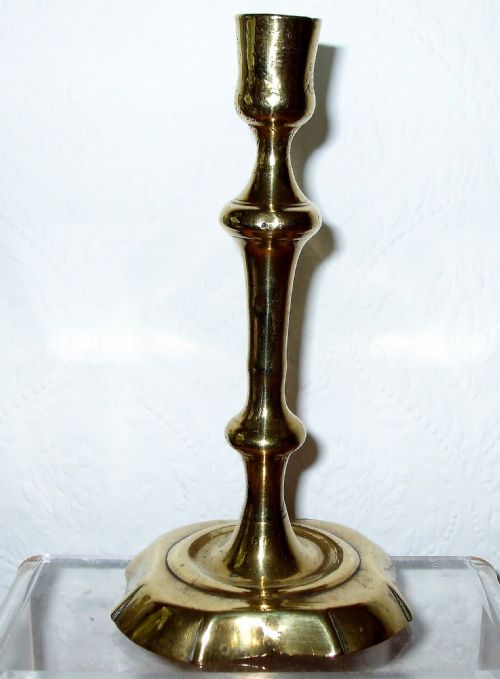


Solid Brass Taper Holder
A solid brass taper holder brings period character to a room, offering functional candlelight housed in durable metal.
Solid Brass Taper Holder
A solid brass taper holder is typically encountered as a candlestick dating from the eighteenth century to the early twentieth century, spanning Georgian, Victorian, and Edwardian periods. These pieces serve as portable lighting devices designed to hold narrow taper candles securely during use.
Most examples found on this page are fashioned as single sticks or matched pairs, taking forms that range from simple columns to ornate designs. The listings show construction in brass, solid brass, and cast brass, occasionally incorporating oak or bell brass elements.
Buyers will encounter items influenced by traditional Georgian styles, Baroque ornamentation, and Arts and Crafts movements. The diversity in these forms reflects the changing domestic lighting needs across the eighteenth, nineteenth, and twentieth centuries.
Materials and construction
Construction relies heavily on brass and solid brass, often utilising casting techniques to produce shaped columns, tear drop columns, and fitted bases. Metalworking methods from the eighteenth and nineteenth centuries ensure substantial weight and durability in these items.
Some examples combine metal with other materials, such as oak candlesticks originating from the Edwardian era, showing a mix of timber and brass components. Bell brass also appears in seventeenth and eighteenth-century items, providing a distinct metallic alloy composition.
Listings span multiple eras from the 18th century through the Edwardian period, incorporating brass, oak, and cast brass materials.
Distinguishing quality across examples
Quality in a solid brass taper holder is determined by the crispness of the casting and the sophistication of the column design, such as shaped or tear drop variations. Ornate Victorian pieces demonstrate intricate detailing that separates standard utilitarian items from finer decorative work.
The integrity of the material and the proportion of the fitted base contribute to the overall balance and visual appeal of the candlestick. Heavier cast brass and clean joints indicate superior craftsmanship across Georgian, Victorian, and Edwardian periods.
The Solid Brass Taper Holder Glossary
- Solid brass
- An alloy of copper and zinc used throughout the construction of these items, providing weight and durability without plating. It forms the primary material foundation for the majority of these listings.
- Tear drop column
- A decorative vertical shaft featuring a tapered, teardrop-shaped profile. This design element adds visual interest to nineteenth-century candlesticks.
- Fitted base
- A specially shaped lower section designed to stabilise the candlestick on a flat surface. It anchors the vertical weight of the piece securely.
- Bell brass
- A specific high-copper alloy traditionally used for bells, known for its resonant qualities and durability. It appears in early Swedish pieces.
- Arts and Crafts
- A design movement emphasising handcraftsmanship and simple forms over mass production. Pieces from this style often incorporate natural materials like oak alongside metal.
Solid Brass Taper Holder: Frequently Asked Questions
What is a solid brass taper holder?
A solid brass taper holder is a metal lighting device designed to support thin candles, appearing across Georgian, Victorian, and Edwardian periods.
These objects were essential for domestic illumination before electric lighting became common in homes.
How do I date an old brass candlestick?
Dating relies on stylistic clues, manufacturing techniques, and period characteristics recorded in eighteenth, nineteenth, and twentieth-century examples.
Changes in column shape, base design, and metal composition help distinguish Georgian items from later Victorian or Edwardian pieces.
Were these candlesticks sold in pairs?
Many listings show pairs of candlesticks alongside individual pieces, reflecting how they were originally used on mantelpieces or dining tables.
Matched pairs are particularly common in Victorian and Edwardian household inventories.
How do I care for solid brass?
Solid brass requires gentle cleaning to maintain its metallic finish without removing the desirable aged patina accumulated over centuries.
Avoid harsh abrasives that can damage the cast details and surface texture of older pieces.