




Solid Brass Door Hardware
Solid brass door hardware brings genuine period weight and character to an entrance, turning a simple threshold into a substantial architectural statement.
Solid Brass Door Hardware
When you search for solid brass door hardware, you encounter functional architectural metalwork designed to endure daily domestic use across multiple historical periods. The selection spans utilitarian fasteners to decorative entry furniture, rooted in Georgian, Regency, and Victorian design.
Centre door knobs dominate the offerings, appearing in distinct geometric profiles such as bee hive, octagonal, and ovular forms. Alongside these knobs, you find heavy knockers, letter boxes, and hinges that complete a traditional doorway.
Pieces originate from varied eras including the nineteenth century, nineteen-ten, and nineteen-forty, reflecting shifting domestic priorities. Whether securing a shop entrance or an interior residential door, each item provides functional metalwork executed in solid brass or iron.
Materials and construction
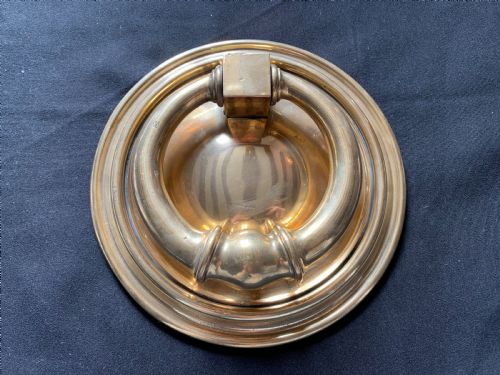
Items rely primarily on solid brass, supplemented by occasional structural elements in iron and steel. Heavy gauge casting creates substantial knockers and handles capable of withstanding repetitive impact.
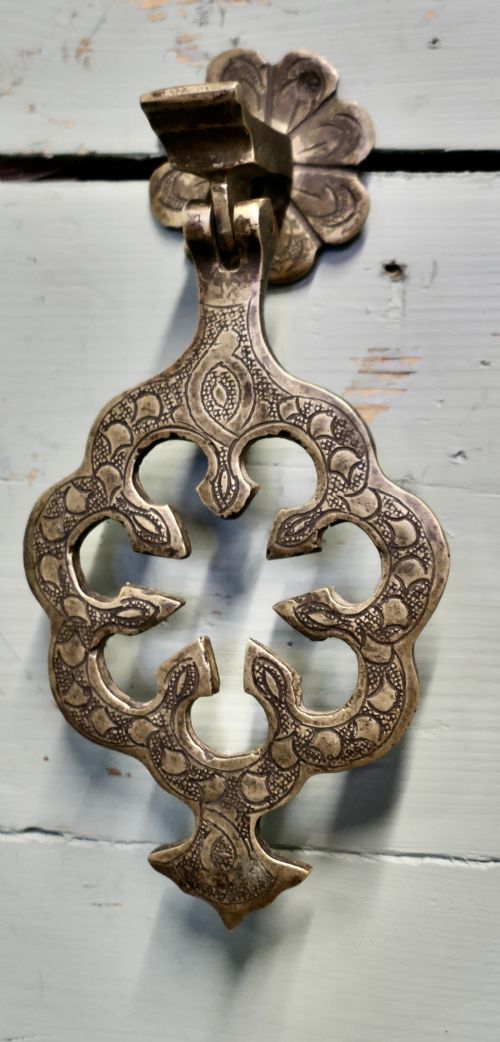
Finishing techniques involve pierced metalwork, applied plates, and decorative finials shaped into botanical or nautical motifs. Component parts like hinges and door chains are joined to function smoothly under frequent mechanical stress.
The listings span periods from the Georgian era through the nineteen-forties, utilising solid brass, iron, and steel.
Assessing quality in metalwork
Quality rests in the weight of the metal gauge and the crispness of the cast decorative detail, such as the ridges on a bee hive knob or the piercing on a large knocker. Substantial thickness prevents flexing during operation.
The integrity of integrated striking plates, matching fixings, and functional pivot points distinguishes superior utilitarian hardware from simpler production.
The Solid Brass Door Hardware Glossary
- Centre door knob
- A prominent handle fixed to the middle of an exterior door rather than the edge, primarily used for pulling the door closed or lifting to strike a latch. These often feature decorative turned profiles like the bee hive or octagonal shape.
- Striking plate
- A metal plate mounted on the door surface that receives the impact of a door knocker to protect the timber from wear. It ensures a resonant sound when the knocker falls.
- Finial
- A decorative terminal ornament, often shaped like an acorn or urn, used to cap the ends of hinges or architectural hardware. It adds a sculptural flourish to functional hardware.
- Letter box
- A horizontal aperture fitted with a spring-loaded flap and a pull handle, designed for receiving postal delivery directly through the door leaf. Victorian examples often incorporate substantial brass framing.
Solid Brass Door Hardware: Frequently Asked Questions
How do I date antique door hardware?
Dating relies on stylistic markers tied to historical design periods, such as the clean symmetry of Regency pieces or the ornate detail characteristic of Victorian Gothic and Victorian items. Manufacturing traits, such as heavy gauge casting methods, also help place an item within the nineteenth or early twentieth century.
Examining the form of centre knobs, such as ovular versus octagonal profiles, narrows down the probable era of production. Comparing the object type against known period catalogues confirms its historical context.
Can I fit antique hinges on modern doors?
Fitting antique brass hinges to contemporary doors is entirely possible, provided the dimensions and weight-bearing capacity match the door leaf. Consideration must be given to the screw gauge and the thickness of the brass leaves.
Careful rebate preparation ensures the hinge sits flush within the timber frame. Professional installation protects the structural integrity of both the antique hardware and the modern door.
How do I clean solid brass hardware?
Cleaning solid brass requires mild soapy water and a soft cloth to remove accumulated surface dirt without stripping the historic patina. Abrasive cleaners should be avoided to preserve the original metal texture.
Gentle polishing maintains the natural lustre developed over decades of exposure. Allowing a degree of ageing preserves the character appropriate to period architectural fittings.
What is a doctors knocker?
A doctors knocker is a specific architectural door knocker design featuring a pivot bar and a striking ball, traditionally mounted on the front doors of medical practitioners. This distinctive configuration provided a clear signal to visitors and patients.
The classic form remains a sought-after example of traditional entry furniture. It combines practical utility with a distinct historical association.