
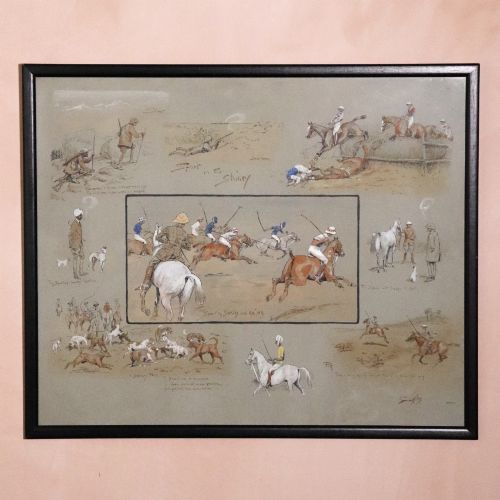


Snaffles Sporting Artwork
Snaffles sporting artwork captures the character of early twentieth-century field sports with humour and precision, offering collectors a vivid slice of British sporting heritage.
Snaffles Sporting Artwork
Snaffles sporting artwork encompasses original prints, watercolours, and printed Christmas cards that focus on hunting, military life, and canine subjects. These pieces span the decades from nineteen hundred through to nineteen forty, documenting British colonial and country house sporting traditions.
Buyers frequently encounter framed prints and original watercolour paintings depicting iconic hunting scenes and character studies. The examples available on this page reflect the distinct aesthetic of Edwardian and early twentieth-century British sporting art.
Materials and technique
The works utilise watercolour and gouache applied to paper, capturing fine details in both prints and paintings. Many of the prints incorporate hand-colouring or unique graphic techniques developed by the artist.
Framing typically employs traditional materials such as wood, specifically oak and gilt frames, protecting the delicate paper surfaces beneath glass. These period frames complement the visual weight of the sporting subjects.
Even military camels receive spirited character studies, proving the artist found personality in every creature he encountered.
Assessing quality and finish
Quality rests upon the strength of the composition and the preservation of the original pigments on paper. Stronger examples retain their vibrant watercolour tones without significant fading from exposure to light.
The integration of the original framing, particularly period oak and gilt surrounds, influences the overall integrity of the piece. Crispness in the printed line and the retention of hand-applied details distinguish superior examples.
Charles Johnson Payne Snaffles
The Snaffles Sporting Artwork Glossary
- Original print
- An impression printed directly from a plate or block created by the artist. These often feature hand-coloured additions that make individual sheets distinct.
- Gouache
- An opaque water-based paint that provides solid, flat areas of colour with a matte finish. It is frequently combined with watercolour in these sporting works.
- Point-to-point
- A form of amateur horseracing over fences, which serves as a frequent subject for the artist. These scenes emphasise movement and rider skill.
- Puggaree
- A lightweight pleated scarf wrapped around a helmet or hat to protect against the sun, often seen in colonial military subjects. The term appears in specific titles documenting British military life.
Snaffles Sporting Artwork: Frequently Asked Questions
What subjects appear in these works?
The artwork predominantly depicts fox hunting, military life, canine portraits, and point-to-point racing scenes. These subjects reflect the active British sporting culture of the early twentieth century.
Characters range from huntsmen and military officers to specific local figures, all captured with distinct personality and dynamic movement.
How should I frame and hang these pieces?
Protect the works from direct sunlight to prevent the watercolour pigments and paper from fading over time. Maintaining stable indoor humidity preserves both the paper and the original wooden frames.
Display them away from moisture sources and ensure that the glass does not directly touch the surface of the print or painting.
How do prints differ from watercolours here?
Original prints are produced in multiples using plates, though many feature individual hand-coloured highlights applied afterwards. Watercolours are unique, one-off painted works executed directly on paper.
Both formats carry the artist's characteristic style, but watercolours represent singular painted compositions rather than printed editions.
Which periods do these pieces represent?
The works span from nineteen hundred through to nineteen forty, covering the Edwardian era and the interwar years. This timeframe captures the height of traditional British country house sporting art.
Styles evolve subtly across these decades, shifting from Edwardian formality towards more expressive depictions of horses, hounds, and riders.