

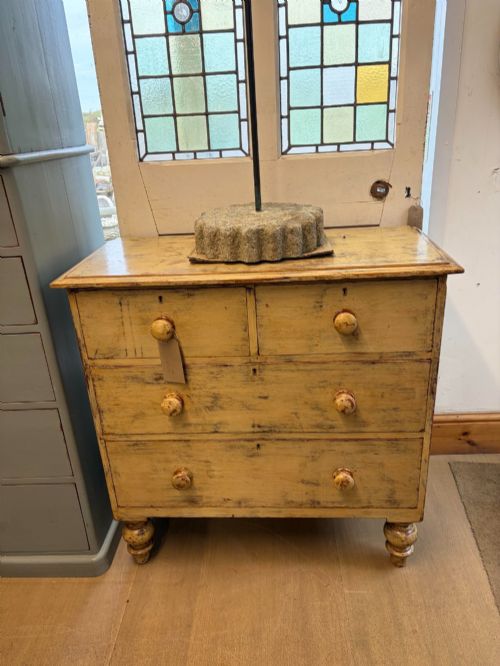
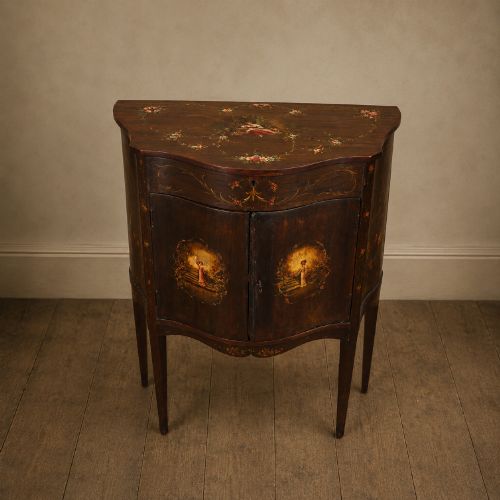


Small Painted Commode
These small painted commode examples offer compact storage with surface artistry, uniting practical drawer space and decorative painted finishes.
Small Painted Commode
A small painted commode provides compact drawer storage while introducing decorative painted surfaces to a room. Buyers searching for a small painted commode will encounter pieces originating from French, Swedish, English, Italian, and Dutch traditions spanning the eighteenth century through the twentieth century.
The forms vary between serpentine chests, bow fronted units, side cabinets, and bedside cupboards. Pine, mahogany, and burr walnut serve as the foundational timber bodies for these decorative chests of drawers.
Stylistic influences range from French Provincial and Louis XV to Swedish Gustavian, Sheraton Revival, and Italian Rococo. Pieces frequently feature simulated finishes or decorative painted details applied over wood.
Materials and construction
Cabinet makers utilised solid timbers such as pine and mahogany, occasionally incorporating burr walnut veneers for drawer fronts. Structural joinery supports the chest while providing stable surfaces for decorative paintwork.
Surfaces received layers of paint, sometimes in Swedish Gustavian or French Provincial schemes, alongside giltwood and gesso enrichment. Certain examples incorporate faux marble tops or simulated painted wood effects to mimic costlier materials.
Small Painted Commode Retail Price Guide 2026
Typical asking prices for small painted commode among the pieces listed under this phrase on Sellingantiques today, from the lower quarter to the upper quarter. They describe what is for sale here now, not the wider market.
Design influences span eighteenth century French work through Victorian Sheraton Revival and twentieth century Italian styles.
Judging quality
Quality rests in the execution of the painted surface and the crispness of the timber carcase. Original paint application displays harmonious ageing, whereas later overpainting alters the visual character of the piece.
Hardware integration, such as brass fittings, and the smoothness of drawer operation distinguish finer examples. Proportions remain balanced, whether the silhouette follows a serpentine front or a straightforward chest format.
The Small Painted Commode Glossary
- Serpentine
- A curved furniture front characterised by a convex centre flanked by concave ends. This contour adds fluid movement to the cabinet silhouette.
- Gesso
- A plaster mixture applied to wood surfaces as a preparation for painting or gilding. It provides a smooth ground for decorative details.
- Gustavian
- The Swedish interpretation of French neoclassical design, known for restrained ornamentation and pale painted finishes. It emerged during the late eighteenth century.
- Giltwood
- Timber decorated with gold leaf or gold paint applied to carved surfaces. It creates a luminous finish on decorative mouldings and frames.
Small Painted Commode: Frequently Asked Questions
Where should I place a small painted commode?
These compact chests suit hallways, bedrooms as bedside cupboards, or living spaces where floor space is limited. Their decorative surfaces allow them to function as focal accent pieces.
Ensure the dimensions align with surrounding furniture so the piece maintains balanced proportions within the room.
How do I identify French provincial styles?
French provincial pieces display softer curves, cabriole legs, and understated carved motifs rather than heavy court ornamentation. Their painted surfaces often show subtle weathering.
Look for traditional regional drawer configurations and characteristic floral or pastoral painted accents.
Are these commodes suitable for daily use?
Solid pine and mahogany carcases provide robust construction for storing everyday items in domestic settings. The drawers offer practical organisation for clothing or accessories.
Handle painted surfaces with care to preserve the original decorative finish over time.