


Small Oval Mirror
A small oval mirror adds focus to a narrow wall space, bringing reflected light and curved lines to a room.
Small Oval Mirror
A small oval mirror is a wall hanging found across several periods, most notably the Regency era and the Victorian and Edwardian decades. These pieces serve as decorative accents in hallways and boudoirs, often encountered as single wall mirrors or matched pairs.
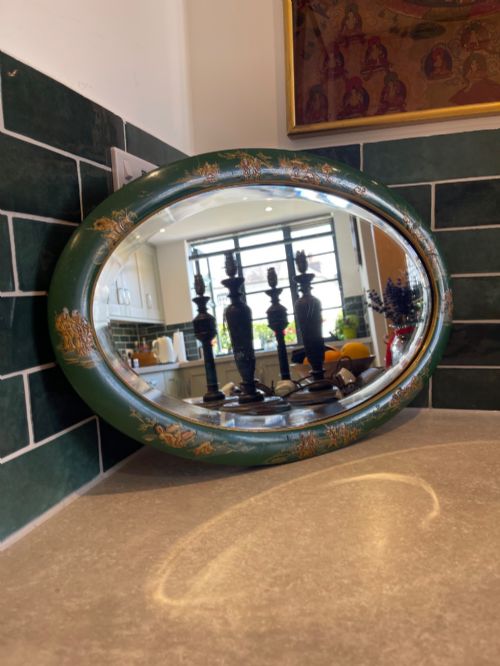
The materials span traditional timber frames in mahogany, beech, walnut, and ebonised wood alongside gilded finishes. Design styles range from restrained Regency frames and rope twist borders to elaborate French Chateau and Chinoiserie lacquered woodwork.
Materials and construction methods
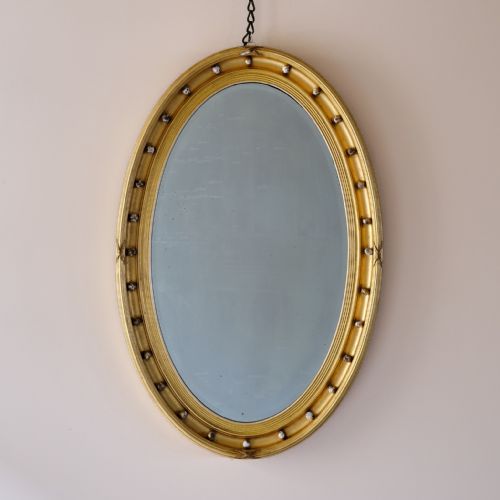
Frames are constructed from solid timbers such as mahogany, beech, and walnut, sometimes finished with lacquer or ebonisation. Gilt pieces utilise gesso applied over wood, finished with gold leaf or water gilding.
Glass plates are set within these frames, occasionally featuring bevelled edges or hand-carved decorative motifs like ribbon pediments and cherubs.
Several small frames include miniature cherubs keeping watch from the top of the glass.
Judging quality and craftsmanship
Quality rests in the crispness of the hand-carved wood or gesso decoration and the depth of the gilding. Early water-gilded surfaces show a warmth and texture that distinguish them from later finishes.
The condition and age of the mirror plate itself matter greatly, with original sparkly plates holding distinct character compared to modern replacements.
The Small Oval Mirror Glossary
- Giltwood
- Wood that has been coated with gold leaf or gold paint. This finish creates a bright reflective surface popular on Regency and Victorian frames.
- Gesso
- A plaster mix applied to wood frames to create a smooth surface for gilding and carving. It allows for intricate relief details.
- Water gilding
- A traditional technique using liquid size to apply gold leaf to gesso, which is then burnished to a high shine. This method produces a rich metallic lustre.
- Chinoiserie
- European decorative style inspired by Chinese art, often featuring lacquered surfaces and painted motifs. It appears on select twentieth-century frames.
- Cabochon
- A polished gemstone-like convex moulding used as a decorative accent on frames. These elements add tactile relief to the wooden border.
Small Oval Mirror: Frequently Asked Questions
Where should I hang a small oval mirror?
These compact pieces fit well in narrow spaces such as hallways, cloakrooms, or above small mantelpieces where a larger frame would overwhelm the wall.
They also work effectively as vanity mirrors or paired together to balance a larger piece of furniture.
How do I identify a Regency period mirror?
Regency frames often display crisp neoclassical details, water-gilded surfaces, and specific proportions characteristic of the early nineteenth century.
Looking closely at the construction techniques and the wear on the gilt layer helps confirm the period.
Are original mirror plates common?
Many older pieces retain their original glass, which often exhibits gentle foxing and a characteristic sparkle that modern glass lacks.
An original plate contributes significantly to the historical integrity of the piece.