


Single Pedestal Desk
These single pedestal desks save floor space without sacrificing workspace, offering a compact writing surface supported by a single stack of drawers.
Understanding the Single Pedestal Desk
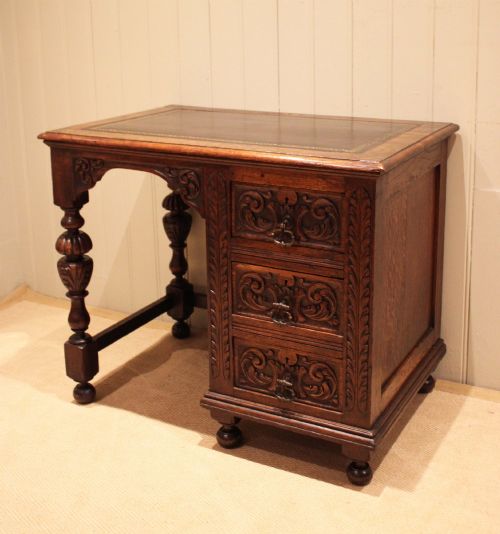
The pieces available span from the late nineteenth century through to the Art Deco period of the nineteen-thirties. Examples range from heavily carved Victorian revival oak desks to restrained Edwardian models and compact walnut writing desks from the interwar years.
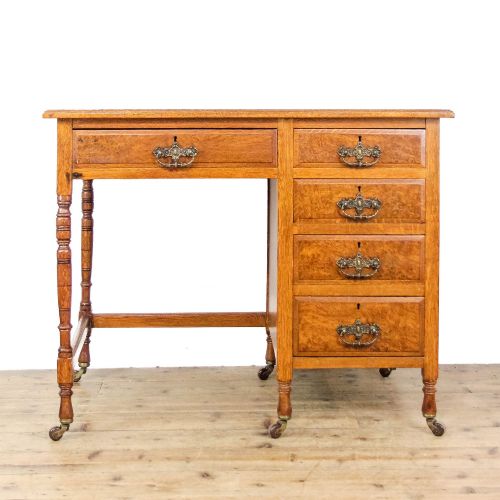
Most entries follow standard historical forms, utilising oak, walnut, and mahogany. Buyers encounter variations including tambour tops, roll tops, and simple kneehole writing tables fitted with leather inserts or fine inlays.
Materials and Construction
Construction relies heavily on hardwoods such as oak, walnut, and mahogany, frequently supplemented by timber veneers and panelled pitch pine. Drawer linings and internal partitions utilise secondary timbers, while some pieces incorporate fine inlays for decorative effect.
Hardware details include brass and iron fittings, drawer pulls, and handles characteristic of their respective periods. Writing surfaces are often inset with leather panels, providing a durable and traditional texture for daily use.
Listings feature oak, walnut, and mahogany across Victorian, Edwardian, and Art Deco periods.
Distinctions in Quality
Quality reveals itself in the selection of timber and the precision of the joinery rather than superficial embellishment. Superior examples display carefully matched grain patterns, solid drawer construction with hand-cut joints, and well-executed carving where ornamentation is present.
The integration of mechanical elements, such as smoothly operating tambour shutters or roll tops, distinguishes finer workshop production from standard utility furniture. Original hardware, intact leather inserts, and structurally sound pedestals elevate the standing of an individual piece.
Globe Wernicke
The Single Pedestal Desk Glossary
- Pedestal
- A structural support column containing a vertical stack of drawers positioned beneath one side of the desk top. This configuration defines the single pedestal form.
- Tambour
- A flexible shutter made of narrow wooden slats glued to a canvas backing, allowing it to slide along a track to enclose the desk surface. This mechanism appears on roll top variations.
- Kneehole
- The central recessed space beneath a desk top designed to accommodate the user's legs. In single pedestal formats, this space sits directly beside the drawer stack.
- Veneer
- A thin layer of decorative hardwood applied over a secondary timber base. This technique creates patterned surfaces on drawer fronts and tops.
Frequently Asked Questions
How do I date an antique desk?
Dating relies on identifying stylistic markers, timber choices, and construction methods characteristic of periods like the Victorian era, the Edwardian period, or the Art Deco nineteen-thirties. Carving styles, hardware, and veneer work also offer clear chronological clues.
Examining secondary timbers inside the drawers helps confirm the era of manufacture.
What woods were used for these desks?
Cabinetmakers primarily used oak, walnut, and mahogany for these pieces, often selecting solid planks or applying veneers over a structural core. Pitch pine also appears in specific regional or period examples.
Hardwood selection determined the durability and natural colour of the finished writing surface.
How do tambour top desks work?
Tambour top desks employ a flexible curtain of wooden strips that slides along grooved tracks to conceal the writing surface and pigeonholes. This mechanism rolls back smoothly to open the desk compartment.
It offers a practical method of securing paperwork without relying on a conventional hinged lid.