
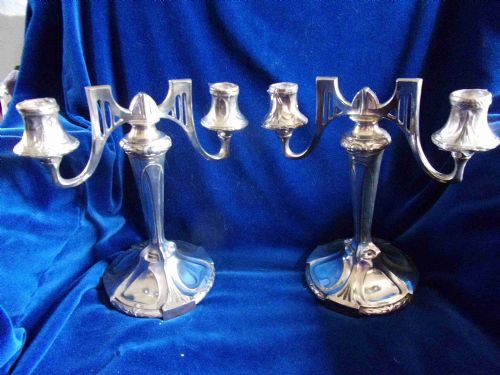


Silver Two Branch Candelabra
These silver two branch candelabra bring genuine dining table presence and soft candle glow to a room.
Silver Two Branch Candelabra
Silver two branch candelabra are table and sideboard lighting pieces designed to hold multiple candles upon twin arms branching from a central column. When you search for silver two branch candelabra, you find items spanning Victorian, Edwardian, Art Deco, Jugendstil and Mid-Century Modern periods.
The versions most commonly met on this page are silver plated examples from the Victorian era alongside twentieth-century sterling silver and plated pieces. Styles range from heavy Rococo Revival and George I Revival interpretations to clean 1930s forms and hand-wrought modernist designs.
These lighting items appear in pairs or as single items, often configured for three candles including the central nozzle. Materials extend beyond solid sterling to include silver plate, nickel silver, gilt bronze and silvered bronze.
How they were made
Makers shaped these pieces using traditional silversmithing techniques, casting structural components and spinning or hammering sheet metals like sterling silver and silver plate over base metal cores. Bronze versions utilise cast gilt and silvered finishes for sculptural detail.
Components such as branches, drip pans and nozzles were assembled by soldering or mechanical fitting. Hand-wrought examples display visible surface marks from the artisan's hammer and shaping tools rather than uniform factory finishing.
Cherubs occasionally peek out from beneath the candle branches, reminding us that Victorian dining tables took their mythology very seriously indeed.
What varies in quality
Quality in these candelabra rests on the weight of the metal, the crispness of chased or cast ornamentation and the structural balance of the branching arms. Superior pieces exhibit substantial gauge metal and robust joints where the arms meet the main stem.
Artisanal execution elevates certain makers, seen in hand-wrought surface textures and careful proportions. Simpler mass-produced silver plate relies on the intactness of the plating over nickel silver or base metal.
Barker Ellis·Robert Edgar Stone·Elkington and Company
The Silver Two Branch Candelabra Glossary
- Sterling silver
- A silver alloy containing 92.5 percent pure silver by mass and 7.5 percent other metals, usually copper. This standard ensures structural durability while maintaining a bright precious metal appearance.
- Silver plate
- A layer of pure silver applied to a base metal core such as nickel silver or copper. This method provided the visual appeal of solid silver at a lower production cost.
- Rococo Revival
- A nineteenth-century revival style drawing on eighteenth-century French design. It is characterised by elaborate asymmetry, C-scrolls and naturalistic floral motifs.
- George I Revival
- A stylistic return to the clean architectural lines and plain surfaces of early eighteenth-century English furniture and silver. Pieces in this style emphasise symmetry and restrained ornamentation.
Silver Two Branch Candelabra: Frequently Asked Questions
What is a two branch candelabra?
A two branch candelabra is a lighting fixture featuring a central stem that splits into two separate arms, holding candles alongside a possible central socket.
These objects functioned historically as principal table illumination before electric lighting became standard in domestic interiors.
How do I clean silver plate?
Silver plate requires gentle cleaning with a specialised silver cloth or mild polish to avoid wearing through the thin silver layer to the base metal underneath.
Regular dusting and minimal chemical exposure help preserve the original surface finish over decades of use.
Can I use standard candles?
Most antique candelabra accept standard taper candles, though older European and British sockets can vary slightly in diameter.
Using dripless taper candles prevents wax from pooling in the drip pans and running down the decorative arms.
How do I date a candelabra?
Dating relies on stylistic clues like Victorian scrollwork or Art Deco geometric lines, alongside stamped hallmarks on sterling pieces.
Maker marks and metal stamps provide definitive clues to the decade and country of manufacture.
Where should I display them?
These candelabra suit dining tables, sideboards and mantelpieces where their height and branching silhouette create visual balance.
Placing them away from direct draughts ensures even burning and prevents wax from blowing onto surrounding furniture.