



Silver Teaspoons Set Six
These silver teaspoons set six collections gather matched groups from Georgian dining rooms to mid-century sideboards, offering usable history in every drawer.
Silver Teaspoons Set Six
A silver teaspoons set six brings together half a dozen matching spoons intended for table service, afternoon tea, or coffee service. Buyers searching for this phrase encounter complete groups sourced from various British, continental, and international origins spanning multiple centuries.
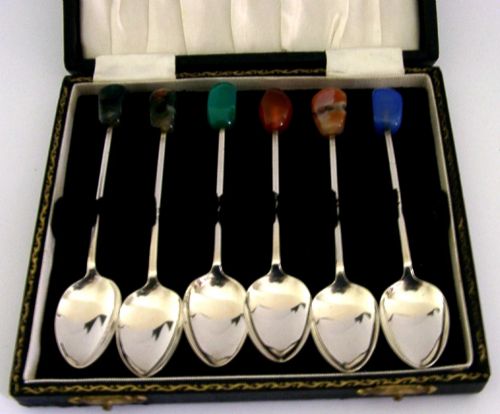
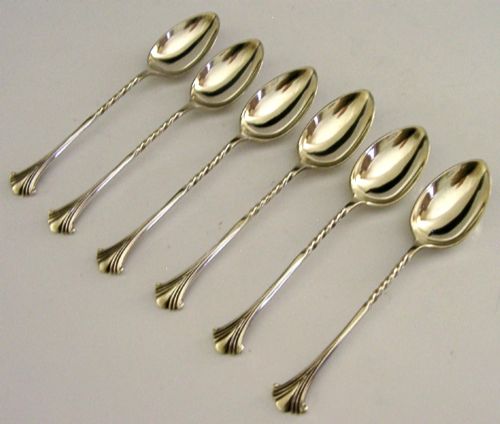
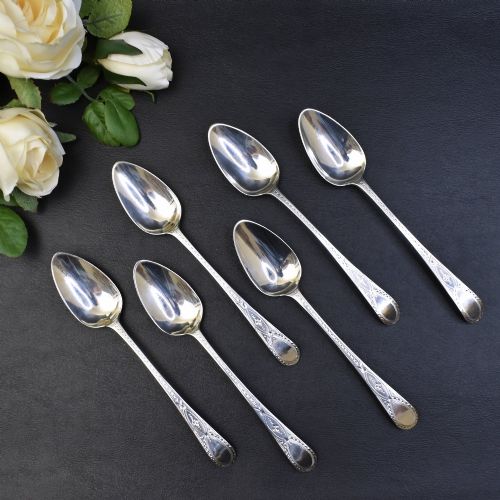
The assortment on this page includes formal George III bright-cut designs, Edwardian sets complete with sugar tongs, Art Deco engine-turned pieces, and mid-century Dutch or Soviet iterations. Many survive within their original fitted presentation cases lined with velvet, satin, or silk.
Most sets comprise six individual teaspoons, occasionally accompanied by matching sugar tongs or presented as smaller coffee spoons. Their survival as a complete sextet rather than scattered single pieces makes them practical for daily use and collectible alike.
Silver, Gilding, and Case Materials
The pieces in these listings utilise solid silver, sterling silver, and silvergilt, shaped through traditional smithing, casting, and bright-cut engraving techniques. Certain sets incorporate coloured enamel work applied to the metal bowls or handles.
Storage cases combine rigid outer frames of leatherette with soft interior linings of velvet, satin, or silk designed to protect the metal from tarnish and abrasion during storage.
Silver Teaspoons Set Six Retail Price Guide 2026
Typical asking prices for silver teaspoons set six among the pieces listed under this phrase on Sellingantiques today, from the lower quarter to the upper quarter. They describe what is for sale here now, not the wider market.
Listings incorporate items spanning from the Georgian era through Art Nouveau, Art Deco, and Mid-Century Modern periods in solid silver and enamel.
Distinctions in Execution and Preservation
Quality rests upon the crispness of the original engraving, whether bright-cut patterns or engine-turned geometry, and the preservation of the original bowl shape against decades of wear. Maker marks and city assay offices provide clear attribution that elevates the standing of an individual set.
The integrity of the presentation case, where applicable, influences the completeness of the object, alongside the uniform match of all six spoons in weight, wear, and proportion.
P A W Bateman·William Eley II·Walker & Hall·Lanson Ltd·Cooper Brothers & Sons Ltd·Chawner & Co
The Silver Teaspoons Set Six Glossary
- Bright-Cut
- An engraving technique utilising faceted V-cut grooves that reflect light from multiple angles. This style appears frequently on Georgian spoons.
- Hallmark
- Official stamps punched into precious metals to indicate standard of purity, assay office, and year of manufacture. British pieces carry distinct town marks and date letters.
- Silvergilt
- Silver objects that have been coated with a thin layer of gold on the surface. This technique provides a warm tone often seen in decorative or commemorative sets.
- Engine-Turned
- A mechanical decoration method producing precise geometric patterns across the metal surface. It is common on Art Deco tableware.
- Seal End
- A traditional spoon terminal shaped like a flat-topped seal or signet. Early examples date back to Tudor times and earlier.
Silver Teaspoons Set Six: Frequently Asked Questions
How were silver teaspoons used historically?
These spoons were utilised during formal tea and coffee services in domestic settings, measuring leaves or stirring sugar into porcelain cups.
Over centuries, wealthy households kept matched sets specifically for entertaining guests in the parlour or drawing room.
Are cased sets intended for display or use?
Original fitted cases protect the silver from environmental tarnish while allowing the collection to be stored compactly in a sideboard or drawer.
Owners frequently transition these pieces from storage into active service during modern dining occasions.
How do I identify a Georgian set?
Georgian pieces typically display distinct hallmarks indicating late eighteenth or early nineteenth-century London, York, or Newcastle production, often accompanied by bright-cut engraving.
The handle shapes and bowl proportions reflect the neoclassical design tendencies of that specific era.
Do all sets include sugar tongs?
Certain boxed presentations incorporate matching sugar tongs alongside the half dozen spoons, while others contain only the six teaspoons.
Sets featuring tongs generally indicate a more complete formal service package from Edwardian or Victorian periods.