
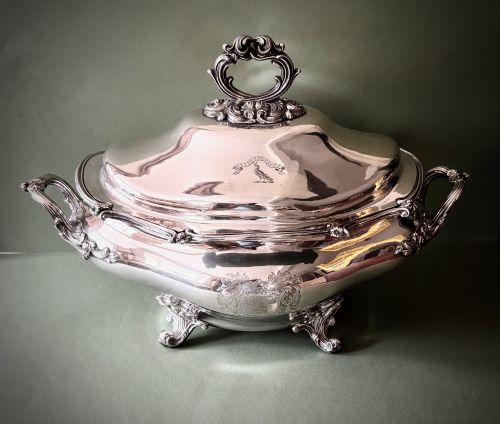
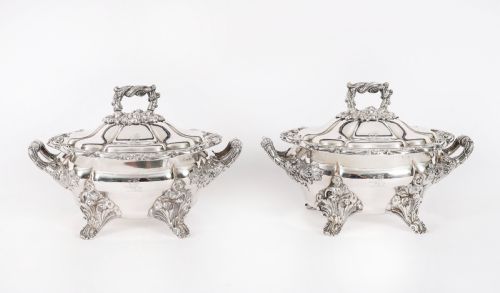
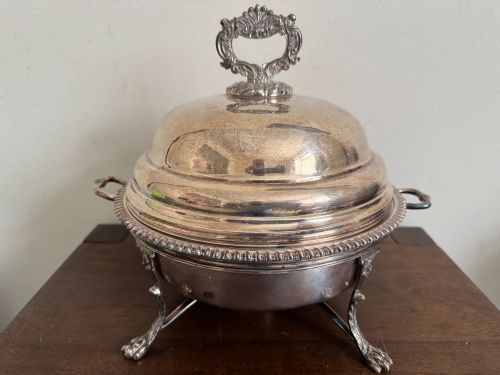

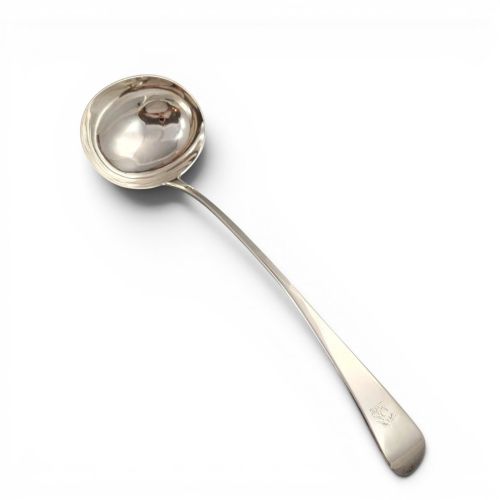


Silver Serving Tureen
A silver serving tureen brings grand dining tables of the eighteenth and nineteenth centuries into daily use.
Silver Serving Tureen
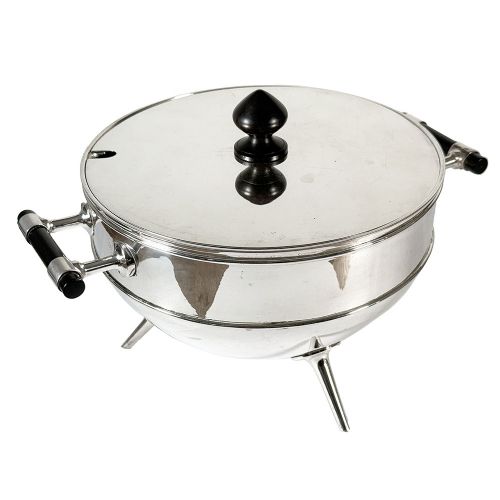
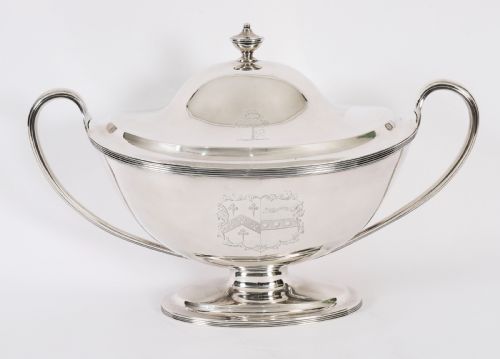
A silver serving tureen is a large, deep covered vessel designed for presenting soups, sauces, or main entrees at the dining table. The pieces found here span from the Georgian period through the Victorian and Edwardian eras, encompassing oval and rectangular forms, sauce boats, and warming dishes.
Buyers will most frequently encounter silver plated and Old Sheffield Plate examples dating from the nineteenth and early twentieth centuries. These range from single lidded tureens to matched pairs of entree dishes and complex multi-piece supper sets with lampstands.
Originating largely from British workshops and silversmiths, these vessels reflect formal dining traditions where display was as important as function. Alongside solid sterling silver, plated metals dominate the selection, offering the visual weight of silver at a different scale of production.
Materials and construction
The construction of these vessels relies heavily on silver plating techniques, notably Old Sheffield Plate and later electroplated nickel silver, alongside solid sterling silver. Old Sheffield Plate fuses a thin sheet of silver to a copper base by heat and pressure, often revealing subtle copper bleed along edges.
Electroplated nickel silver, commonly known as EPNS, emerged in the nineteenth century to allow uniform plating over a white metal alloy. Solid silver pieces utilise traditional hammering, casting, and soldering methods to build substantial bodies and applied decorative borders.
Some nineteenth-century warming dishes were designed to hold boiling water in a lower chamber to keep the gravy from setting.
Distinctions in quality
Quality rests in the crispness of applied cast borders, the weight of the metal base, and the integrity of the plating layer over decades of use. Superior pieces maintain thick silver deposits that resist wear down to the base metal, whilst lesser items show extensive thinning.
The balance of the handles, the secure fit of the cover, and the presence of clear maker marks or crests separate standard production from masterwork pieces. Proportion and restraint in ornamentation also define the higher tier of these serving vessels.
Christopher Dresser for Hukin & Heath·William Bennett·Mappin and Webb·Hamilton & Inches·Daniel and Arter·Edward & John Barnard·Walker and Hall·Elkington·Matthew Linwood·William Hutton & Sons·Cresswick·Dan Holy·Christofle·Gallia·Birchall and Hayne·Reed & Barton·Collis & Co
The Silver Serving Tureen Glossary
- Old Sheffield Plate
- A composite material made by fusing a sheet of silver to a copper ingot. This method was widely used before the invention of electroplating.
- Entree Dish
- A shallow lidded vessel designed for serving individual courses or side dishes at a formal meal. These often fit into warming stands.
- EPNS
- Electroplated Nickel Silver, a base metal alloy coated with a layer of silver using an electrical current. It became standard in the mid-nineteenth century.
- Lampstand
- A metal frame incorporating a burner or heating element placed beneath a serving dish to keep food warm. They are typical of large Georgian supper sets.
- Old English Pattern
- A traditional flatware and utensil design featuring a downward-curving stem and a gentle mid-rib. It appears frequently on serving ladles accompanying tureens.
Silver Serving Tureen: Frequently Asked Questions
What is the difference between a tureen and an entree dish?
A tureen is deep and typically holds liquids such as soup, broth, or sauced vegetables with a high-domed lid.
An entree dish is shallower and wider, designed for solid portions of meat or side dishes, often paired with a warming base.
Can I use antique silver plated tureens for daily dining?
Most silver plated and solid silver tureens are sturdy enough for modern table use if handled with care.
Hand washing with mild soap preserves the plating and prevents damage to historic surfaces.
How do I identify Old Sheffield Plate from electroplate?
Old Sheffield Plate reveals a faint copper line where the fused silver layer wears thin along raised edges or high points.
Electroplated nickel silver shows a greyish or brassy base metal beneath worn spots without the distinct copper hue.
What periods do these serving vessels come from?
The selection spans from the Georgian era through the Victorian and Edwardian periods up to the early twentieth century.
Stylistic shifts move from classical Regency forms toward ornate Victorian revival and clean Art Deco lines.