

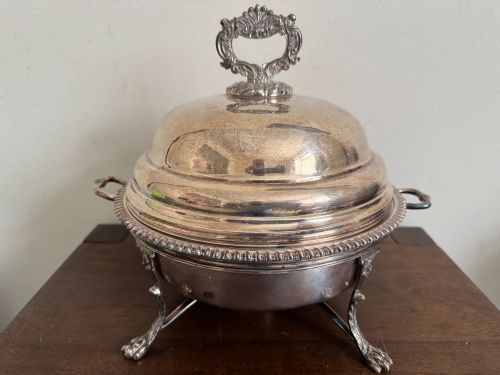


Silver Serving Bowl Cover
These silver serving bowl cover options protect rich sauces and grand roasts at the dining table with enduring weight and shine.
Silver Serving Bowl Cover
A silver serving bowl cover provides an elegant lid for keepsakes of the dining room like tureens, entree dishes, and warming vessels. When searching for a silver serving bowl cover, collectors encounter pieces spanning from the Georgian and Regency eras through to the Edwardian period and Art Deco designs.
The assortment on this page includes sterling silver and heavy silver plate over copper, alongside Old Sheffield Plate and electroplated nickel silver. Forms range from simple domed lids to complete entree dishes with matching stands and lamps.
Origin and maker marks vary widely, stretching from local British workshops to Indian Colonial pieces and French establishments. Each silver serving bowl cover serves to retain heat while bringing polished ceremony to formal dining.
Materials and construction
Silversmiths constructed early pieces from solid sterling silver or fused Old Sheffield Plate, where a layer of silver is fused to a copper core. Later Victorian and Edwardian examples utilise electroplated nickel silver or standard silver plate over a base metal foundation.
Craftsmen shaped the metal through heavy hammering, spinning, and soldering, often incorporating cast handles, beaded borders, and applied crests. Cut glass bodies also appear paired with fitted metal covers in twentieth-century iterations.
Silver Serving Bowl Cover Retail Price Guide 2026
Typical asking prices for silver serving bowl cover among the pieces listed under this phrase on Sellingantiques today, from the lower quarter to the upper quarter. They describe what is for sale here now, not the wider market.
Distinctions in quality
Quality rests upon the thickness of the original plating or the substantial weight of the sterling silver, which prevents bending and denting under daily handling. Superior pieces retain crispness in their chased or cast decorative borders and maintain tight registration between the cover and its vessel.
Maker attribution elevates desirability, particularly when pieces bear clear hallmarks or stamps from known silversmiths and retailers. The presence of matching stands, burners, or original ladles indicates a complete suite rather than a matched pairing.
Mappin and Webb·Hamilton and Inches·Daniel and Arter·Dan Holy·Christofle Gallia·William Bennett·Birchall and Hayne
The Silver Serving Bowl Cover Glossary
- Old Sheffield Plate
- An early fusing technique where a sheet of silver is melted onto a heavy copper block before rolling. This process creates a distinct appearance as the underlying copper occasionally shows through high points.
- EPNS
- Electroplated Nickel Silver, a common nineteenth and twentieth-century base material. It provides a bright silver finish over a durable nickel alloy core.
- Entree Dish
- A shallow serving vessel with a fitted cover used for presenting courses at the table. These often feature detachable handles to allow the cover to double as a secondary serving dish.
- Tureen
- A deep, large bowl with a cover designed for serving soups, sauces, or stews. They frequently rest on fixed or separate stands.
- Hallmark
- An official stamp struck into precious metal indicating the standard of silver, the assay office, and the maker. These marks help date the piece accurately.
Silver Serving Bowl Cover: Frequently Asked Questions
What is a silver serving bowl cover used for?
These covers insulate food on the dining table, keeping roasts, vegetables, and sauces warm between courses. They also present a polished appearance during formal meals.
Beyond dining use, collectors display them on sideboards or utilise them as decorative lidded vessels in traditional interiors.
How do I clean an antique silver plate cover?
Wash the piece gently in warm water with mild, non-abrasive soap and dry it immediately with a soft cloth. Avoid harsh dips that strip historical patina or damage underlying base metals.
Apply a quality silver polish sparingly only when necessary, working gently around chased details and engraved crests to preserve the finish.
How can I tell Old Sheffield Plate from later electroplate?
Old Sheffield Plate often reveals a subtle pinkish copper tone along exposed edges where the silver layer has worn thin through generations of polishing. The weight is substantial due to the copper core beneath the fused silver sheet.
Electroplate typically shows a uniform silver surface right to the edge, sometimes with white base metal showing if the plating is severely worn away.
Are these covers safe for regular food use?
Most solid silver and silver-plated pieces remain suitable for serving food provided they are washed thoroughly before use. Check that the plating is intact, particularly on the interior surfaces that contact moisture and acidic foods.
Pieces with extensive plate loss exposing base metals like copper or nickel are better reserved for display rather than active dining service.
Can I use a cover without its original base?
Many covers function independently as decorative tabletop accents or display pieces even if the matching tureen or dish is missing. Measure the rim diameter carefully to ensure a secure fit if you plan to pair a loose cover with an existing bowl.
Displaying them on open shelving highlights their chased decoration and reflective metal surfaces.