
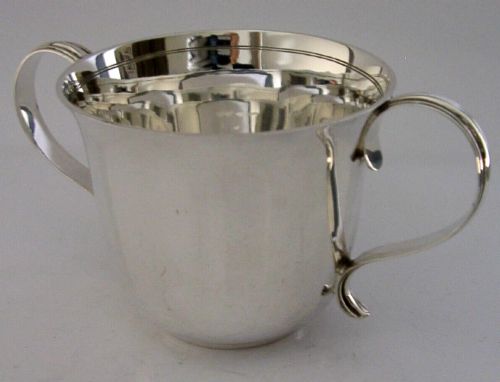
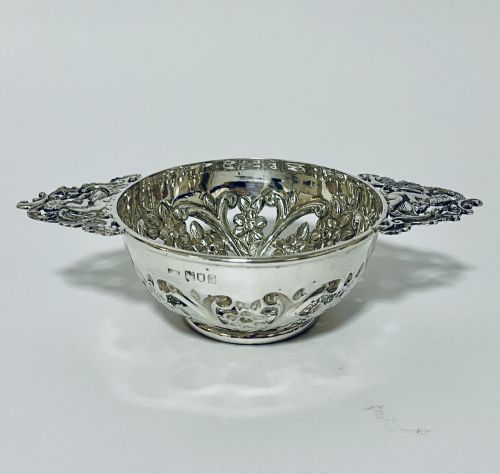


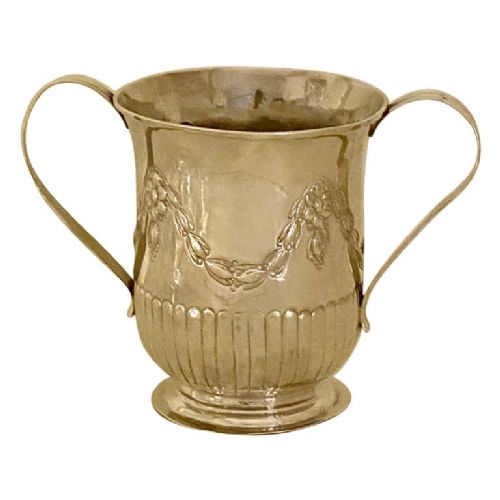
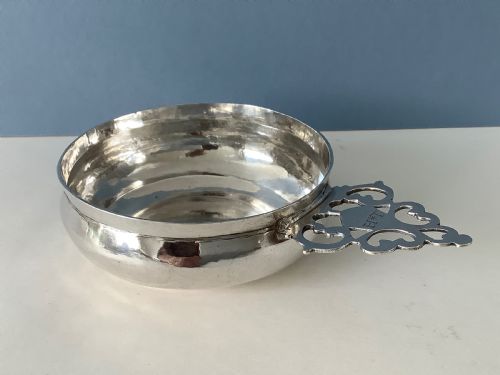
Silver Porringer Cup
A silver porringer cup is a domestic vessel with twin handles that spans from seventeenth century origins to twentieth century revivals.
Silver Porringer Cup
When you examine a silver porringer cup, you encounter a small two-handled bowl designed for domestic use across several centuries. The form appears most frequently in seventeenth and eighteenth century examples alongside later Edwardian and twentieth century revivals.
The evidence shows these pieces functioning variously as bowls, christening sets, and trophy cups. Makers utilised forms ranging from simple circular vessels to covered pieces and variants featuring coin insets.
On this page, you will meet examples spanning the 17th Century, 18th Century, Victorian, Edwardian, and Art Deco periods. Many pieces display traditional styling from the Georgian, Restoration, and William and Mary eras.
Materials and construction
The objects recorded here are constructed primarily from sterling silver and Britannia standard silver. Certain pieces incorporate supplementary materials in their presentation, including leather, velvet, and silk.
Silversmiths shaped these vessels by hand, employing techniques such as planishing to create distinct textured surfaces on Arts and Crafts examples. Later pieces often replicate earlier seventeenth and eighteenth century styles with precise chasing and embossing.
Recorded styles span from the seventeenth century through Georgian, Victorian, Edwardian, and Art Deco periods.
Judging quality and provenance
Quality in a silver porringer cup rests on the crispness of the original chasing, the weight of the metal, and the integrity of the hallmarks. Early seventeenth century examples command attention through authentic patination and maker marks.
Provenance and original documentation elevate certain pieces, particularly Irish cups and those bearing specific family crests or coin insertions. Later copies and revival pieces vary according to the fidelity of their historical execution.
Richard Gurney·Thomas Sutton·Corney Drake·Asprey·J Langlands
The Silver Porringer Cup Glossary
- Porringer
- A small, deep two-handled bowl used historically for porridgers, broths, and later as christening gifts. These vessels feature prominently in seventeenth and eighteenth century domestic silver.
- Britannia Standard
- A purer alloy of silver introduced by statute in England to curb the melting of coinage. This standard contains a higher proportion of pure silver than standard sterling.
- Planished
- A surface texture created by hammering metal with a polished round-faced hammer. This technique leaves small, controlled indentations visible on many Arts and Crafts pieces.
- Quaich
- A traditional two-handled drinking vessel originating in Scotland. Edwardian silversmiths adapted this form alongside standard porringer designs.
- Hallmark
- An official stamp applied to precious metals indicating the standard of purity, the assay office, and the date of manufacture. These marks allow collectors to date pieces accurately.
Silver Porringer Cup: Frequently Asked Questions
What was a silver porringer cup used for?
These vessels originally served personal dining functions, holding soft foods, porridges, or liquids for individual consumption at the table. Over time, their role shifted toward ceremonial uses, decorative display, and traditional christening gifts.
Many surviving examples from the Georgian period onward function primarily as presentation pieces, christening bowls, or trophies. Their twin handles made them practical for lifting while seated.
How do I date an antique silver porringer?
Dating relies primarily on the stamped hallmarks, which indicate the exact assay year, maker, and silver standard. Comparing the decorative style, such as William and Mary embossing or Arts and Crafts planishing, provides a secondary guide.
Makers frequently produced revival pieces in the nineteenth and twentieth centuries that copied seventeenth century models. Examining the wear patterns and construction methods helps distinguish an original period piece from a later copy.
What is Britannia standard silver?
Britannia standard is a purer silver alloy containing ninety-five point eight percent pure silver, introduced by English law to prevent the melting of circulating silver coins. It appears on specific early pieces, such as Queen Anne bowls.
This standard feels softer in the hand than standard sterling silver due to the higher silver content. Pieces bearing this standard carry distinct marks including the figure of Britannia.
Are coin porringers authentic?
Coin porringers incorporate historical coins inset directly into the base or bowl of the silver vessel. Silversmiths produced genuine examples in the late seventeenth and early eighteenth centuries, and revivalists copied them during the Victorian era.
Determining authenticity requires examining the date of the inset coin against the hallmark stamped on the silver vessel. A genuine piece matches the era of the coin, whereas copy pieces feature older coins mounted in nineteenth century frames.