


Silver Moonstone Necklace
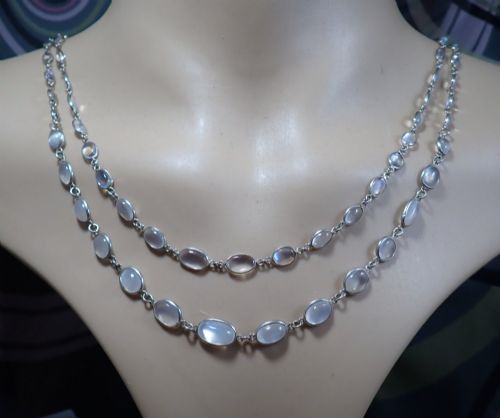
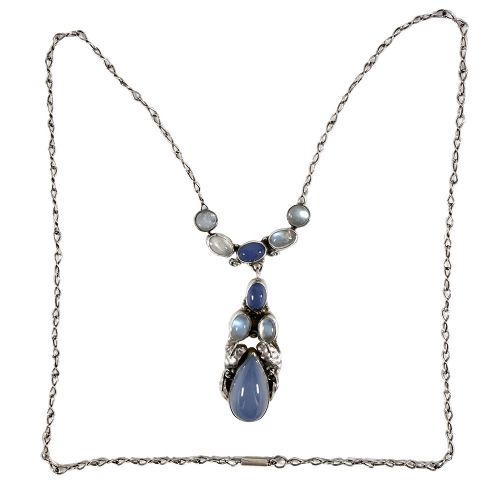
These silver moonstone necklaces bring together ethereal adularescent stones and hand-wrought silver work for a distinct historic aesthetic.
Understanding the Silver Moonstone Necklace
A silver moonstone necklace balances shimmering adularescent feldspar with cool metal settings across various historic forms. These pieces primarily date from the early twentieth century, spanning Edwardian, Victorian, and Arts and Crafts periods.
Makers fashioned these designs as pendants, long chain necklaces, and multi-stone festoon arrangements. Examples often incorporate complementary gems alongside moonstones, such as chalcedony, amethyst, and coral.
The Arts and Crafts movement heavily influences the selection, showing hand-worked silver alongside bezel-set cabochons. Buyers frequently encounter pieces from the nineteen-hundreds through the nineteen-thirties.
Materials and Construction
Craftsmen shaped sterling silver and standard silver into settings that secure moonstone cabochons by hand. Artisans combined these central stones with secondary gems like chalcedony and coral.
Metalwork often displays hammered finishes, wirework, and bezel settings typical of early twentieth-century jewellery workshops. Chain links and findings are frequently handmade to suit the distinct pendant or necklace drop.
Retail Price Guide 2026
Typical UK retail prices for silver moonstone necklace, calculated from the Sellingantiques database of over a million retail prices indexed since 2003. This retail price guide relies exclusively on Sellingantiques data; no external sources or auction records are used, so the figures do not describe the wider market.
Some historic necklaces incorporate tiny coral beads that peek out like hidden berries between the moonstones.
Assessing Quality and Merit
Quality rests upon the optical depth and blue sheen of the moonstone cabochons, alongside the subtlety of the silver handcrafting. Stones with superior adularescence and clean cutting elevate the overall piece.
Design complexity and attribution to named makers distinguish exceptional studio work from standard production. Harmonious integration of secondary gems like amethyst or chalcedony adds notable merit.
Mary Thew·Dorrie Nossiter·Amy Sandheim
The Silver Moonstone Necklace Glossary
- Adularescence
- The internal optical phenomenon where light scatters billowy blue or white light across a moonstone cabochon. This visual property defines the stone's primary appeal.
- Cabochon
- A gemstone shaped and polished with a smooth, convex domed surface rather than faceted edges. Moonstones are almost exclusively cut this way to showcase their sheen.
- Bezel setting
- A method of securing a gemstone using a narrow metal rim that wraps around the stone's girdle. This technique dominates Arts and Crafts silver work.
- Festoon
- A necklace design featuring draped chains or links suspended across the collarbone, often accented with drops. These arrangements frequently incorporate multiple coloured gems.
Frequently Asked Questions
How do I date these necklaces?
Dating relies on stylistic markers, hallmarks, and construction methods associated with the Victorian, Edwardian, and Arts and Crafts eras.
Early twentieth-century pieces often feature handmade bezels and distinctive studio characteristics rather than mass-produced uniformity.
What stones appear alongside moonstones?
Historic pieces frequently incorporate chalcedony, amethyst, coral, and fire opal into the silver designs.
These complementary gems are chosen to contrast or harmonise with the central adularescent moonstones.
Are these necklaces fragile?
Moonstones have a moderate hardness and require sensible care to avoid scratching against harder materials.
Secure settings protect the stones, but delicate handmade silver chains benefit from gentle handling during storage and wear.
What defines Arts and Crafts jewellery?
This style emphasises hand-wrought silver techniques, visible craftsmanship, and individual artistic expression over machine manufacturing.
Settings showcase natural gemstone variations rather than strict geometric symmetry.