




Silver Enamel Spoons
Silver enamel spoons combine precious metalwork with vibrant vitreous glass, offering collectors a striking miniature canvas from the late nineteenth and twentieth centuries.
Silver Enamel Spoons
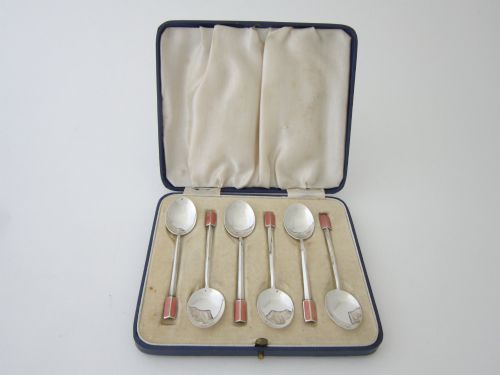
When searching for silver enamel spoons, buyers encounter small utensils designed for tea, coffee, dessert, or decorative display, frequently found complete in their original presentation cases.
The most common examples on this page date from the Art Deco period through to the mid-twentieth century, originating from British makers, Scandinavian workshops, and Russian imperial centres.
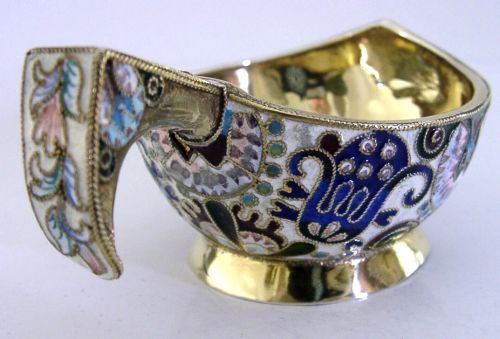
Forms range from simple coffee bean spoons and floral motifs to intricate cloisonné vessels, reflecting diverse manufacturing traditions across Europe.
Materials and construction
Craftsmen built these pieces using sterling silver or solid silver, frequently applying a gold wash known as silver gilt to the bowl interiors for contrast and protection.
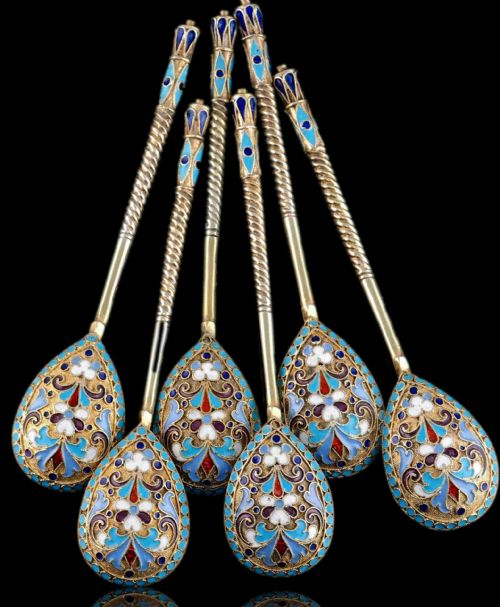
Coloured glass paste was fused to the metal surface through high-temperature firing, often over engine-turned guilloché engraving or contained within wire cloisonné cells to create intricate patterns.
Listings feature items spanning the nineteenth century through the 1960s, incorporating styles from Art Nouveau and Art Deco to Mid-Century Modern.
Assessing craftsmanship
Quality separates through the precision of the metalwork and the clarity of the vitreous enamel, where superior pieces exhibit even translucency, smooth surface tension, and crisp geometric or organic detailing.
Completeness dictates value, as matched sets retaining their original fitted presentation boxes and crisp hallmarks demonstrate higher original status and careful preservation.
David Andersen·Dmitrii Nikolaevich Nikolaev·Vasily Agafonov·Liberty and Co·Turner and Simpson Ltd·Henry Clifford Davis·Walker and Hall·Simon Groth
The Silver Enamel Spoons Glossary
- Guilloché
- A decorative mechanical engraving technique that etches precise repeating patterns into metal before translucent enamel is applied over the top.
- Cloisonné
- A method of ornamentation where thin metal wires are soldered to a metal base to create compartments that are then filled with coloured enamel paste.
- Silver Gilt
- Solid silver that has been coated with a thin layer of gold, providing a rich golden interior finish to spoon bowls.
- Bean Knop
- A terminal shaped like a coffee bean, commonly found on the handles of mid-century coffee spoons.
- Demitasse
- A small cup used for serving strong espresso or Turkish coffee, typically paired with matching miniature spoons.
Silver Enamel Spoons: Frequently Asked Questions
How do I clean silver enamel spoons?
Clean these items gently using warm water, mild soap, and a soft cloth to protect the fragile glass surface from scratching.
Avoid abrasive polishes, harsh chemical dips, and ultrasonic cleaners, which can permanently damage or discolour the enamel work.
Were these spoons meant for daily use?
Many sets were produced specifically as luxury presentation items or commemorative pieces, intended more for display than for heavy domestic service.
While functional as coffee or teaspoon sets, their delicate vitreous surfaces benefit from careful handling during occasional use.
How can I date silver enamel spoons?
British pieces generally rely on standard assay office hallmarks stamped onto the metal to verify the exact year of manufacture.
Continental and Scandinavian examples often depend on maker marks, stylistic indicators, and the presence of original fitted boxes to narrow down the decade.
What is the difference between cloisonné and guilloché?
Cloisonné involves soldering wires onto a flat metal plate to form distinct enclosed cells that hold separate pools of coloured enamel.
Guilloché carves a geometric pattern directly into the silver base beneath a single layer of translucent enamel to create shimmering depth.