

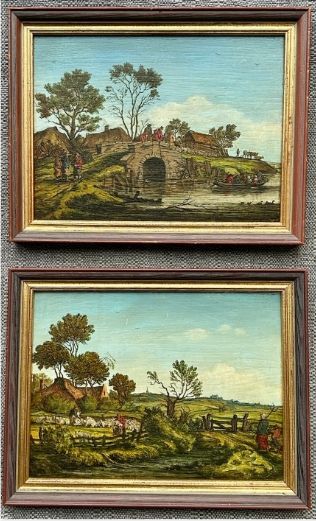

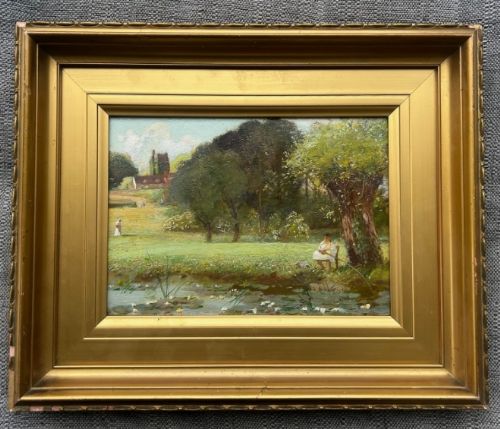


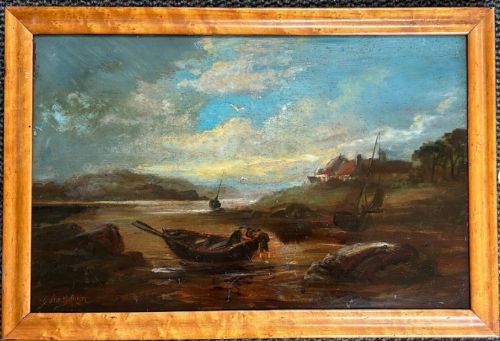


Signed Oil Panel Painting
A signed oil panel painting carries the direct mark of the hand that made it, offering a compact window into historical landscapes and portraits.
Signed Oil Panel Painting
A signed oil panel painting brings together compact wooden supports and traditional pigment, focusing largely on British and European landscapes, rural views, and portraits.
The pieces on this page span the eighteenth, nineteenth, and mid-twentieth centuries, with particular strength in Victorian and early twentieth-century British and Scottish school works.
Buyers encounter everything from small intimate coastal scenes and pastoral river valleys to detailed portrait studies and architectural glimpses.
Materials and construction
Artists painted primarily using oil paint applied to prepared wood panels, pine panels, mahogany panels, or occasionally metal panels, providing a rigid support that held fine brushwork well.
Many works retain their original gilt wood frames or burr walnut style frames, which complement the texture of the panel and protect the edges of the artwork over time.
Listings feature wood panels and pine panels painted in oil, paired with nineteenth-century and mid-century British, Scottish, and Italian styles.
Quality and execution
Quality rests on the confidence of the brushwork, the depth of the palette, and how effectively the artist used the grain and smoothness of the wood panel to build light and atmosphere.
Stronger examples display clear artist signatures, deliberate handling of natural light in landscapes or interiors, and stable integration between the painted surface and its period frame.
Tom Campbell·W Klombeck·William Howard Hardy·Sir David Murray·Fernando Del Basso·William Williams·H Wallace·C.E. Howson·John Gilbey Bowles·Sam Bough·Del Buono·Arthur W Newsholme·William Burns·Isabelle Cohen·Jan van Kessel the Elder·John Smith Atherton·A Sefton·Lewis Creighton·William Maxwell Reekie·William E Tindall·Van Gullen·Paul Fordyce Maitland·William Manners·James Peel·Kershaw Schofield
The Signed Oil Panel Painting Glossary
- Oil paint
- A slow-drying paint made by mixing pigments with oils such as linseed, allowing for rich blending and textured impasto on a rigid surface.
- Wood panel
- A flat solid piece of timber, such as mahogany or pine, used as a sturdy alternative to stretched canvas for oil paintings.
- Gilt wood frame
- A wooden picture surround covered with a thin layer of gold leaf or metallic gilt, typical of nineteenth-century presentation.
- Impasto
- A technique where paint is laid onto a panel in thick areas, leaving visible brush or knife marks that catch the light.
Signed Oil Panel Painting: Frequently Asked Questions
Why paint on wood panels instead of canvas?
Wood panels provided artists with a completely rigid surface that did not slacken or stretch over time. This firmness allowed for precise, detailed brushwork, particularly in smaller landscape and portrait formats.
Panels also absorbed preparatory grounds evenly, creating a durable foundation that has helped many nineteenth-century and earlier works survive in stable condition.
How do I identify a nineteenth-century panel painting?
Nineteenth-century works usually display characteristic preparation layers on the reverse of the wood, alongside period framing styles such as ornate gilt wood mouldings. Signatures are often brushed directly into the wet paint or inscribed subtly near the edge.
Examining the type of wood, such as mahogany or pine, alongside the handling of the oil medium helps place the work within Victorian or Edwardian painting traditions.
Were these paintings meant to be framed originally?
Most panel paintings were housed in frames from the moment they left the studio, serving both to protect the vulnerable edges of the wood and to complete the visual presentation. Original frames often match the aesthetic of the period, from simple nineteenth-century sweeps to decorative gilt borders.
Keeping a painting in its period frame preserves the historical context in which the artist intended the work to be viewed.
How should I care for an oil panel painting?
Oil panel paintings require stable indoor environments away from direct sunlight, excessive heat sources, and rapid humidity fluctuations. Because wood naturally expands and contracts with moisture changes, keeping the room climate steady protects both the panel and the paint layer.
Dusting should be done gently with a soft, dry brush, avoiding any liquids or chemical cleaners on the painted surface or the gilt frame.