

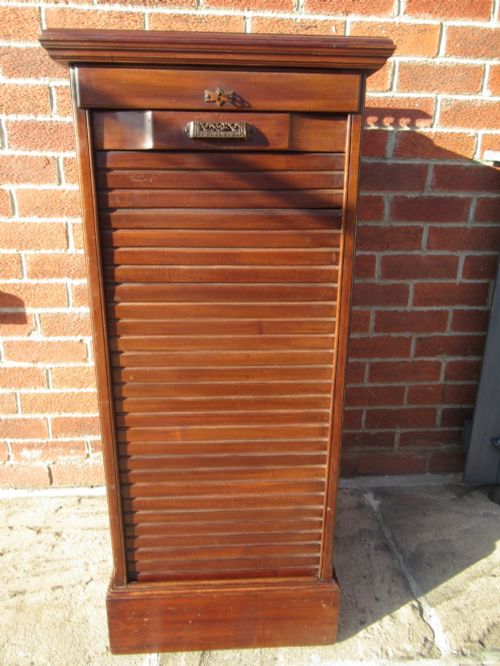

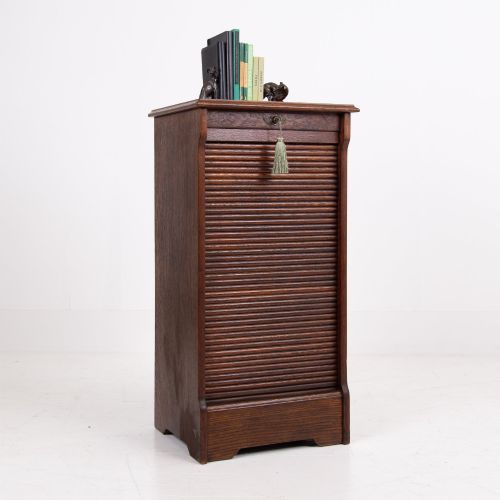
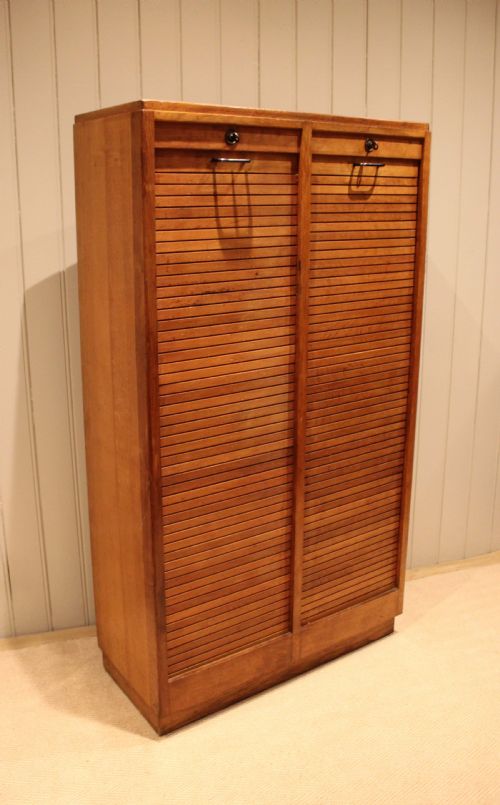
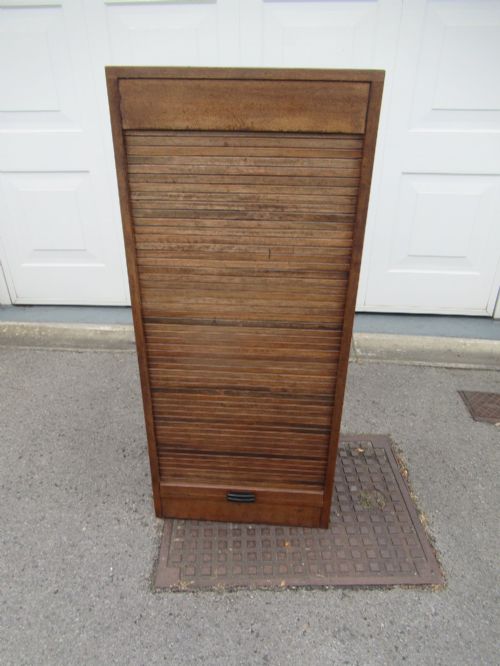


Shutter Front File Cabinet
A shutter front file cabinet is a practical piece of office furniture with slatted doors that slide away to reveal internal storage.
Shutter Front File Cabinet
When you search for a shutter front file cabinet, you are looking at workspace storage designed to keep documents organised while saving floor space. The form relies on slatted wooden panels that travel along tracks to open smoothly without swinging outward into the room.
The versions you are most likely to meet on this page date from the Edwardian era through the 1940s. They appear in forms such as single tambour front filing cabinets, double tambour front office filing cabinets, and general office cabinets with adjustable shelves.
These pieces originate from English and French workshops, reflecting early twentieth century commercial needs. Materials span oak, mahogany, and pine, often paired with brass hardware and occasionally canvas.
How they were made
Cabinet makers constructed these pieces primarily using solid timbers like oak, mahogany, and pine. The distinctive slatted doors, known as tambour, consist of narrow strips of wood glued to a flexible canvas backing that allows the shutter to curve around internal tracks.
Hardware details typically include brass handles, escutcheons, and label holders. Construction methods focus on durability for office environments, utilising sturdy joints and internal partitions or adjustable shelving to support heavy paper files.
Shutter Front File Cabinet Retail Price Guide 2026
Typical asking prices for shutter front file cabinet among the pieces listed under this phrase on Sellingantiques today, from the lower quarter to the upper quarter. They describe what is for sale here now, not the wider market.
What varies in quality
The distinction between standard office furniture and finer examples lies in the selection of timber and the precision of the slatted door mechanism. Cabinets built from figured oak or rich mahogany with smooth-running tambour tracks represent a higher grade of craftsmanship.
Proportion and internal arrangement also drive differences in quality. Pieces featuring double doors, adjustable shelves, and well-fitted internal filing compartments demonstrate superior utility compared to simpler single-door variants.
The Shutter Front File Cabinet Glossary
- Tambour
- A flexible door made of narrow wood strips attached to canvas, allowing it to slide around a curved track. This mechanism permits access to contents without requiring clearance for swinging doors.
- Edwardian
- A stylistic period spanning the reign of King Edward VII, noted in these listings for refined office cabinetry. Pieces from this era often feature light oak and traditional joinery.
- Art Deco
- A design style from the early twentieth century characterised by geometric lines and modern industrial influences. Cabinets from this movement bring a distinct decorative edge to workspace furniture.
- French Utility
- A utilitarian style emerging from France during the mid-twentieth century, focusing on functional forms and robust construction. These pieces prioritise straightforward utility over excessive ornamentation.
Shutter Front File Cabinet: Frequently Asked Questions
What is a tambour door?
A tambour door is a flexible shutter made from narrow slats of wood joined to a canvas backing. This allows the door to slide smoothly along a curved track within the cabinet frame.
This ingenious mechanism saves space in tight office environments because the door disappears into the sides of the cabinet rather than swinging outward.
How do I date these cabinets?
Dating relies on stylistic clues, materials, and construction markers visible in the woodwork and hardware. Pieces span from the Edwardian period and 1900s through the 1930s and 1940s.
Earlier examples often feature rich dark oak and traditional brass pulls, while later pieces from the Art Deco or French Utility eras display distinct geometric lines or alternative proportions.
Are the shelves adjustable?
Many office cabinets feature adjustable shelving to accommodate varying sizes of files, books, or ledgers. This versatility made them popular in early twentieth century workspaces.
When evaluating a cabinet, check the interior for slot systems or shelf supports that allow you to customise the internal layout for your storage needs.
What woods were used?
The primary timber seen in these listings is oak, appearing in dark, light, and figured varieties. Mahogany and pine are also utilised for specific regional styles and cabinet types.
These durable woods were chosen to withstand heavy daily use in busy offices, ensuring the structure remains solid over a century later.