

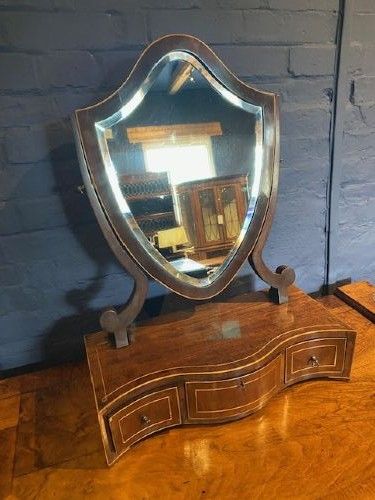
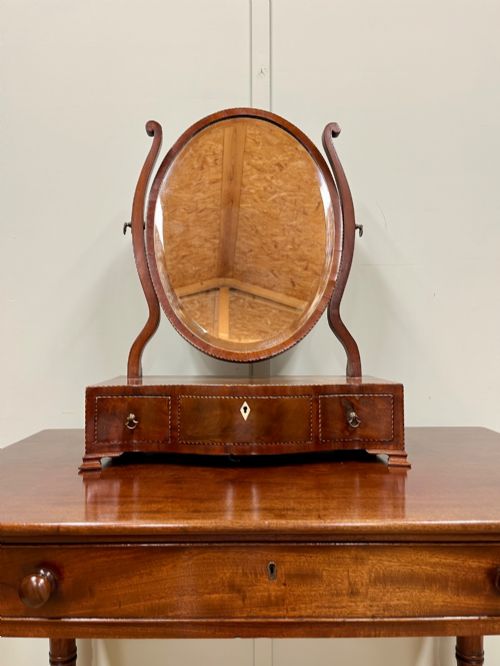
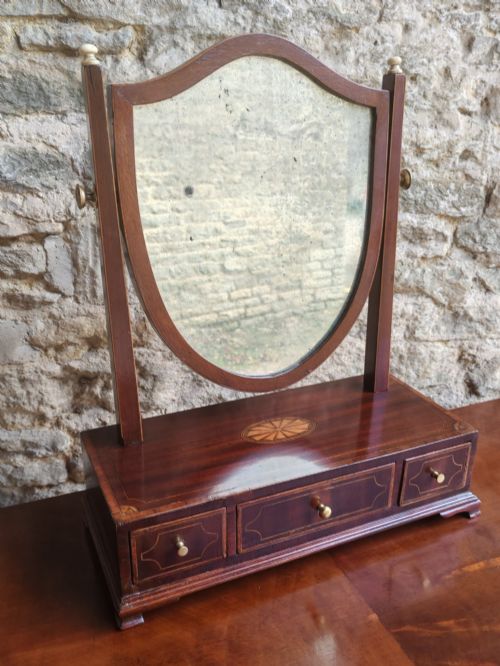


Sheraton Swing Mirror
These sheraton swing mirror pieces are refined dressing accessories designed to sit upon a chest or table for personal grooming.
Sheraton Swing Mirror
When you search for sheraton swing mirror, you encounter dressing table mirrors and toilet mirrors spanning the Georgian, Regency, and Sheraton Revival periods. These pieces comprise a pivoting glass plate held within upright arms atop a miniature base, frequently fitted with small drawers.
The versions you are most likely to meet on this page date from the eighteenth and nineteenth centuries, constructed in forms ranging from simple oval plates to elaborate serpentine bow-fronted boxes.
Makers designed these items to be portable desktop accessories for bedrooms and dressing rooms, providing adjustable angles for daily toilet.
Materials and Construction
Cabinetmakers utilised rich timber stocks such as mahogany, flame mahogany, satinwood, and harewood, frequently applying contrasting boxwood inlay and stringing to define the edges and drawer fronts.
The mirror plates were framed in wood and mounted on brass pivot screws or side arms, allowing the glass to tilt smoothly within its upright supports.
Bases were constructed as box plinths containing one or more small drawers, sometimes featuring ogee bracket feet or serpentine shapes.
Sheraton Swing Mirror Retail Price Guide 2026
Typical asking prices for sheraton swing mirror among the pieces listed under this phrase on Sellingantiques today, from the lower quarter to the upper quarter. They describe what is for sale here now, not the wider market.
Object forms span oval, shield-shaped, and rectangular mirror plates mounted above serpentine bow-fronted drawer bases.
Assessing Quality and Merit
Quality reveals itself in the choice of timber figurations, such as deeply figured flame mahogany or carefully selected satinwood veneers, alongside the precision of the boxwood inlay.
Finer examples demonstrate subtle proportions, such as gracefully curved serpentine drawer fronts and elegant, slender horn supports holding the glass plate.
The craftsmanship of the base construction, including the dovetailing of miniature drawers and the integrity of the original brass hardware, separates simpler utility pieces from superior workshop output.
The Sheraton Swing Mirror Glossary
- Swing mirror
- A mirror plate mounted on pivots between two upright posts so that the glass angle can be adjusted.
- Toilet mirror
- A small dressing mirror designed to stand on a dressing table or chest of drawers.
- Serpentine
- A curved shape featuring a convex centre flanked by two concave curves, often seen on drawer fronts.
- Boxwood inlay
- Narrow strips or geometric patterns of pale boxwood inlaid into a darker wood surface for contrast.
- Flame mahogany
- A distinct veneer cut from the fork of a mahogany tree, showing a flamelike pattern of grain.
Sheraton Swing Mirror: Frequently Asked Questions
What is a sheraton swing mirror?
A sheraton swing mirror is a tabletop dressing glass framed in wood and mounted on pivots between two upright arms, usually set above a small drawer base.
These pieces emerged in the eighteenth century as fashionable accessories for bedrooms and dressing rooms, reflecting classical geometric lines and refined inlay work.
How were these mirrors used?
They were placed on top of dressing tables, chests, or sideboards to assist with shaving, hairstyling, and personal grooming.
The pivoting mechanism allowed users to tilt the glass to their preferred angle, while the small drawers held rings, pins, and cosmetics.
How do I place one in a modern room?
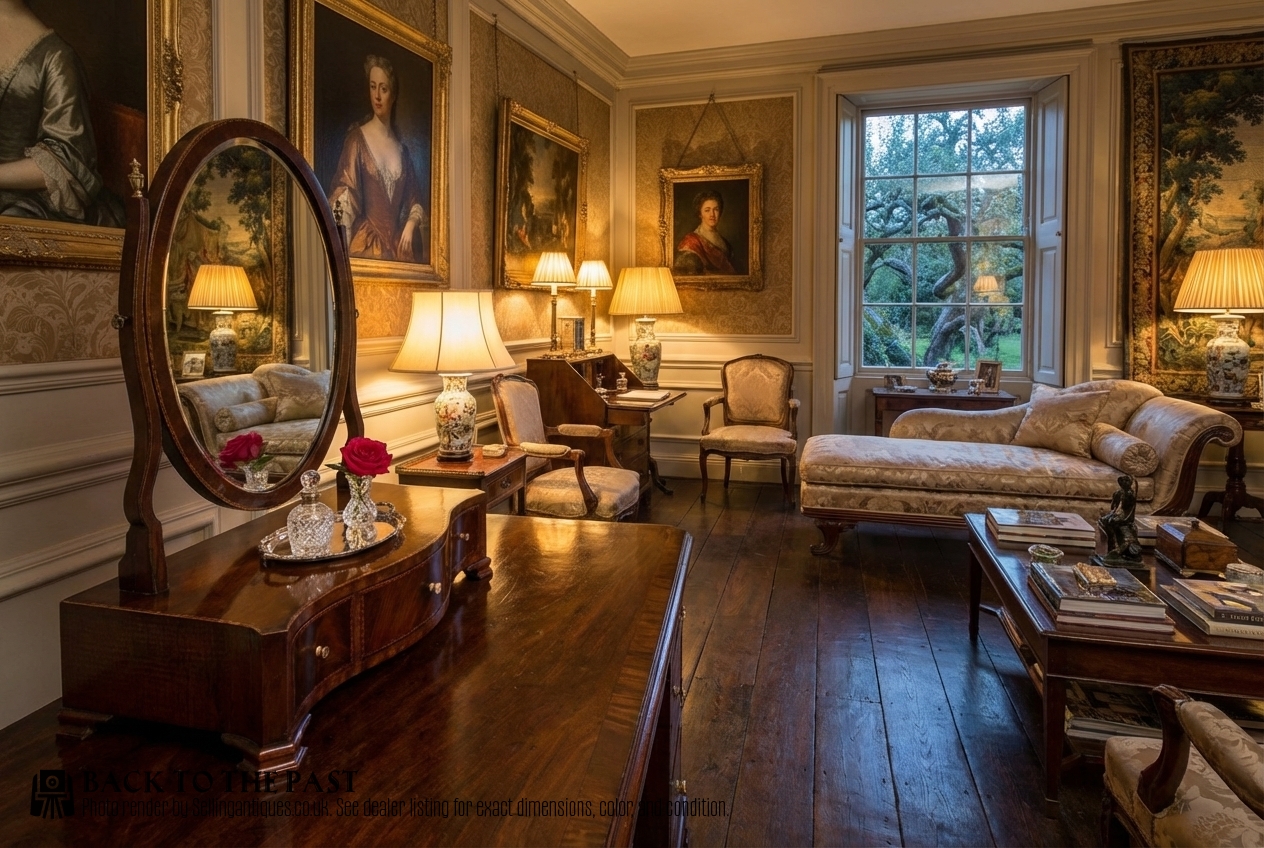
These mirrors suit traditional and contemporary spaces alike when placed securely on a sturdy chest of drawers, console table, or dressing desk.
Ensure the surface is level and deep enough to support the base plinth safely without overhang.
How do I distinguish Georgian from later periods?
Eighteenth-century and early nineteenth-century pieces tend to show authentic cabinetmaking techniques, such as hand-cut dovetails and period timber patination.
Later Sheraton Revival pieces from around nineteen hundred often exhibit lighter construction methods and different secondary woods behind the veneers.