

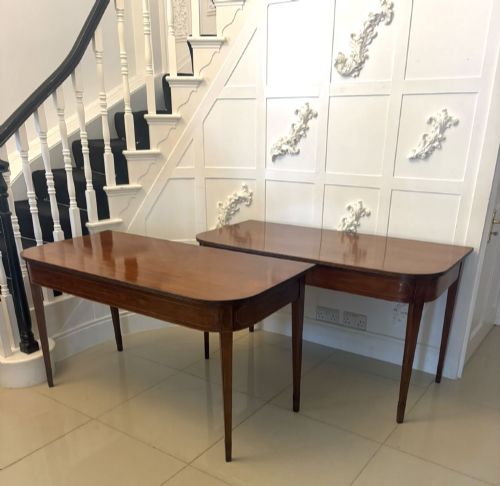
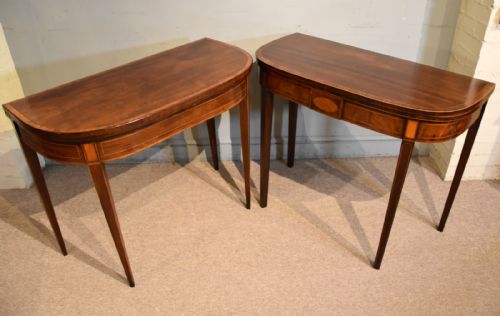
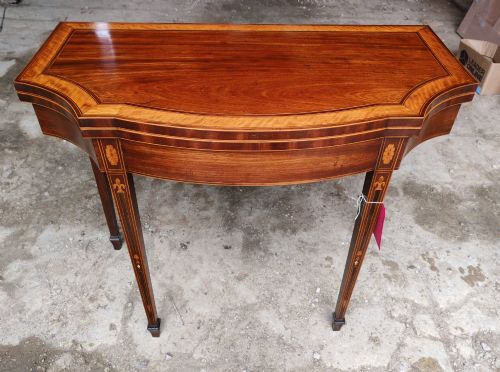


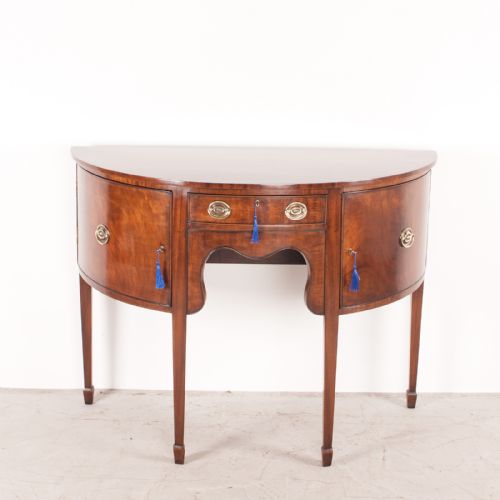


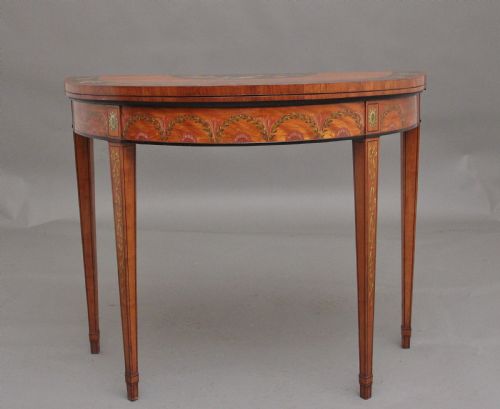


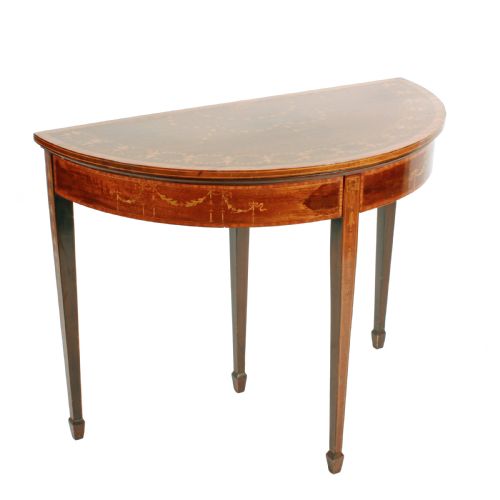


Sheraton Style Demilune Table
These sheraton style demilune table examples bring graceful semicurved forms and fine inlaid timbers into a room.
Sheraton Style Demilune Table
A sheraton style demilune table forms a semicircular silhouette designed to stand flat against a wall, frequently doubling as a card, games, or tea table with a foldover top. You meet these primarily in mahogany and satinwood, spanning the eighteenth century through the Edwardian period and later revivals.
The form appears across several functional variations, including console tables, sideboards, and occasional pieces. Card tables and games tables dominate the selection, often featuring inlaid boxwood and crossbanding along the semicircular edge.
How they were made
Cabinetmakers constructed these tables using solid timber carcases faced with figured veneers like satinwood, mahogany, and rosewood. Delicate stringing and marquetry in boxwood provide the characteristic linear decoration.
Surfaces frequently incorporate painted timber details, brass fittings, and foldover leaf hinges that allow the semicircular top to open out.
Sheraton Style Demilune Table Retail Price Guide 2026
Typical asking prices for sheraton style demilune table among the pieces listed under this phrase on Sellingantiques today, from the lower quarter to the upper quarter. They describe what is for sale here now, not the wider market.
Materials recorded across the selection include satinwood, mahogany, rosewood, boxwood, brass, and painted timber.
What varies in quality
The refinement of the timber selection and the crispness of the boxwood inlay distinguish the finer examples from simpler workshops. Figured satinwood veneers and complex marquetry demand superior craftsmanship.
Proportion and the handling of the curved D-shape dictate the visual success of the piece, particularly where folding leaves must align precisely with the frieze.
The Sheraton Style Demilune Table Glossary
- Demilune
- Half-moon shaped, describing furniture with a curved front and a flat back designed to sit against a wall.
- Satinwood
- A light yellowish timber prized for its lustrous grain and used extensively for veneering and marquetry.
- Crossbanding
- A strip of veneer laid perpendicular to the grain of the surface, framing the edge of the tabletop.
- Marquetry
- Decorative patterns formed by fitting together contrasting veneers of wood or other materials.
- Stringing
- Thin inlaid lines of contrasting timber used to outline panels and edges on furniture.
Sheraton Style Demilune Table: Frequently Asked Questions
Where should I place a demilune table?
These semicircular tables fit comfortably in hallways, living rooms, and dining areas where floor space is limited. Their flat back allows them to rest securely against a wall without protruding too far into the room.
Foldover variants also function well as occasional serving surfaces or card tables when opened out for use.
How do I identify a revival piece?
Edwardian and later revival examples often exhibit brighter, more uniform satinwood veneers and machine-cut stringing compared to eighteenth-century originals. Examining the secondary timbers on the underside helps clarify the period of manufacture.
Construction methods and nail types inside the frame provide further clues to distinguish Georgian work from nineteenth and twentieth-century interpretations.
Can I use a foldover table daily?
Foldover card and games tables accommodate regular use provided the hinge mechanisms and supporting swing legs are handled with care. The top leaf rests on a pivoting leg or gateleg action when opened.
Avoid placing excessively heavy items on the extended leaf to protect the vintage joints and timber hinges from strain.
What woods were commonly used?
Mahogany and satinwood form the primary visual surfaces across most examples, supplemented by rosewood and oak in the underlying structure. Boxwood frequently provides the pale contrast for inlaid stringing and geometric details.
Selected pieces also incorporate painted decoration directly onto the timber surface alongside traditional marquetry.