



Sheraton Style Chest
A sheraton style chest brings together classic proportion and fine timber inlay, offering both functional storage and restrained neoclassical elegance for a room.
Sheraton Style Chest
When searching for a sheraton style chest, buyers encounter pieces that reflect the lighter, more refined geometry characteristic of late eighteenth and early nineteenth century design. The versions most commonly met on this page range from Georgian originals through to Edwardian and later revival interpretations.
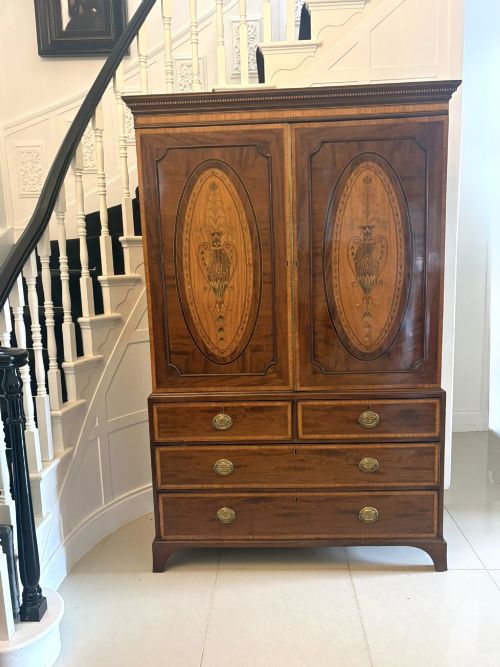
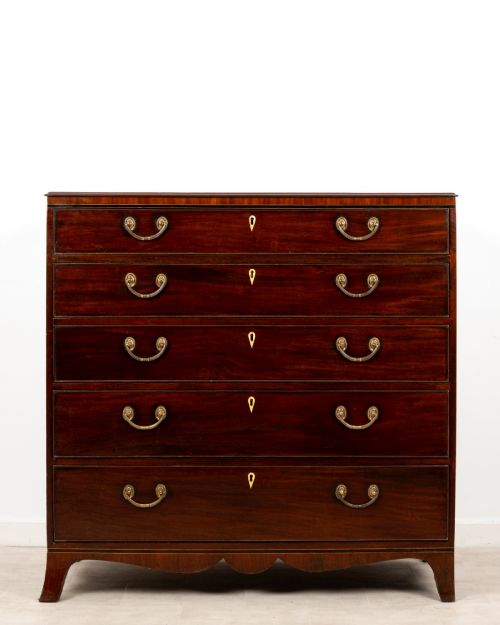
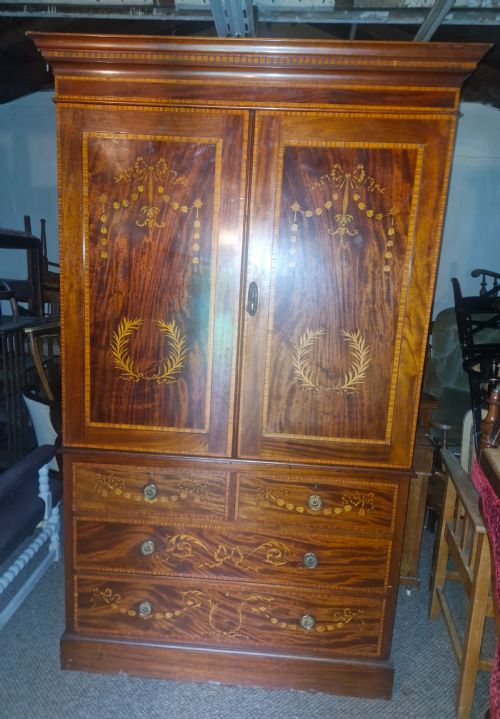
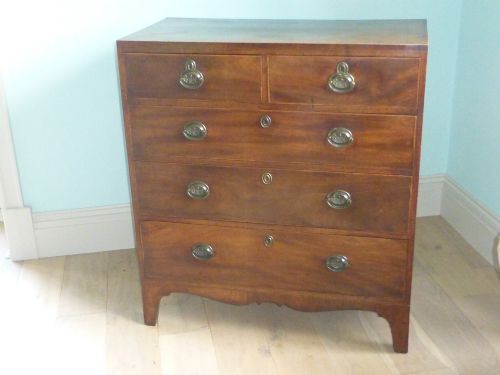
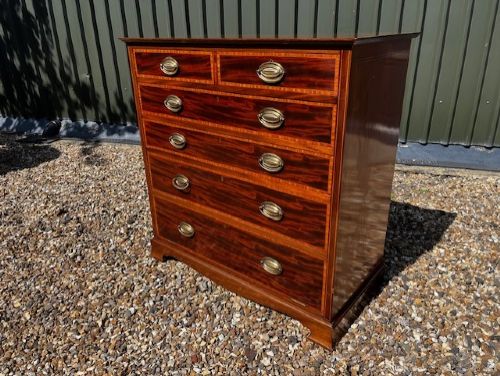
The form primarily appears as a chest of drawers or a bow front chest, often constructed with multiple graduated drawers raised on bracket feet. Alongside standard chests, the selection includes related case furniture such as tallboys, linen presses, and bedside chests sharing the same stylistic vocabulary.
Origins span distinct periods including the Georgian era, the nineteenth century, and the Edwardian period, with revival pieces produced well into the twentieth century. Each variation displays the characteristic straight lines, slender proportions, and attention to surface detail associated with the style.
Materials and construction
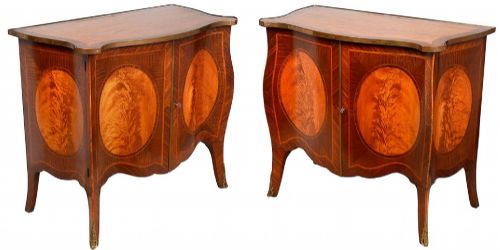
Mahogany and satinwood serve as the primary timbers, frequently combined to create contrasting borders and panels. Cabinet makers utilised these woods alongside supportive secondary timbers to build sturdy carcases capable of housing multiple graduated drawers.
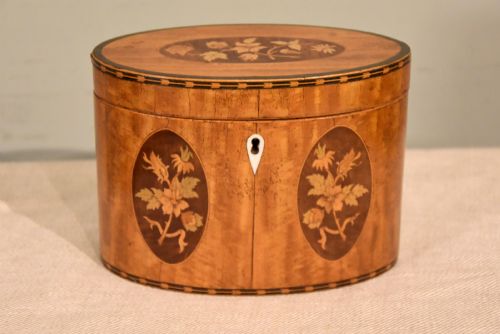
Surface ornament relies heavily on timber inlay and decorative banding utilising boxwood, ebony, and bone. Craftsmen cut precise recesses into the primary wood to insert delicate lines, shells, and geometric motifs before finishing the surface with polish.
Listings feature mahogany, satinwood, and partridge wood alongside decorative bone and boxwood inlays.
Judging quality and finish
Quality reveals itself in the crispness of the timber inlay and the selection of figured veneers. Superior examples display perfectly flush brass hardware, tight joints at the drawer corners, and well matched grain patterns across the front.
The refinement of the proportions and the delicacy of the banding separate standard production from finer cabinet work. Attention to internal construction, such as solid drawer linings and smooth runner action, marks the distinction at the upper end.
Edwards and Roberts·Druce & Co.
The Sheraton Style Chest Glossary
- Bow front
- A cabinet front that curves outward in a convex shape. This configuration softens the boxy profile of a standard case piece.
- Satinwood
- A lustrous tropical timber with a yellowish gold colour used extensively for veneers and decorative panels. It provides a bright contrast against darker woods like mahogany.
- Inlay
- A technique where pieces of contrasting wood, bone, or metal are inserted into depressions flush with the surface. This creates decorative borders and pictorial motifs.
- Tallboy
- A tall chest of drawers consisting of one chest stacked on top of another. It offers extensive vertical storage capacity while maintaining a compact footprint.
- Serpentine
- A front shape defined by a central convex curve flanked by two concave curves. This undulating outline requires exceptional skill from the cabinet maker.
Sheraton Style Chest: Frequently Asked Questions
How do I date a sheraton style chest?
Dating relies on examining the secondary timbers inside the drawers, the method of dovetailing, and the style of the brass handles. Georgian originals show hand cut joinery and native oak or pine linings, whereas Edwardian revivals often feature machine cut elements and lighter interior woods.
Changes in veneer thickness and the type of polish also provide clues to the age of the piece. Revival pieces from the late nineteenth and early twentieth centuries frequently emulate the earlier neoclassical aesthetic while retaining manufacturing marks characteristic of their actual period of production.
Are these chests suitable for modern bedrooms?
The restrained proportions and shallow depth of these pieces make them well suited for contemporary bedroom spaces. They provide practical drawer storage without overwhelming the surrounding room.
The balanced geometry and warm tones of mahogany and satinwood allow the furniture to sit comfortably alongside modern interior schemes. They function effectively as standalone storage items or paired with bedside tables.
What is the difference between a chest and a tallboy?
A standard chest of drawers provides low level storage in a single horizontal carcase, usually standing at waist height. A tallboy builds upward by stacking one chest section upon a larger base section, creating a much taller vertical silhouette.
Both forms utilise similar inlay techniques and drawer configurations, but the tallboy is designed to maximise storage capacity in rooms with limited floor space. The higher elevation changes the overall proportions of the piece within a room.
How do I care for satinwood veneer?
Satinwood veneer requires protection from direct sunlight to prevent the golden tones from fading over time. Regular dusting with a soft, dry cloth helps maintain the surface without building up residue.
Applying a quality microcrystalline wax occasionally will nourish the wood and preserve the polish. Avoid placing wet items or heavy heat sources directly on the top surface.