




Sheraton Serpentine Sideboard
A sheraton serpentine sideboard brings together disciplined neoclassical lines and fluid cabinetmaking, offering both a commanding presence and practical storage for a dining room.
Sheraton Serpentine Sideboard
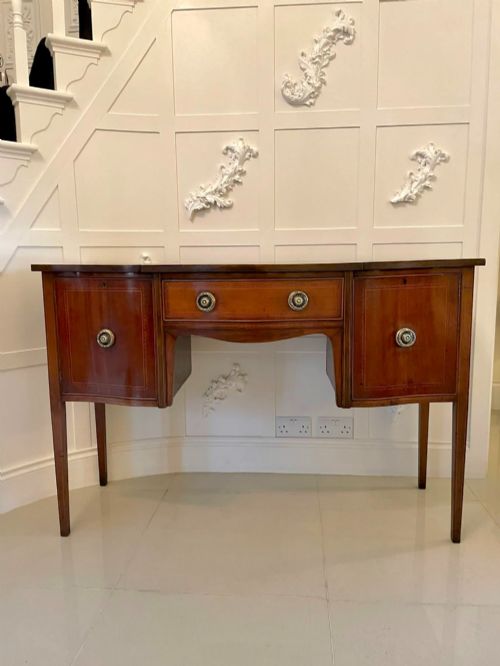
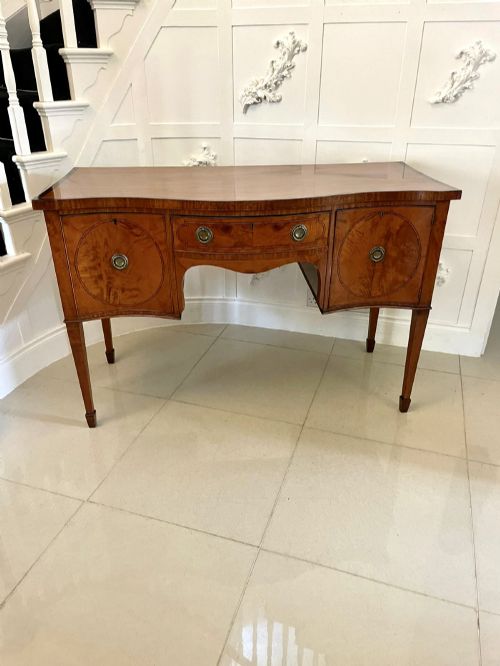
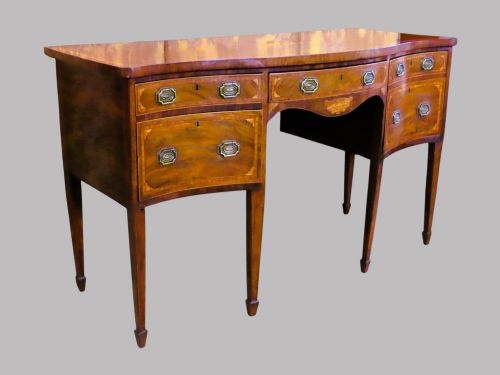
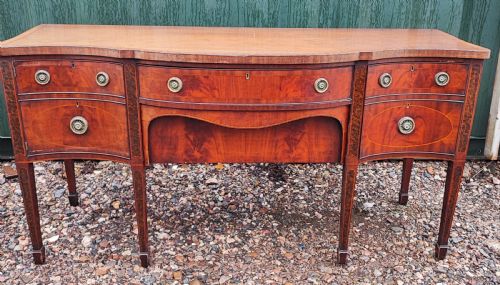
A sheraton serpentine sideboard presents a sweeping, undulating curved front that softens the substantial geometry of formal dining room furniture. These pieces emerge principally from the Georgian and George III periods, as well as later Edwardian and Victorian revivals.
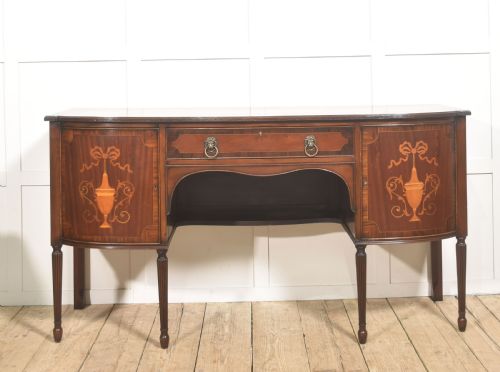
The form combines expansive drawer arrangements with flanking cupboards or cellarette compartments, designed to house dining silver and linen. While many examples follow the classical proportions of the late eighteenth century, others appear in later revival iterations dating into the early twentieth century.
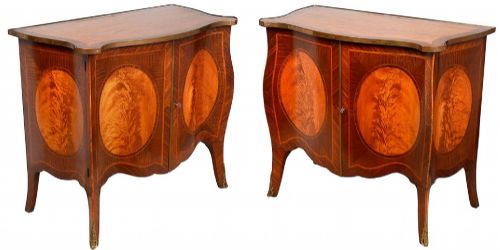
Beyond standard sideboards, the category encompasses related forms sharing the same distinctive curved profile and cabinetwork. Buyers will encounter side cabinets, display cabinets, and smaller accessories such as knife boxes and cutlery boxes built in matching timbers.
Materials and construction
Makers constructed these pieces using dense timber foundations, relying primarily on rich mahogany alongside occasional lighter satinwood. Cabinetmakers selected figured grain patterns, such as flame mahogany, to create visual movement across the broad central drawers and cupboard doors.
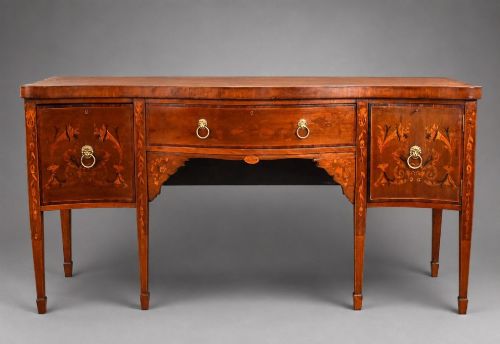
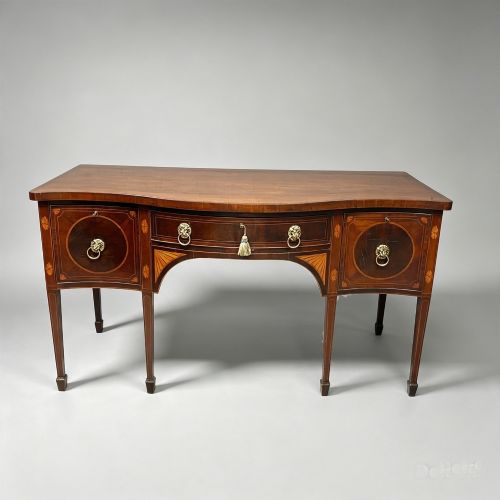
Surface ornamentation relies heavily on contrasting timber details rather than heavy carving. Craftsmen applied satinwood inlay, boxwood inlay, marquetry, and delicate wood inlay in geometric and floral motifs to define the serpentine borders and panel edges.
Listings feature mahogany predominantly, complemented by satinwood, boxwood inlay, and marquetry across Georgian, Victorian, and Edwardian periods.
Judging quality in serpentine furniture
The integrity of the serpentine curve sets superior examples apart, demanding precise joinery where the convex and concave sections meet. Finer pieces maintain crispness in their inlaid borders and retain balanced proportions across the entire front elevation.
Original hardware, such as brass pulls and escutcheons, alongside intact internal fittings like cellarettes, contributes significantly to a piece's integrity. The choice of primary timber and the delicacy of the contrasting boxwood or satinwood stringing further indicate the maker's skill.
The Sheraton Serpentine Sideboard Glossary
- Serpentine
- A front contour characterised by a convex centre flanked by two concave curves. This shape requires advanced cabinetmaking skill to execute smoothly across drawer fronts and framing.
- Cellarette
- A built-in compartment within a sideboard designed to hold wine bottles upright. These lead-lined or partitioned spaces are often found behind the lower side doors.
- Satinwood
- A durable, lustrous yellowish timber native to Ceylon and India. It was utilised extensively for banding, stringing, and entire cabinet faces during the Georgian and revival periods.
- Inlay
- A decorative technique where pieces of contrasting wood are fitted into recesses carved into the primary surface. Craftsmen used boxwood and satinwood to create fine linear borders.
- Marquetry
- Elaborate decorative veneer work assembled to form pictorial or floral patterns. This technique appears on select revival pieces and cabinet doors.
- George III
- The period spanning from 1760 to 1820, encompassing the height of neoclassical furniture design in Britain. Pieces from this era establish the baseline for later revival styles.
Sheraton Serpentine Sideboard: Frequently Asked Questions
How do I spot a reproduction?
Examine the construction methods visible within the drawer linings and back panels, as machine-cut timber and modern adhesives indicate a later manufacture date. True period pieces display hand-cut dovetails and timber movement appropriate to their stated age.
Compare the decorative inlay against known eighteenth-century motifs to ensure the style aligns with the period claimed. Revival pieces from the Edwardian era often employ brighter, more uniform satinwood and distinct secondary woods compared to their Georgian predecessors.
What is a cellarette?
A cellarette is a dedicated storage space built directly into the sideboard to hold wine and spirits. In traditional pieces, these compartments are often lined and fitted with internal racks.
Their presence adds both utility and historical interest to the piece, reflecting formal dining customs of the eighteenth and nineteenth centuries.
Where should I place it?
Position the piece against a primary wall in a dining room or formal hallway where its curved profile can be appreciated without obstruction. Ensure there is adequate clearance for the central drawers and side cabinet doors to open fully.
Keep the timber away from direct heat sources and strong sunlight to prevent the mahogany and delicate satinwood inlay from fading or drying out over time.
How do I care for the wood?
Maintain the surface by dusting regularly with a soft, dry cloth and applying traditional beeswax sparingly when the timber appears dry. Avoid commercial silicones or abrasive cleaners that can damage the antique polish and lift the fine inlay work.
Control the room's humidity to prevent the solid mahogany and veneered panels from warping or splitting along the intricate curved joints.