
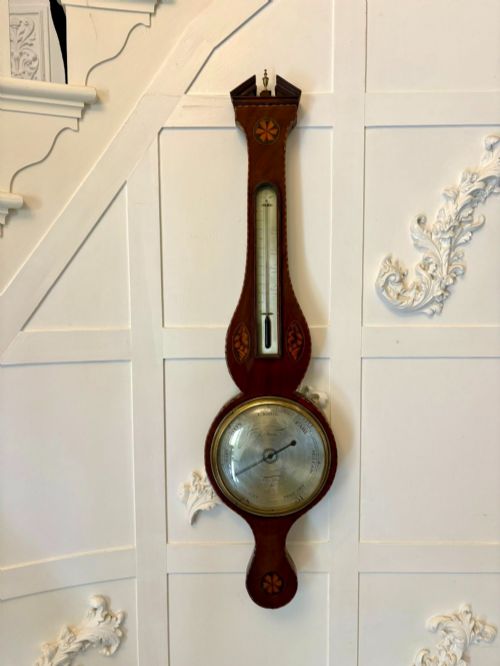
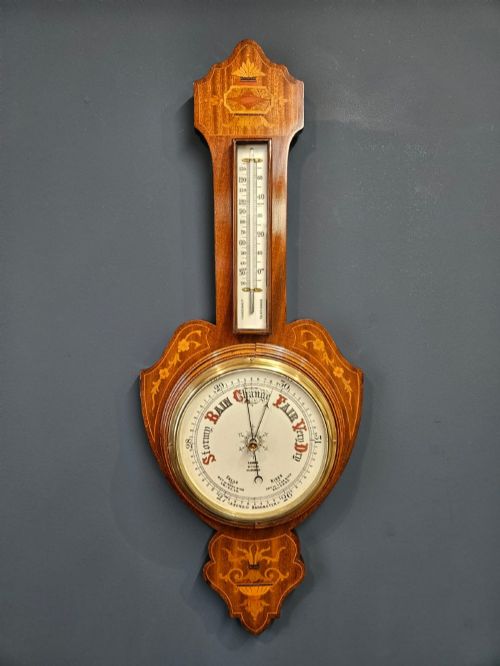
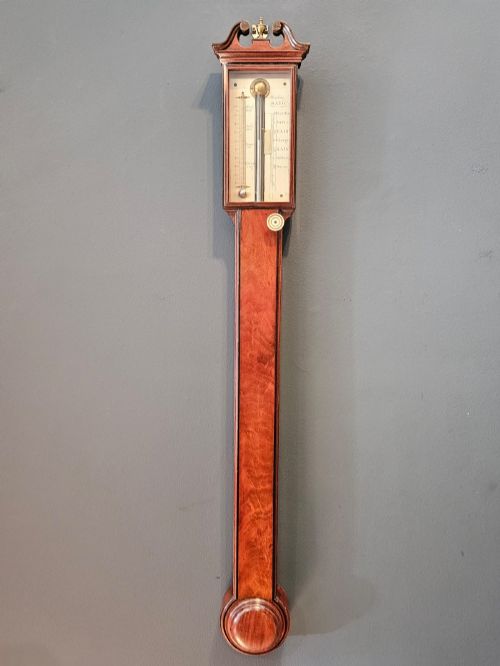
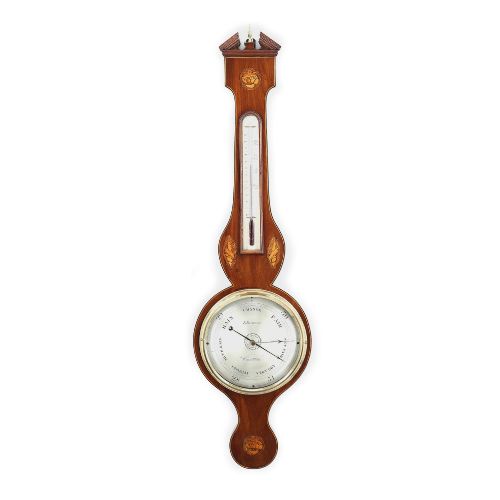


Sheraton Mahogany Barometer
A sheraton mahogany barometer combines practical weather forecasting with refined cabinet-making, bringing Georgian elegance into any hallway.
Sheraton Mahogany Barometer
When you search for a sheraton mahogany barometer, you encounter pieces primarily from the Georgian, 19th Century, and Edwardian periods. These instruments take the form of banjo barometers, wheel barometers, and stick barometers, with occasional mantel clock combinations.
The version most commonly met on this page is the banjo or wheel barometer framed in rich mahogany and enhanced with delicate inlays. Originating in workshops across Britain, these instruments served as both scientific tools and status symbols for prosperous homes.
How they were made
Cabinet-makers constructed the bodies from solid and veneered mahogany, frequently selecting timber with deep grain patterns. They incorporated boxwood and satinwood stringing alongside marquetry inlay to create contrasting geometric and floral motifs.
Brass dials, bezels, and hygrometers punctuated the wooden frames, while protective glass covered the delicate instrument faces and mercury tubes.
Makers often engraved their dials with optimistic forecasts like 'Set Fair' even during heavy downpours.
What varies in quality
The standard of cabinet-work distinguishes the finer examples, particularly the precision of the boxwood and satinwood inlays and the richness of the mahogany figure. Crispness in the engraved brass dials and the retention of original glass and fittings elevate an instrument's standing.
Proportion and balance dictate the aesthetic success of the piece, with superior models displaying harmonious lines from the dampening cistern cover to the broken pediment at the crest.
B Besozzi of Weymouth·Prada of High Wycombe·L Casatelli of Liverpool·A Rivolta·J Groce York·Luisetti of London·J C Moretti·Walter Gough London
The Sheraton Mahogany Barometer Glossary
- Banjo barometer
- A domestic weather glass housed in a case shaped like a banjo, featuring a circular dial at the base and a long trunk leading to a hygrometer or thermometer at the top.
- Stick barometer
- A tall, narrow wall instrument where the mercury tube is exposed or protected by a glazed door, representing the earlier and more scientifically precise form of weather glass.
- Marquetry inlay
- The art of applying small pieces of varied veneers to form decorative pictures or patterns, frequently seen in floral or shell motifs on these pieces.
- Aneroid barometer
- A type of weather indicator that measures atmospheric pressure through the expansion and contraction of a flexible metal box rather than liquid mercury.
Sheraton Mahogany Barometer: Frequently Asked Questions
How do I read a wheel barometer?
The upper dial displays general weather predictions such as rain or fair, connected to an internal mechanism that tracks atmospheric pressure. The pointer is adjusted using the central knob to align with the current reading so changes become visible.
Secondary dials on the face often include a hygrometer for humidity or a thermometer for temperature, providing a comprehensive domestic weather station.
Where should I hang a barometer?
Choose an interior wall free from direct sunlight and away from radiators or draughts, as sudden temperature fluctuations affect the internal mechanism. Hallways and studies provide stable environments that suit the traditional timber cases.
Ensure the wall fixings are secure, as these instruments possess significant weight due to the timber frames and glass components.
How do I date a barometer?
Examine the dial design, the complexity of the woodwork, and the style of any inlays, comparing them against known periods from Georgian to Edwardian. Stick barometers and simpler dampening cistern covers often point to earlier 18th-century origins.
The presence of maker signatures engraved on the brass dial plates also helps establish a precise timeline of manufacture.
Are these barometers still accurate?
Many surviving mercury instruments retain their functionality and respond correctly to changes in barometric pressure. Aneroid versions introduced later also track weather patterns reliably when calibrated correctly.
Minor recalibration can be performed using a reference point, though many owners appreciate them primarily as historical furnishings.