
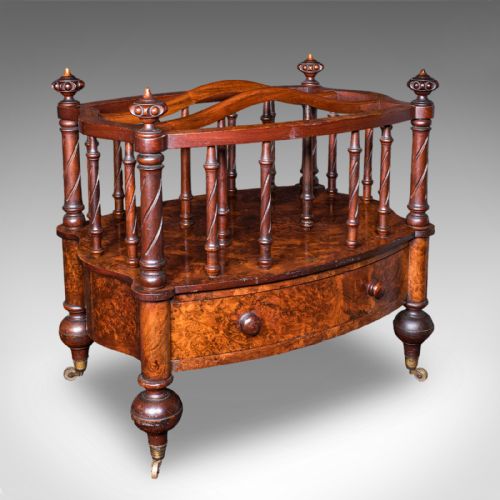
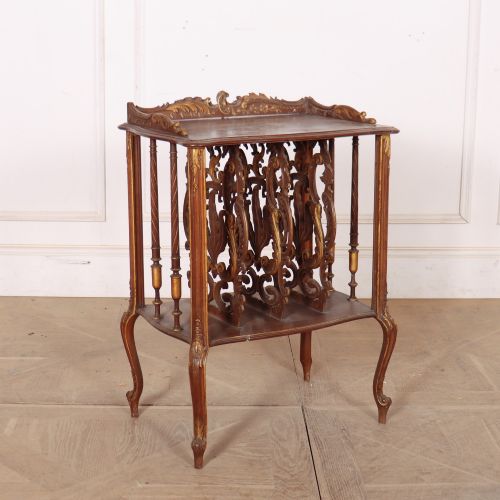


Sheet Music Holder Table
These sheet music holder table pieces combine storage compartments and table surfaces, offering a practical way to keep folios and periodicals tidy beside a seat.
Sheet Music Holder Table
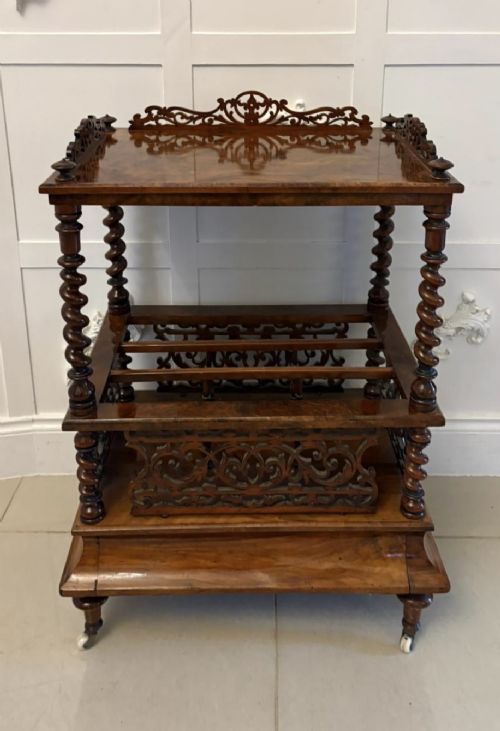
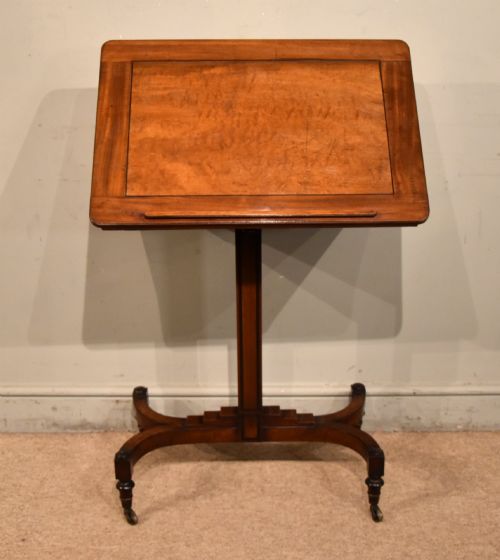
When you search for a sheet music holder table, you encounter pieces primarily described as canterburys, music stands, and occasional tables. These items function simultaneously as small display surfaces and upright partitions for papers.
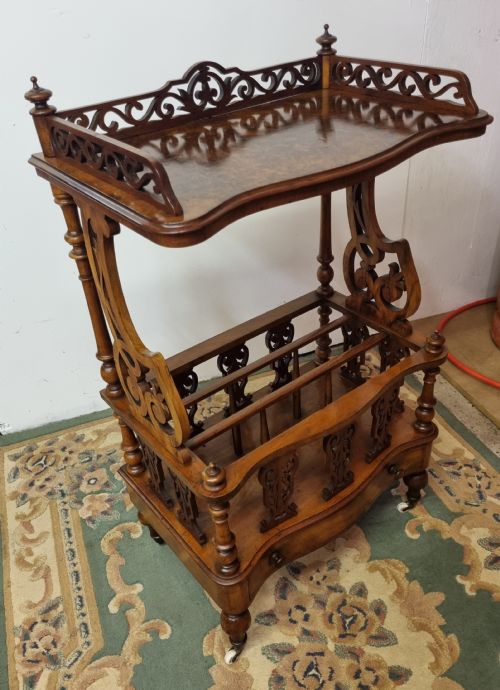
The versions most commonly met on this page span the Regency, Victorian, and wider nineteenth-century periods. They include forms such as the canterbury whatnot, reading stands, and magazine racks with integrated drawers or work tops.
Originating largely in English and French workshops, these furnishings employ timber frames designed to support folios, newspapers, and sheet music while serving beside a chair or sofa.
How they were made
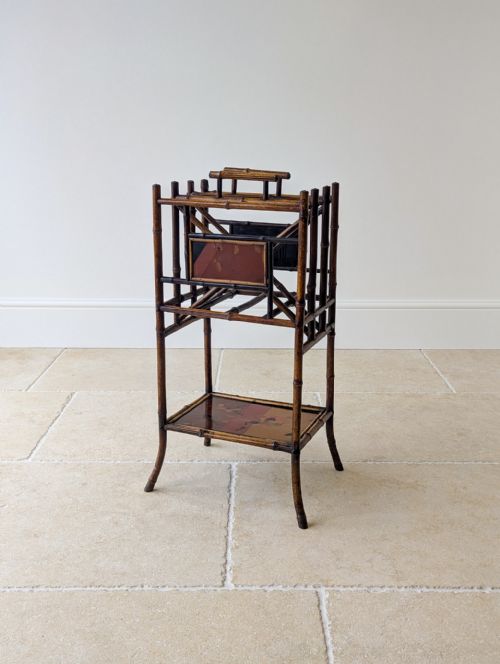
The construction relies heavily on cabinet timbers such as mahogany, walnut, burr walnut, rosewood, and satinwood, often selected for rich grain patterns. Some examples incorporate bamboo or ebonised finishes.
Makers integrated brass castors, ceramic components, and carved details into the wooden frames. Adjustable mechanisms appear on reading and music stands to alter the angle of the rest.
The listings on this site span the nineteenth century, featuring materials from burr walnut and rosewood to bamboo and ceramic.
What varies in quality
The standard of timber selection and complexity of cabinetwork define the scale of quality across these pieces. Plain mahogany variants contrast with intricately figured burr walnut and satinwood examples.
Additional functions, such as incorporated drawers, combined whatnot tiers, or adjustable reading ratchets, separate basic upright partitions from highly developed multi-use tables.
The Sheet Music Holder Table Glossary
- Canterbury
- A low stand featuring upright partitions for holding sheet music, newspapers, or periodicals. It frequently includes a small drawer beneath the divisions.
- Whatnot
- An open set of multi-tiered shelving used for display, often mounted above a canterbury base. It provides additional surface area for small decorative objects.
- Reading stand
- An adjustable wooden framework designed to hold books or sheets at a readable angle. These items often feature folding supports and brass adjustment fixtures.
- Aesthetic Movement
- A late nineteenth-century design style emphasising art for art's sake. Pieces from this movement often utilise materials like bamboo and simplified forms.
- Serpentine shape
- A curved outline featuring a convex centre flanked by concave curves. This contour appears on the edges and tops of better cabinet pieces.
Sheet Music Holder Table: Frequently Asked Questions
What is a sheet music holder table used for?
These furnishings hold sheet music, newspapers, and periodicals upright within partitioned compartments while providing a surface on top for lamps or decorative items.
They sit beside a piano, desk, or seating area to keep working papers organised and accessible.
How do I tell a Victorian piece from a Regency one?
Regency items frequently employ mahogany or rosewood with restrained classical lines and brass mounts. Victorian examples often showcase burr walnut, richer carvings, and multi-tiered whatnot structures.
Construction details and timber choice help distinguish the earlier Regency period from the later Victorian era.
Can I use these tables for modern magazines?
The vertical partitions easily accommodate modern periodicals, art books, and sheet music alongside traditional folios. The underlying table surface functions well for small daily items.
Their original purpose matches modern living needs for compact paper storage.
Where should I place a canterbury in a room?
These pieces fit naturally beside a sofa, armchair, or piano where reading materials accumulate. Their finished backs and compact footprints allow them to stand freestanding or against a wall.
They work well in sitting rooms, libraries, and studies.