




Shaped Front Credenza
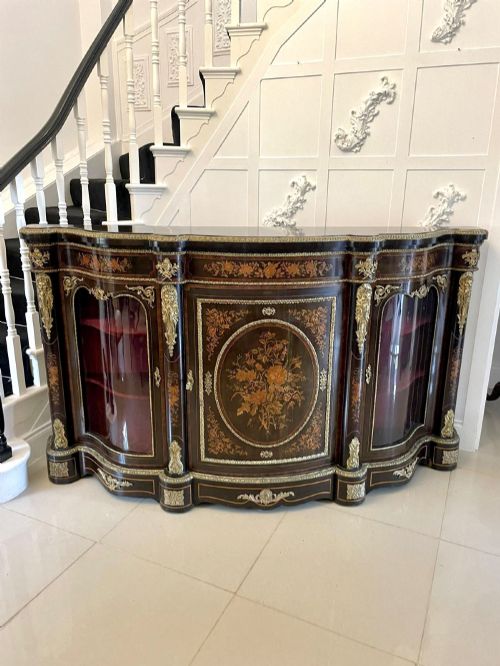
A shaped front credenza brings architectural curves to a room, offering grand storage through serpentine lines and burr walnut or mahogany surfaces.
Shaped Front Credenza
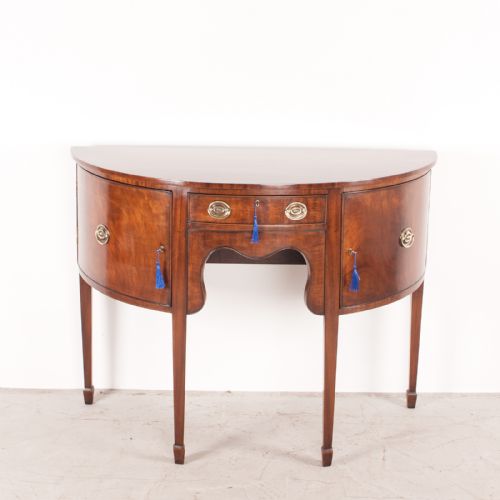
The shaped front credenza category encompasses sophisticated case pieces including serpentine sideboards, demi lune cabinets, and cocktail units that bridge dining and reception spaces. These pieces emerge from periods spanning the Georgian era through to the 1930s, showcasing curves that soften rigid room layouts.
Victorian and Edwardian iterations frequently feature rich mahogany, rosewood, and burr walnut veneers enhanced by floral marquetry and ormolu mounts. Buyers on this page regularly encounter serpentine silhouettes and demi lune formats designed to hug parlour and dining room walls.
Earlier Georgian examples demonstrate understated timber figuring and refined proportions, while later revival pieces lean into ornate French styling and elaborate brass details. Each iteration provides substantial interior storage behind sweeping doors shaped with precision carpentry.
Materials and construction methods
Cabinet makers utilised dense hardwoods including mahogany, walnut, and rosewood as the structural foundation for these curved carcasses. Craftsmen applied delicate boxwood stringing and floral marquetry to accentuate the sweeping contours of serpentine and demi lune fronts.
Ormolu mounts and brass hardware punctuate the timber surfaces, while glass panels and marble tops appear on select Victorian examples. Structural support often incorporates barley twist columns or tapered legs that balance the heavy, curving forms above them.
Shaped Front Credenza Retail Price Guide 2026
Typical asking prices for shaped front credenza among the pieces listed under this phrase on Sellingantiques today, from the lower quarter to the upper quarter. They describe what is for sale here now, not the wider market.
Barley twist columns add an unexpected spiral rhythm to formal mahogany credenzas, giving serious Victorian timber a playful bounce.
Markers of distinction
Quality reveals itself in the continuity of the timber grain across complex curved surfaces and the precision of the joinery along serpentine edges. Superior examples display crisp, hand-cut marquetry and heavy, fire-gilt ormolu mounts rather than mass-produced metalwork.
The choice of primary timber sets the tier of the piece, with richly figured burr walnut and dense mahogany commanding attention. Original fittings, intact marble tops, and refined interior configurations elevate a piece far above standard utilitarian production.
The Shaped Front Credenza Glossary
- Serpentine
- A curved architectural line that gently bows outward in the centre and curves inward toward the ends. This profile requires advanced carpentry to execute across solid timber and veneer.
- Demi lune
- A half-moon shape used for cabinets and sideboards designed to stand flush against a wall. The flat back meets a sweeping curved front.
- Marquetry
- Decorative patterns formed by inserting thin veneers of different coloured woods into a fitted wooden background. Floral motifs are common across Victorian and Edwardian iterations.
- Ormolu
- Gilded bronze furniture mounts cast in ornate scrollwork or floral designs. These metallic accents highlight corners and framing on high-status nineteenth-century pieces.
- Bombe
- A swollen, bulging outward curve on the front and sides of a cabinet. This exuberant French style creates deep visual volume.
Shaped Front Credenza: Frequently Asked Questions
What is a shaped front credenza used for?
These versatile pieces function primarily as serving surfaces and storage cabinets in dining rooms and grand hallways. Interiors typically accommodate glassware, linens, and dining accessories behind heavy panelled doors.
In modern settings, they often serve as statement cocktail cabinets or media consoles. Their curved proportions allow them to sit gracefully in corners or against prominent walls without dominating the floor plan.
How do I date an antique credenza?
Dating relies on examining the secondary timbers, construction joints, and decorative vocabularies present on the piece. Georgian and George III examples display hand-cut dovetails and restrained timber selection, whereas Victorian pieces frequently incorporate heavy burr walnut and elaborate ormolu.
Revival styles from the early twentieth century often mix historical motifs with modern manufacturing traces. Cross-referencing the specific combination of brass hardware, veneer thickness, and edge moulding provides a reliable timeline.
How do I care for mahogany and walnut veneers?
Maintain these polished timber surfaces by keeping them away from direct sunlight and steady heat sources that dry out old adhesives. Regular dusting with a soft, dry cloth prevents particulate build-up in the intricate marquetry and carved mouldings.
Apply traditional beeswax sparingly to nourish the grain without leaving heavy residues. Avoid chemical cleaning agents and excessive moisture, which can lift delicate boxwood stringing and veneer edges.
What is the difference between a sideboard and a credenza?
Sideboards traditionally served dining spaces for the presentation of food and storage of tableware. Credenzas originated as low side cabinets, frequently featuring glass doors and decorative mounts suited to formal reception rooms.
Over time, makers and retailers began using the terms interchangeably, particularly for pieces exhibiting elaborate serpentine fronts and decorative marquetry. The primary distinction rests on the historical room of origin rather than the internal mechanics.