

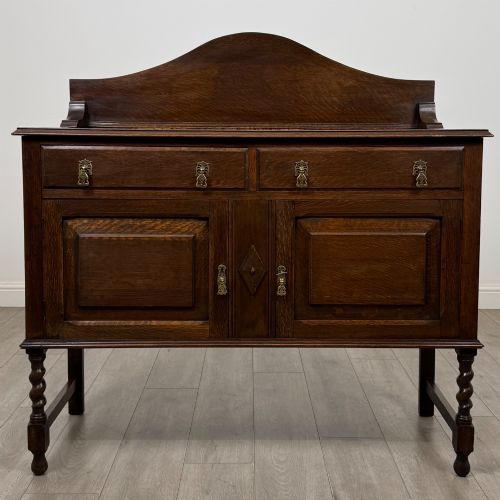
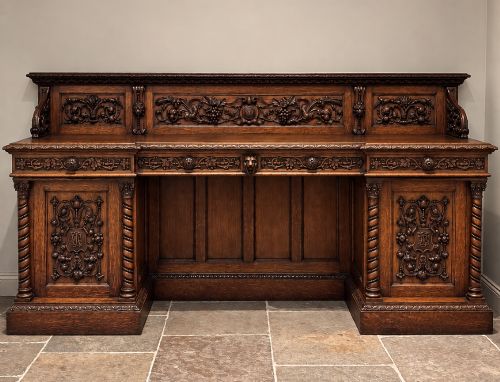
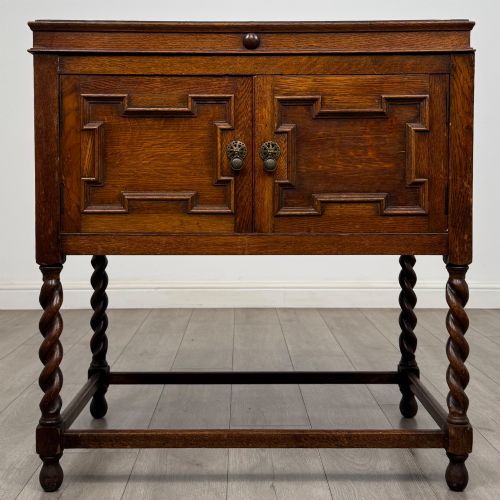
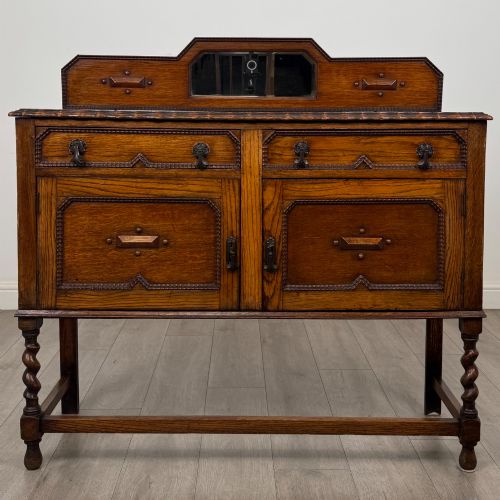


Barley Twist Credenza
These barley twist credenza options bring carved timber and turned columns to your dining room or hall.
Barley Twist Credenza
A barley twist credenza unites heavy timber construction with helical turning inspired by earlier centuries. These storage pieces appear across nineteenth-century and Edwardian periods.
Most examples you encounter here take the form of sideboards, side cabinets, and chiffoniers in oak or mahogany. Makers also utilised walnut and rosewood to build these large storage items.
Stylistic influences range from Jacobean Revival to Victorian Gothic and French regional furniture. A mirrorback or marble top frequently completes the composition.
Materials and construction methods
Carpenters built these cabinets predominantly in solid oak, mahogany, rosewood, and walnut. Timber selection dictated the weight and colour capacity of each individual sideboard.
Turned barley twist columns form a defining structural and decorative element, flanked by carved panels and brass hardware. Glass doors and mother of pearl inlay occasionally appear on cabinet variants.
Barley Twist Credenza Retail Price Guide 2026
Typical asking prices for barley twist credenza among the pieces listed under this phrase on Sellingantiques today, from the lower quarter to the upper quarter. They describe what is for sale here now, not the wider market.
Periods represented include Victorian, Edwardian, William IV, and nineteenth-century revival styles.
Judging the quality of craftsmanship
The crispness of the carved ornamentation and the symmetry of the turned columns distinguish finer examples from standard production. Deep relief carving on oak or figured grain in mahogany indicates superior workshop standards.
Original hardware, sound timber joinery, and intact glass or marble tops elevate a piece. Substantial proportions and well-executed revival styles separate the top tier of sideboards from simpler variants.
The Barley Twist Credenza Glossary
- Credenza
- A low cabinet for storage or serving, often featuring doors and decorative columns. These items anchor dining rooms and reception spaces.
- Barley Twist
- A decorative turned wooden column resembling a spiral or rope. This helical form became popular during revival periods.
- Chiffonier
- A compact sideboard or tall chest fitted with doors or drawers. They served smaller entertaining spaces in nineteenth-century homes.
- Jacobean Revival
- A nineteenth-century style imitating seventeenth-century English furniture. It favours dark oak, deep carving, and robust proportions.
- Mirrorback
- A wooden sideboard superstructure incorporating an integrated mirror. This feature reflects light and displays porcelain or silver.
Barley Twist Credenza: Frequently Asked Questions
Where should I place a credenza?
These large storage units suit dining rooms, hallways, or living spaces where surface area and interior shelving prove useful.
Ensure adequate wall space and clearance for doors to open fully before positioning your cabinet.
How do I date these cabinets?
Examine the timber species, joinery methods, and hardware style to determine the period. Oak revival pieces often point to the later nineteenth century, whilst mahogany and rosewood span earlier decades.
Turned columns and carved motifs provide further clues to whether a piece belongs to the Victorian or Edwardian eras.
Can I use it as a sideboard?
Many examples function directly as serving sideboards or storage buffets for dining ware and linens.
Marble top variants offer durable surfaces for food and drink presentation during gatherings.
What woods were used most?
Oak and mahogany appear most frequently across these listings, providing robust frames and rich grain patterns.
Walnut and rosewood also feature in specific nineteenth-century cabinet designs.