
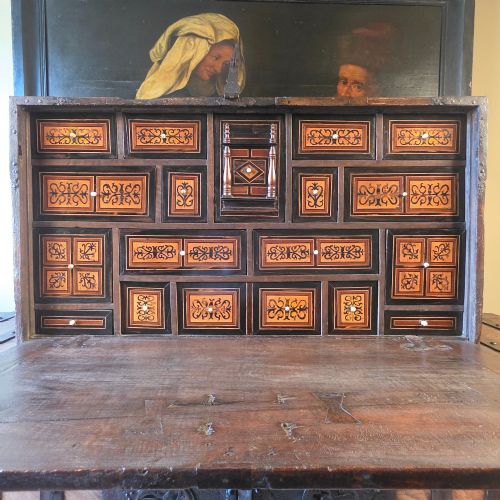
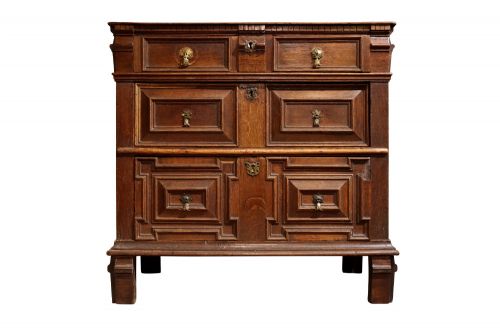


Seventeenth Century Style Cabinet
A seventeenth century style cabinet brings heavy timber and dense carved detail into a room, offering both storage and genuine period presence.
Seventeenth Century Style Cabinet
When you search for a seventeenth century style cabinet, you encounter sturdy timber furniture drawing on Jacobean, Charles II, and William and Mary designs. The selection spans authentic seventeenth century survivals alongside nineteenth and early twentieth century revival pieces made in the same spirit.
Forms range from court cupboards and dressers to side cabinets, writing bureaus, and chests of drawers. Revival pieces from the nineteen-twenties frequently replicate earlier proportions and decorative schemes using traditional dark wood construction.
How they were made
Cabinet makers relied primarily on solid oak, walnut, and fruitwood, building robust frames designed to last for centuries. Joinery involved traditional methods where panels sat within grooved framing to accommodate natural wood movement.
Decoration relied on deep carving, geometric moulding, and occasional bone or wood inlay to create texture across drawer fronts and cupboard doors. Iron and brass hardware, including drop handles and hinges, fastened the heavy timber doors and drawers securely.
Some nineteenth century carvers grew so fond of early patterns they added bogus seventeenth century dates into the oak friezes.
What varies in quality
Quality rests upon the depth and crispness of the carved details rather than flat surface decoration. Pieces with hand-carved panels show distinct chisel marks and individuality, whereas later mass-produced revivals sometimes display softer, uniform moulding.
The choice of primary timber and secondary framing woods alters the heft and stability of the piece. Dense oak and figured walnut command attention through their natural grain and patination, built by makers who understood how timber settles over decades.
The Seventeenth Century Style Cabinet Glossary
- Court cupboard
- A heavy storage piece with an upper enclosed section supported by pillars above a lower recess or cupboard. These served as display surfaces for plate and food in wealthy households.
- Jacobean revival
- A late nineteenth and early twentieth century style mimicking the heavy carved oak furniture of the early seventeenth century. Makers utilised older joinery techniques to recreate historic forms for modern homes.
- Moulded front
- A cabinet or drawer facade shaped with raised and recessed bands to catch light and create depth. This technique defined much of the decorative work on seventeenth century case furniture.
- Writing bureau
- A desk featuring a sloping fall-front that opens to reveal internal small drawers and pigeonholes. These items combine writing surfaces with enclosed storage below.
Seventeenth Century Style Cabinet: Frequently Asked Questions
How do I spot a true seventeenth century piece from a revival?
Examine the tool marks, timber shrinkage, and construction joints beneath the cabinet. Authentic period pieces exhibit hand-riven boards and irregular peg placements that differ from twentieth century machine-cut standardisation.
Look closely at the underside and back panels for signs of historic hand-planing. Revival furniture often employs modern screws or uniform timber widths hidden behind an aged dark finish.
What rooms suit a seventeenth century style cabinet?
These dark wood cabinets anchor large dining rooms, libraries, or hallway spaces demanding substantial presence. Their heavy timber frames balance well against plain plastered walls and stone floors.
Keep them away from direct heat sources and strong sunlight to protect the aged polish and prevent the dry oak from splitting. Regular application of clear wax maintains the rich lustre of the timber.
How were court cupboards originally used?
Wealthy households used court cupboards in dining parlours to display costly silver, pewter, and ceremonial plate. The upper tier held valuable vessels while the lower compartments stored linens and provisions.
Over time their function shifted toward general domestic storage as dining habits changed. Today they serve equally well as sideboards or focal display units in period interiors.