
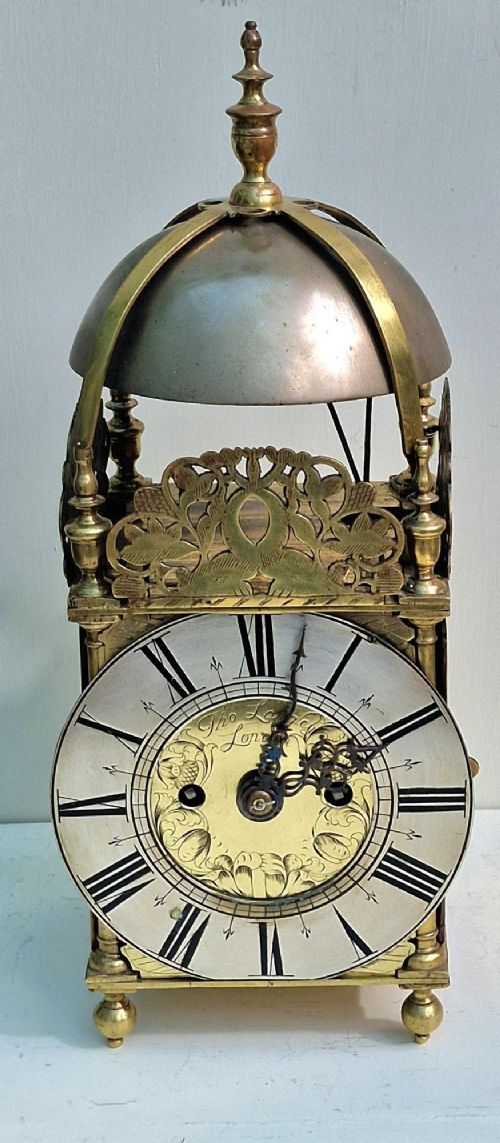


Seventeenth Century Brass Clock
A seventeenth century brass clock brings mechanical ingenuity and enduring metalwork into a room, offering both precision timekeeping and historic character.
Seventeenth Century Brass Clock
A seventeenth century brass clock encompasses lantern clocks, table clocks, bracket clocks, and longcase clocks. These horological pieces emerge primarily from the seventeenth century and English Baroque, William and Mary, or Jacobean styles.
Lantern clocks and longcase clocks dominate the selection, often constructed in oak, walnut, or ebony veneer with brass dials. Pieces range from early chamber clocks to later bracket and longcase formats with eight-day movements.
What varies in quality
The sophistication of the movement and the integrity of the dial distinguish different tiers of work. Elaborate quarter-repeating mechanisms, finely engraved brass dials, and basket tops require advanced horological skill.
Cabinetry execution similarly separates standard production from exceptional examples, seen in the selection of burr walnut, marquetry patterns, and ebony veneers. The harmony between the original movement and the fitted case dictates the overall standard.
Listings feature brass, steel, iron, walnut, glass, oak, lead, and ebony veneer across lantern, longcase, table, and bracket clock formats.
Thomas Langley·John Spershott·Joseph Windmills·Samuel Tinham·Peter Closon·Edward East·Joseph Knibb·William Clement·William Noke·Henry Massy·Richard Baker
The Seventeenth Century Brass Clock Glossary
- Lantern clock
- An early domestic timepiece, typically made of brass with a weight-driven movement and a bell on top. These wall-hung clocks represent some of the earliest portable domestic timepieces in England.
- Longcase clock
- A tall pendulum clock housed in a wooden case, commonly referred to as a grandfather clock. These floor-standing pieces protect the weights and pendulum while displaying the dial at eye level.
- Bracket clock
- A portable table or shelf clock, often featuring a repeating mechanism or a handle for carrying. The term originates from the wall brackets upon which such clocks were historically placed.
- Marquetry
- The art and craft of applying pieces of veneer to a structure to form decorative patterns. Craftsmen utilised various woods to create intricate floral or geometric designs on clock cases.
- Ebony veneer
- A thin decorative layer of dark, dense ebony wood applied to a secondary timber core. This material finish provided a striking, polished black surface favoured on high-end table clocks.
Seventeenth Century Brass Clock: Frequently Asked Questions
What is a seventeenth century brass clock?
A seventeenth century brass clock is a weight- or spring-driven timepiece featuring prominent brass dials and movements, created during the 1600s or in later revival styles. These objects include wall-hung lantern clocks and tall floor-standing longcase models.
They serve as both functional timekeepers and historical decorative art objects, showcasing the mechanical and artistic developments of early modern horology.
How were these clocks used?
Owners placed these timepieces in domestic chambers, halls, and public spaces to regulate daily routines and mark the hours. Weight-driven lantern clocks hung securely on walls, while longcase clocks stood freely on floors.
Many required regular manual winding using keys or by pulling hanging weights, depending on whether the mechanism used a spring or a falling weight system.
How do I live with a brass clock?
Living with these pieces involves placing them away from direct sunlight, dampness, and sudden temperature shifts to protect the wood, veneer, and metal. Securing longcase models to a wall prevents accidental tipping.
Regular professional maintenance ensures the mechanical gears, steel components, and brass plates continue to function without excessive wear over time.
How do I tell periods apart?
Distinguishing periods relies on examining case construction, dial decoration, and movement technology. Early seventeenth-century pieces often feature simpler iron and brass lantern formats, whereas later decades introduce walnut longcases and marquetry.
Stylistic cues such as William and Mary or English Baroque details help date the evolution from basic chamber clocks to sophisticated bracket and longcase designs.