

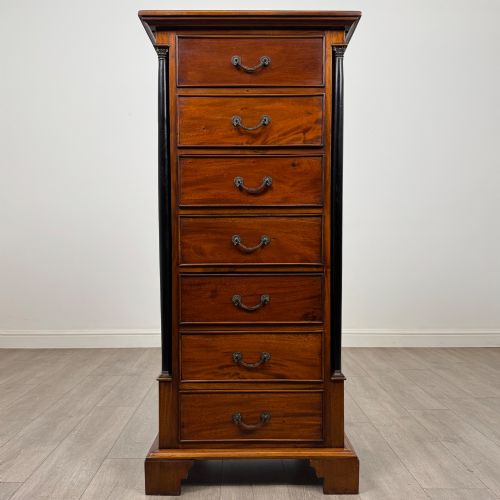
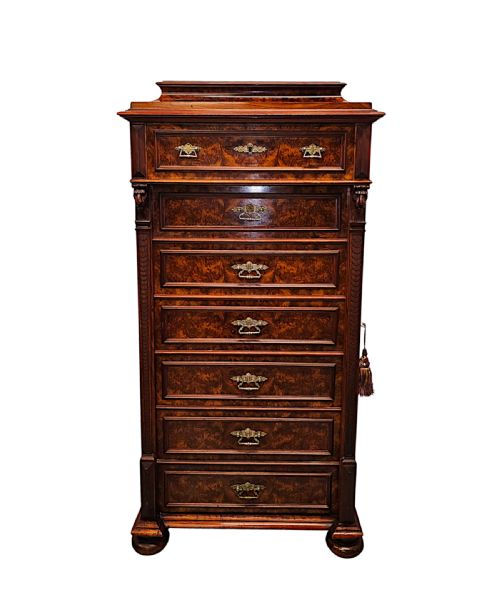
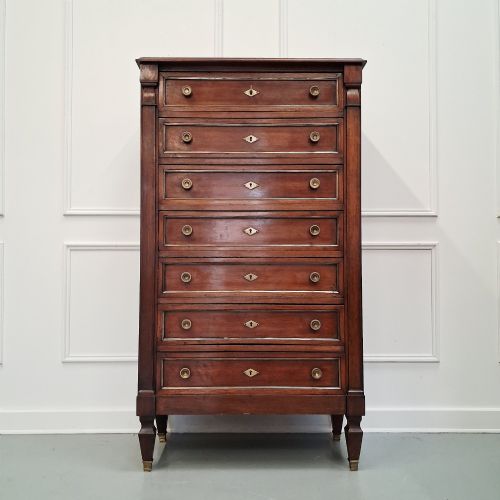
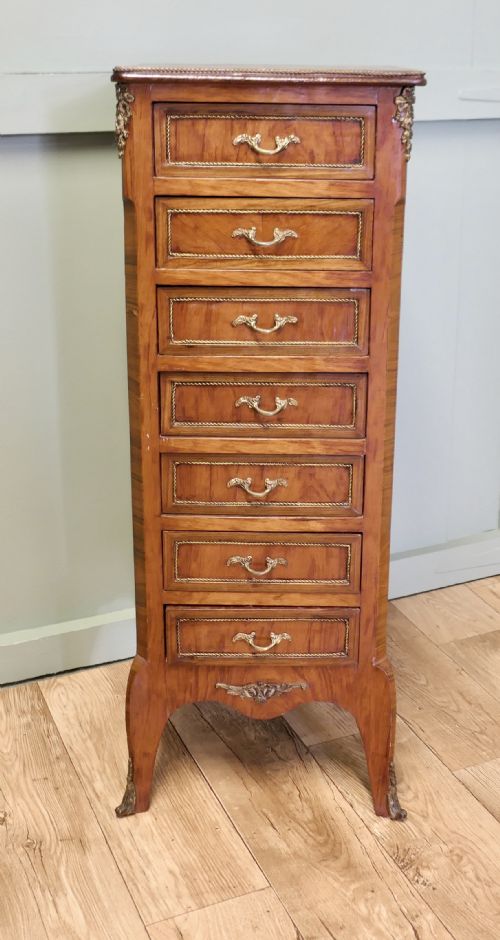


Seven Drawer Semainier
A seven drawer semainier provides the vertical storage every room requires, balancing slim proportions with seven deep tiers.
Seven Drawer Semainier
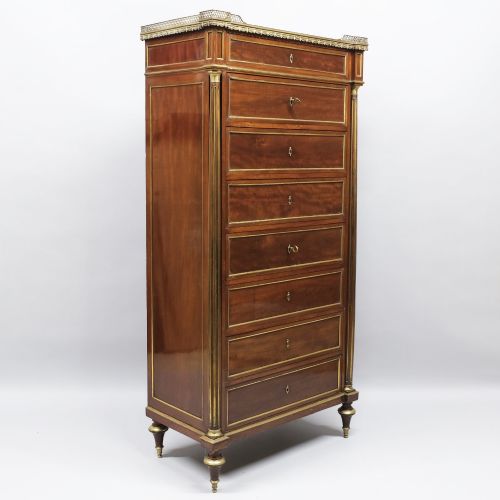
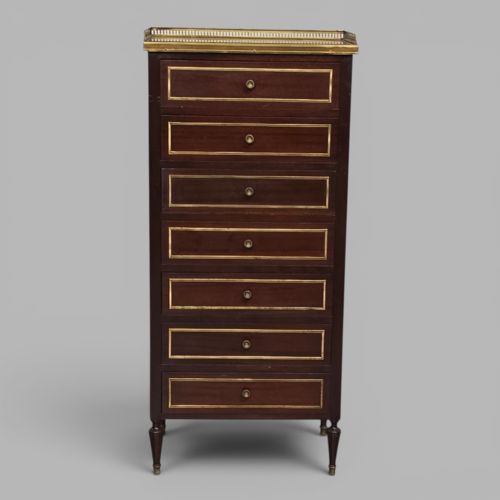
A seven drawer semainier is a tall, narrow chest traditionally designed with one drawer for each day of the week, appearing in French and British variants across the nineteenth and twentieth centuries.
The version most commonly met on this page is the French walnut or mahogany semainier, often featuring a marble top and gilt brass or ormolu mounts.
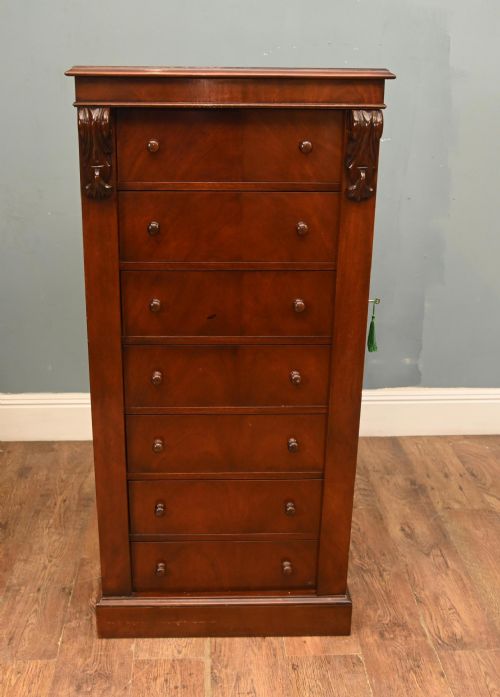
Makers also produced related tall formats including mahogany Wellington chests and pillar chests from the Victorian and Edwardian periods.
Materials and technique
Cabinet makers utilised dense hardwoods like mahogany and walnut, frequently applying burr walnut, rosewood, kingwood, or tulipwood veneers over oak or pine carcass frames.
Surface decoration relies on finely matched grain patterns, marquetry, and parquetry, complemented by cast brass handles, escutcheons, and ormolu mounts.
Many examples incorporate fitted marble slabs inset into the top surface, adding weight and a cool, durable finish.
Several pieces include secret locking mechanisms designed to keep weekly secrets securely shut.
Assessing quality
Quality rests upon the selection of timber veneers and the precision with which grain patterns are matched across seven separate drawer fronts.
The refinement of the brass hardware and the weight of the marble top separate standard production pieces from finer cabinet work.
Maple & Co.
The Seven Drawer Semainier Glossary
- Semainier
- A tall, narrow chest of seven drawers originating in France, traditionally intended to hold a week of undergarments or linens. The name derives from the French word for week.
- Wellington chest
- A sturdy British tall chest featuring a hinged locking side stile that secures all drawers simultaneously. The design is traditionally attributed to the Duke of Wellington.
- Ormolu
- Gilt bronze mounts applied to furniture edges and handles, providing metallic contrast against dark wood veneers. The technique was particularly popular in French Empire and Louis XV styles.
- Parquetry
- Geometric wood inlay work arranged in patterns such as cubes or chequers. Craftsmen utilised contrasting timbers to create decorative surface designs.
- Marquetry
- Detailed pictorial or decorative veneer work assembled from various coloured woods. Artisans cut delicate patterns to adorn drawer fronts and tops.
Seven Drawer Semainier: Frequently Asked Questions
What is a semainier used for?
A semainier serves as a tall storage unit where the seven distinct drawers traditionally held daily items or linens. Its narrow footprint makes it suitable for tight corners.
Today, owners utilise the stacked drawers for organising clothing, papers, or accessories without occupying excessive floor space.
Where does the name semainier come from?
The term originates from the French sempiternal root linked to semaine, meaning week. Each drawer corresponds to one day.
This functional layout allowed domestic staff or owners to plan weekly wardrobes systematically.
How do I clean a marble top?
Marble surfaces require gentle wiping with a damp cloth and mild soap to protect the polished stone from acidic staining. Avoid harsh chemical cleaners.
Dry the surface thoroughly afterwards to maintain the natural lustre of the stone.