


Set of Four Prints
A set of four prints brings balanced symmetry to a wall, offering matched narratives in sporting scenes, natural history or classical allegories.
Understanding a set of four prints
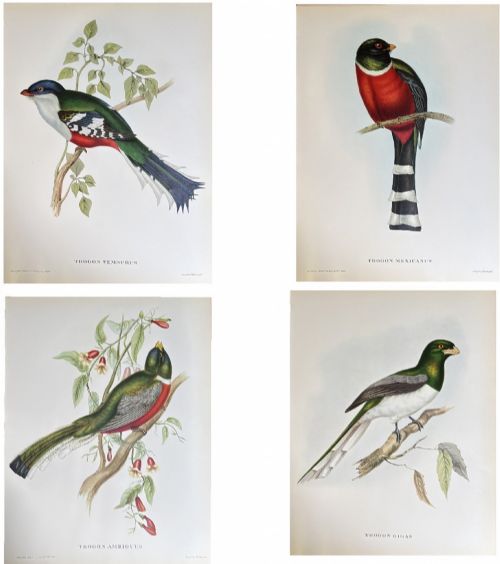
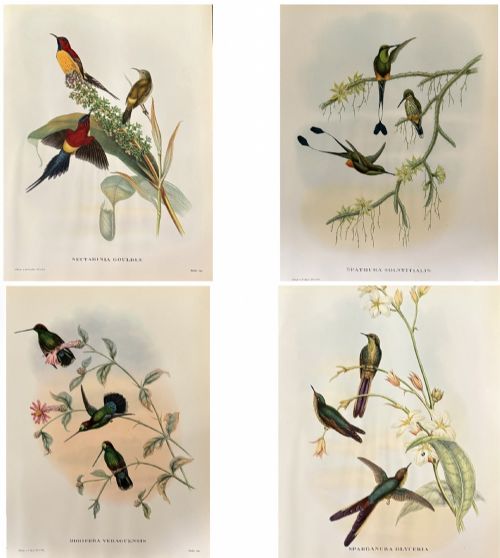
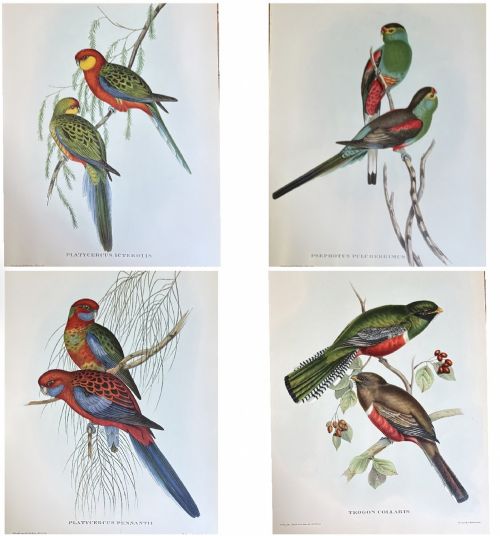
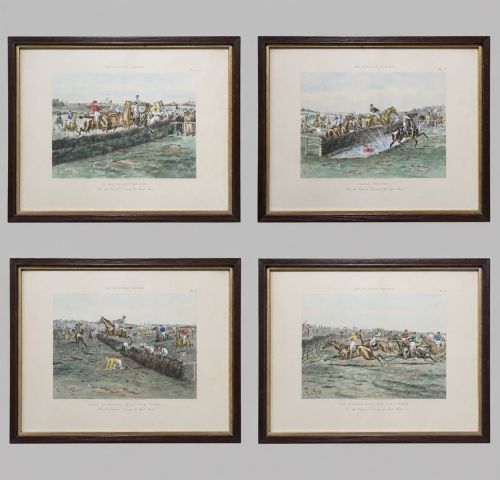
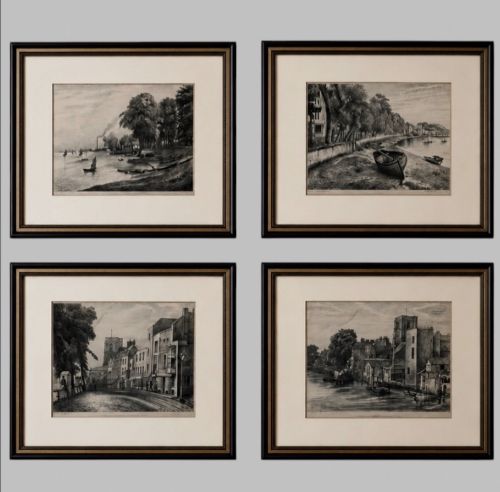
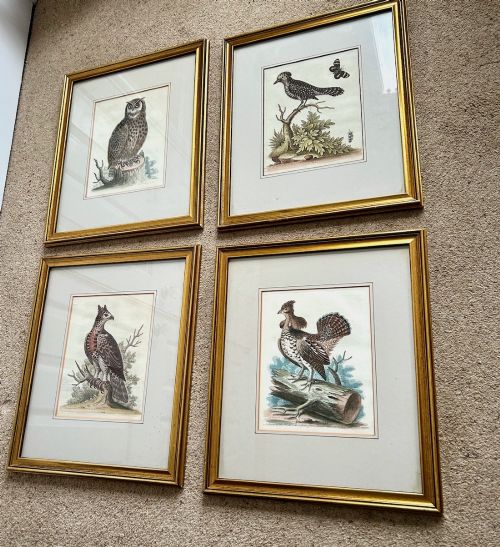
A set of four prints organises wall space through serial imagery, most frequently encountered in sporting scenes, botanical studies and allegorical themes such as the seasons. These suites maintain a uniform scale and framing style, designed to be hung together as a cohesive group rather than dispersed across a room. The tradition spans multiple centuries, with English and Japanese works appearing frequently alongside continental European examples.
The subjects range from Georgian engravings of architectural scenes and Shakespearean plays to Victorian horse racing, hunting and golf. Natural history subjects appear through butterflies, tropical birds and Japanese botanical woodblock prints. French fashion plates and Spanish bullfighting etchings also form part of the recorded record.
Dating ranges from the eighteenth century through the nineteenth century and into the early twentieth century. Georgian and Regency examples often depict hunting or classical seasons, while Victorian items lean towards sporting coaching scenes and natural history. Format varies from oval butterfly arrangements to large architectural views and theatrical subjects.
Materials and technique
Paper serves as the primary ground for these works, carrying ink applied through various intaglio and relief methods such as engraving, etching, aquatint, mezzotint and woodblock. Many Victorian examples incorporate hand colouring, adding watercolour or tinted washes over lithographic or aquatint lines. Japanese woodblock examples rely on water-based pigments pressed onto specialist papers.
Framing materials reflect the period of production, utilising wood, gilt wood, gold leaf, rosewood, burr yew and Hogarth frames, often protected by glass. Printers and publishers such as William Day worked alongside artists to produce these multi-plate suites. The combination of paper, ink and period framing dictates the physical integrity of each surviving set.
Retail Price Guide 2026
Typical UK retail prices for set of four prints, calculated from the Sellingantiques database of over a million retail prices indexed since 2003. This retail price guide relies exclusively on Sellingantiques data; no external sources or auction records are used, so the figures do not describe the wider market.
Materials recorded across these print listings include paper, glass, wood, gilt wood, ink and gold leaf.
Distinctions in quality
Quality rests upon the crispness of the impression and the fidelity of the plate ink. Early pulls from a metal plate or woodblock yield sharp, deep lines and clear details, whereas later impressions lose definition as the matrix wears down. The skill of the contemporary hand colouring further separates ordinary impressions from superior examples.
The survival of original framing elements, such as Hogarth frames or burr yew borders, contributes significantly to the integrity of the piece. Matching paper tones across all four sheets and the absence of heavy acid burn or foxing distinguish the finest survivors of these series.
George Edwards·J.C Burgess·William Day·Joaquim Terruella Matilla·George Finch Mason
The Set of Four Prints Glossary
- Aquatint
- An intaglio printmaking technique that produces tonal areas resembling watercolour washes. It was frequently utilised for sporting and architectural subjects.
- Mezzotint
- A method of engraving on copper that allows smooth gradations of light and shade. This technique suits dark, atmospheric portrait and narrative series.
- Lithography
- A planographic printing process based on the repulsion of oil and water. It enabled the production of multi-coloured Victorian botanical and topographical plates.
- Woodblock
- A relief printing method where ink is applied to the raised areas of a carved block. Traditional Japanese botanical prints rely entirely on this medium.
- Hogarth frame
- A distinctive narrow wooden picture frame with a profile moulding, popular in the eighteenth and nineteenth centuries for enclosing prints.
Frequently Asked Questions
Why were prints published in sets of four?
Publishers created matching suites of four to satisfy domestic interior decoration trends, particularly for symmetrical wall hanging.
Themes such as the four seasons, the four elements or sequential sporting events naturally lent themselves to this balanced format.
How do I identify the period of a print set?
Dating relies on the paper stock, printing technique, typography and framing style associated with each era. Georgian items often display laid paper and hand-tinted copperplate engravings.
Victorian examples frequently use lithography with brighter hand colouring, while twentieth-century sets show modern paper structures.
Are these prints hand-coloured?
Many nineteenth-century sporting and botanical prints feature hand-applied watercolour over an inked printed base. This work was often carried out by workshops employing skilled colourists.
Close inspection reveals brushwork nuances that distinguish applied pigment from printed colour.
How should framed print sets be hung?
Framed sets require placement away from direct sunlight to prevent paper fading and the deterioration of watercolours or ink. Maintaining stable indoor humidity protects both the paper sheets and the wooden frames.
Spacing the four pieces evenly preserves the balanced aesthetic intended by the original publisher.