
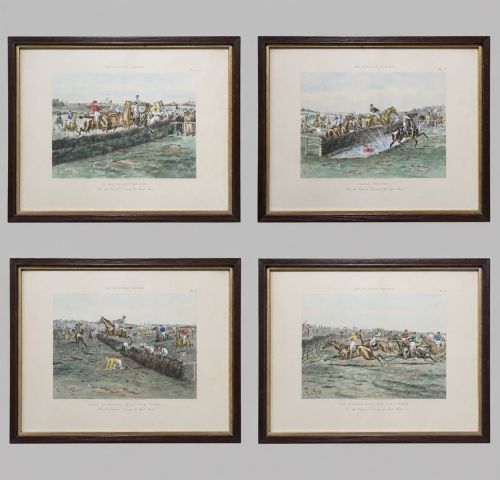
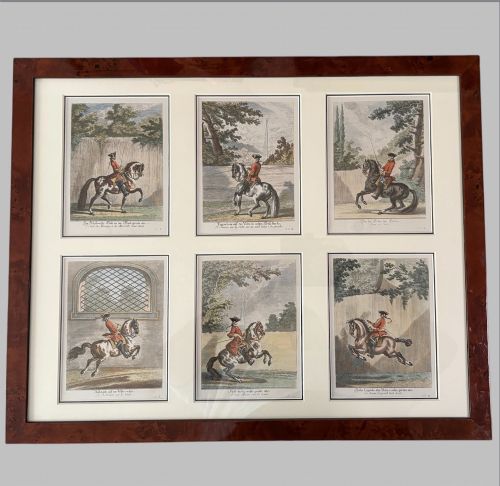
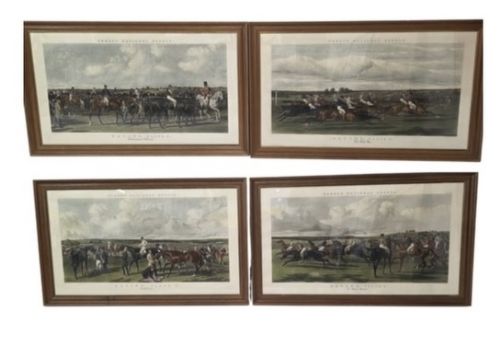
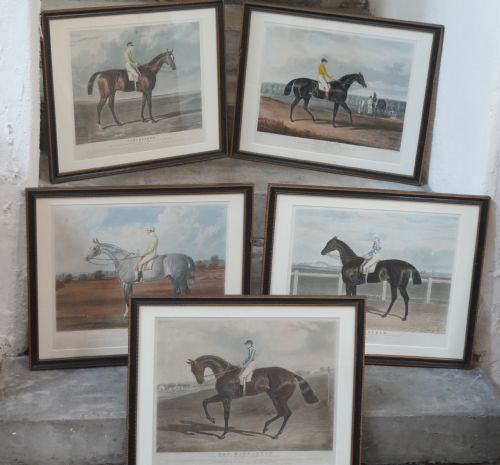


Set of Equestrian Prints
A set of equestrian prints captures the speed and tradition of the turf, offering spirited historic imagery for country houses and libraries.
Set of Equestrian Prints
A set of equestrian prints brings together matched groups of framed horse racing, hunting, and sporting scenes spanning from the Georgian era to the mid-twentieth century. Buyers searching for a set of equestrian prints encounter framed works grouped in fours or fives, frequently featuring notable subjects such as racing courses, hunting packs, and famous racehorses. These collections range from hand-coloured copper engravings and early aquatints to mid-century photographic prints and watercolour sketches. The groupings preserve narrative sequences on the wall, showing the progression of a hunt or the action of a steeplechase across uniform frames.
The material presentation often includes traditional wooden framing under glass, sometimes complemented by burr wood veneer or gold leaf accents. Works attributed to named artists and historic publishers appear alongside anonymous Victorian and Georgian impressions. Sets vary from traditional hunting sequences depicting famous packs like the Quorn and Belvoir to dynamic studies of jockeys and racing moments. Each assembly offers a coherent glimpse into historic equine culture through varied printmaking techniques.
Technique and materials
Early examples rely on copper plate engraving and aquatint processes, where intricate lines and tonal areas are bitten with acid and frequently enhanced by hand colouring. Lithography and photographic reproduction emerge in later nineteenth and twentieth century pieces, capturing finer tonal gradations for larger editions. Paper serves as the primary ground across all periods, housed behind protective glass to preserve the delicate ink and watercolour mediums.
Framing materials reflect the aesthetic preferences of their respective decades, utilising solid oak, burr wood veneer, and gilt moulding to complement the artwork. Matting and glazing protect the fragile paper supports from environmental damage while maintaining the decorative integrity of the grouped pieces.
Represented periods span from the Georgian era through Victorian production into mid-century twentieth-century photographic and painted works.
Factors of quality
Quality rests upon the crispness of the impression from the plate and the subtlety of any hand colouring applied to the paper surface. Early pulls from copper plates retain sharper detail and deeper contrasts than later impressions where the plate has worn. The presence of recognised artists, engravers, or publishers elevates the standing of a group, distinguishing workshop output from mass production.
The condition of the paper and the integrity of the original framing elements also dictate overall value. Strong, even plate marks and well-preserved margins indicate careful historical handling, whereas heavy fading or damp staining detracts from the visual impact of the series.
George Finch Mason·Ridinger·Alken·Charles Johnson Payne Snaffles·Victor Adam·Charles Hunt·Francis Calcroft Turner·J F Herring
The Set of Equestrian Prints Glossary
- Aquatint
- A printmaking technique that produces tonal areas resembling watercolour washes by using acid-resistant resin on a copper plate. It allows artists to achieve subtle gradients of light and shadow in sporting scenes.
- Engraving
- A method of cutting design lines directly into a metal plate with a sharp tool called a burin. This process creates exceptionally sharp and durable lines visible in many eighteenth-century sporting works.
- Lithography
- A planographic printing process based on the mutual repulsion of oil and water, widely used for nineteenth-century illustrations. It enabled the faithful reproduction of fluid artistic strokes and multi-coloured compositions.
- Plate mark
- The indentation left on paper by the edge of a printing plate under high press pressure. Its presence confirms an authentic intaglio print rather than a modern photographic reproduction.
Set of Equestrian Prints: Frequently Asked Questions
How should I hang a set of horse prints?
Keep the frames at eye level and maintain equal spacing between each piece to preserve the visual rhythm of the sequence. Matching frames help unify prints that originate from different walls or rooms.
Ensure the grouping is protected from direct sunlight to prevent the paper and any hand-applied watercolours from fading over time.
What is the difference between an engraving and an aquatint?
An engraving uses direct incision into a metal plate to produce fine, sharp lines. An aquatint uses acid biting through resin to create broad, tonal areas resembling wash drawings.
Sporting prints often combine both techniques to render distinct outlines alongside soft atmospheric backgrounds.
How do I care for framed paper prints?
Display the works away from damp environments and fluctuating temperatures to protect the historic paper supports. Glass glazing shields the surface from dust and accidental contact.
Use stable wall fixings suited to the weight of solid wood frames and heavy glass.
Are these prints original period items?
The listings include original copper engravings, lithographs, and photographic plates dating from the eighteenth to the mid-twentieth century. Each piece reflects the printing technology and aesthetic standards of its specific period.
Examine the paper substrate, plate marks, and framing construction to understand the age and manufacture of each item.