
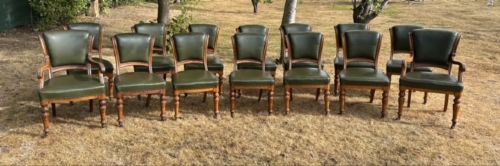


Set of 14 Dining Chairs
A set of 14 dining chairs provides the necessary seating for a large dining table, spanning periods from the Victorian era to the twentieth century.
Set of 14 Dining Chairs
A set of 14 dining chairs typically comprises a combination of single chairs and carvers with arms, designed to accommodate large gatherings around an extending or fixed dining table. These large groupings are difficult to assemble organically, making a matched or harlequin group a practical solution for period interiors.
The options span robust oak iterations from the nineteenth century to refined mahogany revival pieces influenced by Chippendale, Queen Anne, and Sheraton designs. Buyers encounter both uniform sets and configurations split into twelve singles and two carvers.
Origins range across English, Scottish, and French workshops, utilising classic timber frameworks paired with traditional upholstery, leather, or fabric seats.
Materials and construction methods
Makers relied heavily on solid mahogany and oak for the structural frames, utilising mortise and tenon joinery to ensure stability across large sets. Ebonised timber, giltwood, and pollard oak also appear, showing varied surface treatments from French polishing to lacquering.
Upholstery involves traditional stuffing techniques applied to drop-in or fixed seats covered in fabric, leather, or brass-studded materials. Carved details such as crown splats, balloon backs, and cabriole legs are hand-shaped directly into the timber frame rather than being cast or glued on.
Listings for a set of 14 dining chairs frequently feature mahogany and oak, spanning Victorian, Edwardian, and Regency periods.
Assessing quality in large dining sets
The integrity of a large set depends on uniformity across all fourteen pieces, where consistency in timber grain, carving depth, and colour separates a unified dining group from a cobbled-together assembly. Subtle variations in stretcher placement or leg turnings indicate whether chairs were produced in a single workshop run.
The crispness of hand-carved motifs, such as ribbon backs or ball and claw feet, distinguishes finely executed revival pieces from simpler commercial production. Timber selection also matters, particularly in larger oak and mahogany sets where well-figured grain enhances the visual weight around a dining table.
James Reilly·William Birch for Liberty's
The Set of 14 Dining Chairs Glossary
- Carver
- An armchair designed with elbow supports, usually intended for the head of the table.
- Splat
- The vertical central strip of wood in the back of a chair, often shaped or pierced for decoration.
- Cabriole leg
- A furniture leg that curves out at the knee and tapers inward to an ankle, derived from animal limbs.
- Harlequin set
- A collection of chairs that match in general style and period but vary slightly in minor details, often gathered over time.
Set of 14 Dining Chairs: Frequently Asked Questions
How do I seat fourteen people comfortably?
A set of 14 dining chairs usually includes a mix of twelve single chairs and two carvers with armrests. The armchairs sit at either end of a long table, while the single chairs line the sides.
Measuring the length of the dining table ensures that six chairs fit comfortably down each long side without crowding.
What is a harlequin set?
A harlequin set is a collection of chairs that share a similar period, timber, and style but were not originally carved as a single commission. These groups allow buyers to seat large numbers of guests using period seating that harmonises visually.
Careful inspection of the heights, back designs, and leg forms helps identify how closely the individual chairs match.
How do I care for antique upholstery?
Maintaining antique fabric or leather upholstery requires gentle vacuuming with a soft brush attachment to remove dust without stressing the textile. Direct sunlight should be avoided to prevent fading on silk or wool covers.
Professional cleaning preserves fragile period fabrics and maintains the structural integrity of the internal stuffing.
How do I distinguish revival styles?
Chippendale revival chairs typically feature interlaced ribbon splats and cabriole legs, while Queen Anne style examples show solid vase-shaped splats and pad feet. Comparing the backrest shape and leg termination reveals which eighteenth-century aesthetic the nineteenth-century maker was copying.
Looking underneath the seat frame often reveals timber ageing and construction clues that confirm the true age of the set.