

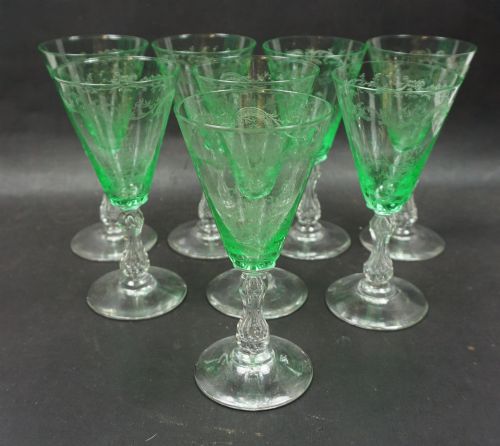
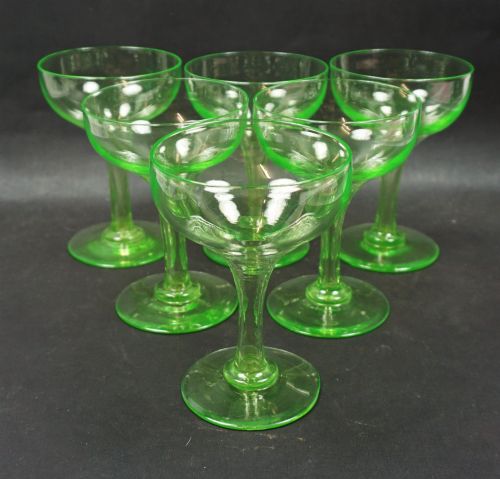
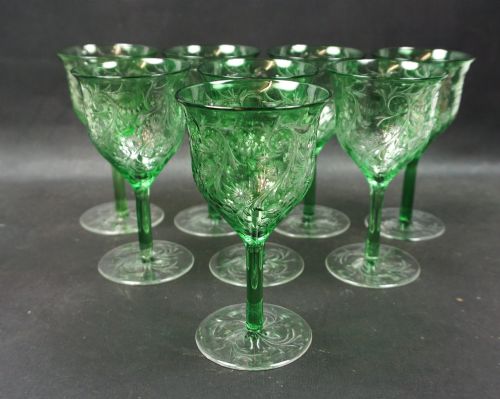
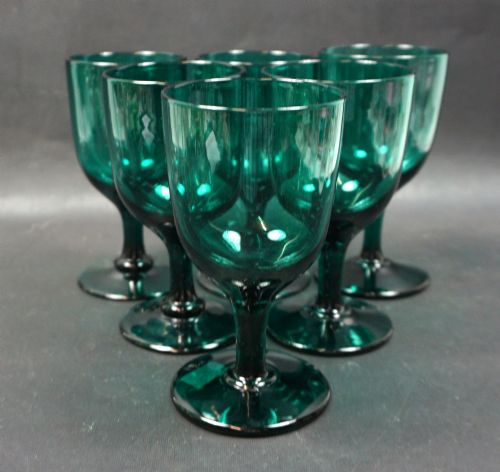


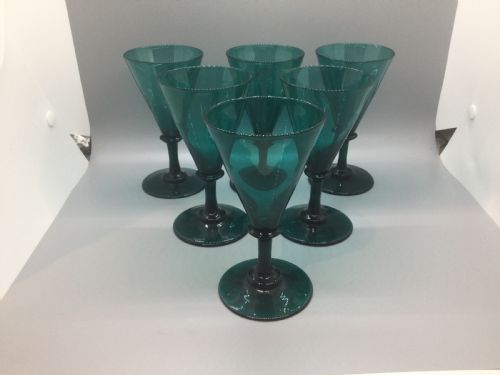


Set Green Wine Glasses
These set green wine glasses bring rich colour and historic character to the table, offering a vibrant alternative to plain crystal.
Set Green Wine Glasses
When you search for set green wine glasses, you encounter matching groups spanning the Georgian, Victorian, and Edwardian eras, produced in England, Bohemia, and Germany.
The most common form you meet on this page is the Victorian Bristol green wine glass, often shaped with a bucket bowl or knopped stem.
Sets range from modest groups of four up to larger gatherings of twelve or fourteen, reflecting how dining traditions demanded uniformity around the table.
How they were made
Makers achieved the distinct shade through coloured glass or overlay techniques, sometimes casing green glass over clear layers before cutting.
Decoration often involved wheel-cutting, gold leaf application, enamel work, or fine vine engraving executed by hand across the surface.
Set Green Wine Glasses Retail Price Guide 2026
Typical asking prices for set green wine glasses among the pieces listed under this phrase on Sellingantiques today, from the lower quarter to the upper quarter. They describe what is for sale here now, not the wider market.
The inventory spans the Georgian, Victorian, and Edwardian eras, utilising coloured glass, cut crystal, enamel, and gold leaf.
What varies in quality
Quality rests upon the depth and consistency of the green hue, the precision of the glassblower's form, and the crispness of any cut or engraved detail.
Earlier Georgian and fine Victorian examples display superior weight, hand-finished stems, and unblemished metal that elevate them above later commercial output.
John Walsh
The Set Green Wine Glasses Glossary
- Bristol green
- A strong, dark green glass traditionally associated with English production around the Bristol area during the Georgian and Victorian periods. This intense colour served to mask impurities in early metal.
- Roemer
- A traditional Germanic or Bohemian large drinking glass featuring a wide bowl atop a heavily knopped or studded stem. These pieces often appear in pale or mossy green tones.
- Hock glass
- A tall stemmed glass originally designed for German white wines, frequently rendered in coloured crystal with elaborate cut or enamelled decoration. They bring considerable height to the table.
- Overlay glass
- A technique where a layer of coloured glass is fused over a clear or contrasting body, then partially cut away to reveal the underlayer. This creates bold geometric or floral patterns.
- Knopped stem
- A stem featuring one or more rounded, decorative projections or nodes shaped by the glassblower. These additions improve grip and add visual rhythm to the profile.
Set Green Wine Glasses: Frequently Asked Questions
Are these green wine glasses safe for modern use?
These antique and vintage vessels were designed for dining, but their age calls for gentle handling.
Hand washing in warm water keeps the glass and any enamel or gold leaf secure from harm.
How do I tell Georgian green glasses from Victorian ones?
Georgian pieces generally show deeper, sootier green tones with heavier pontil marks on the underside.
Victorian examples often present brighter Bristol green shades and more diverse bowl shapes like buckets or tulips.
Why are matching sets harder to find in large numbers?
Over the centuries, individual glasses from large dining sets inevitably suffered accidental breakage during use or washing.
Finding a complete set of six, eight, or more remains a notable survival of domestic history.
What is the difference between roemers and standard wine glasses?
Roemers are distinctly continental forms with large round bowls and studded stems rooted in Germanic traditions.
Standard wine glasses follow more slender English silhouettes designed for port, sherry, or table wine.