

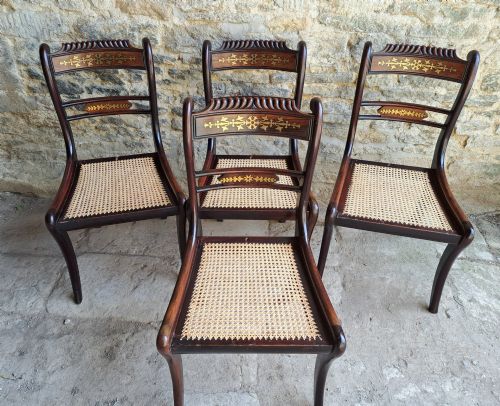
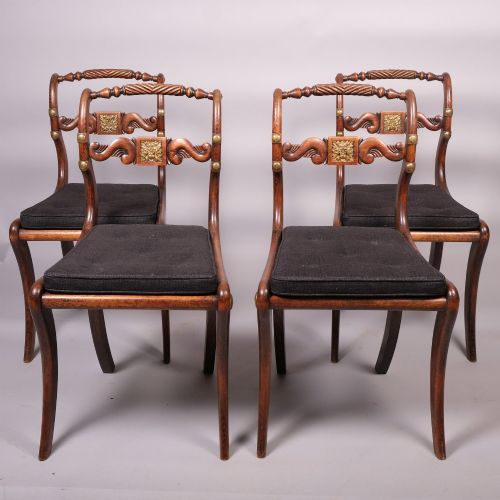
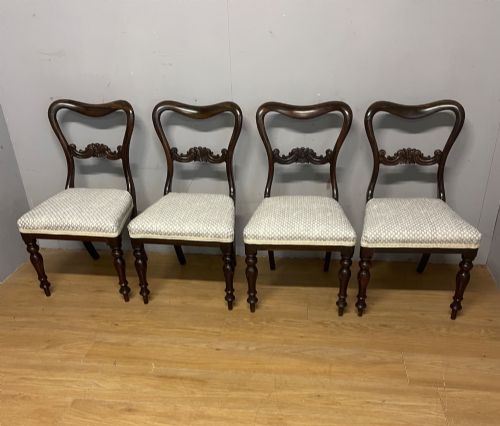
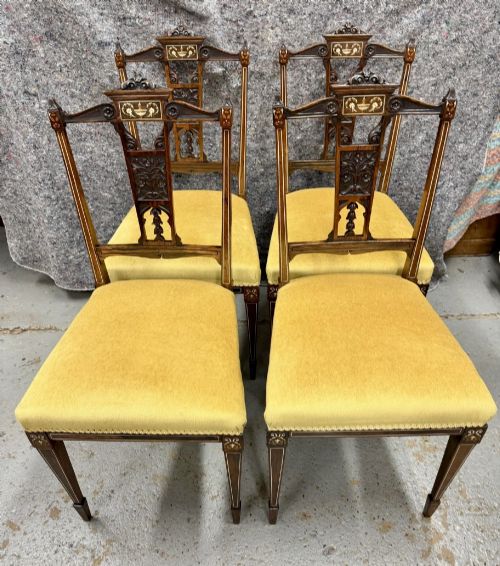


Set Four Rosewood Chairs
These set four rosewood chairs bring the rich grain and deep colour of the timber to the dining room, offering both seating and presence.
Set Four Rosewood Chairs
A set four rosewood chairs brings together four matching seats fashioned from a dense, richly figured exotic timber, most often formed as dining or salon chairs. When searching for this phrase, a buyer meets examples spanning the Georgian, Regency, William IV, and Victorian eras, alongside later Edwardian revivals.
The dominant forms on this page are dining chairs with sturdy frames, often featuring balloon backs, bar backs, or carved top rails. These suites were designed for formal dining rooms and drawing rooms, where uniformity of timber and design demonstrated taste.
Originating largely from British workshops of the nineteenth century, these sets also include Anglo-Indian and continental interpretations. They serve today as practical dining furniture that retains the architectural weight and warmth of the period.
How They Were Made
Cabinet makers utilised solid rosewood or applied fine veneers over secondary timbers like mahogany, occasionally employing simulated rosewood finishes on beech. Brass inlay, marquetry, and boxwood stringing were frequently set into the timber surfaces to provide geometric or floral contrast.
Traditional joinery methods, including mortise and tenon joints, secured the structural frames of these chairs. Seats were constructed with drop-in pads, cane work, or upholstered springs covered in fabric, leather, or velvet.
Listings feature rosewood alongside brass, velvet, cane, and boxwood across Victorian and Regency periods.
What Varies in Quality
The distinction between ordinary and superior sets lies in the depth of the timber's grain and the crispness of the hand-carved details. Higher quality examples display meticulous brass inlay and solid rosewood construction rather than simpler painted or simulated surfaces.
Proportion and structural integrity separate fine craftsmanship from standard production. Sets that retain their original matched frames, balanced proportions, and well-preserved joinery hold a stronger visual presence.
J Sinclair·Howard and Sons
The Set Four Rosewood Chairs Glossary
- Rosewood
- A heavy, dense tropical timber prized for its dark grain patterns and deep reddish-brown colour. It takes a high polish and forms the primary structural and decorative material for these chairs.
- Balloon Back
- A rounded, curved chair back shape resembling a balloon, popular during the Victorian period. This profile offers ergonomic support while displaying the figured grain of the timber.
- Marquetry
- The art of applying decorative veneer pieces in various woods and materials to form pictorial or geometric patterns. It appears frequently on the splats and top rails of Edwardian and Victorian sets.
- Simulated Rosewood
- A painted or grained finish applied to a secondary timber, such as beech, to imitate the appearance of genuine rosewood. This technique was used to achieve a uniform look at a lower cost.
Set Four Rosewood Chairs: Frequently Asked Questions
What periods do these chairs come from?
These chairs primarily date from the nineteenth century, encompassing Georgian, Regency, William IV, and Victorian periods. Later Edwardian interpretations also appear among the selections.
The styles shift from the classical lines of the Regency era to the more robust carved forms of Victorian manufacture.
How were these chairs originally used?
They served primarily as formal dining chairs or salon seating around large tables in substantial homes. Their uniform appearance provided a cohesive aesthetic for entertaining guests.
Many featured upholstered or cane seats designed for comfort during long meals and evening gatherings.
How do I care for rosewood furniture?
Rosewood benefits from a stable environment away from direct sunlight and extreme temperature fluctuations to prevent the timber from drying out. Gentle dusting with a soft cloth maintains the polished surface.
Applying occasional appropriate wax preserves the depth of the grain without building up a heavy residue.
Are these chairs suitable for daily use?
These antique chairs are structurally robust enough for regular dining when the joinery remains sound and stable. Many have endured for nearly two centuries through careful construction.
Checking the tightness of the frame ensures they safely accommodate everyday sitting.