

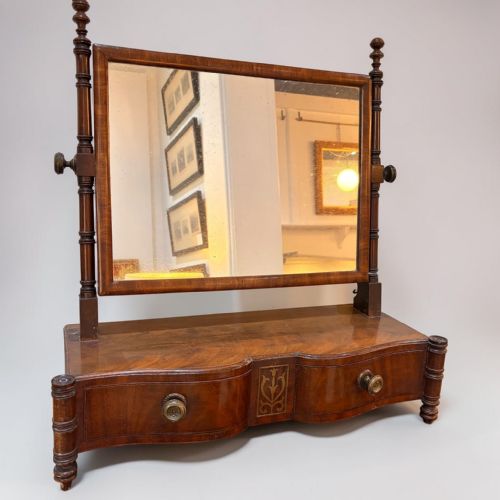
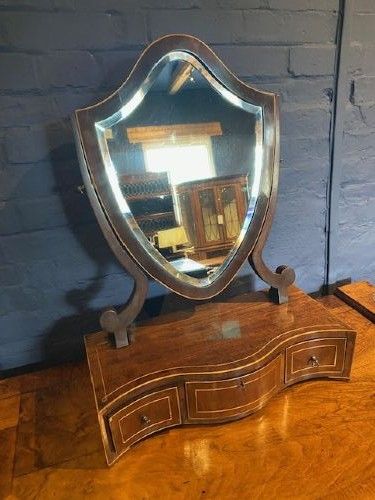
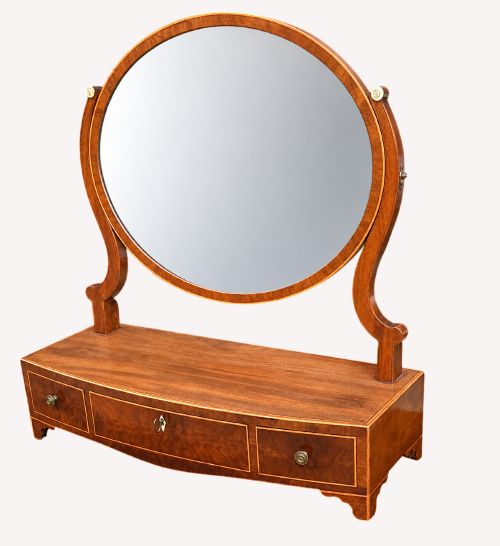
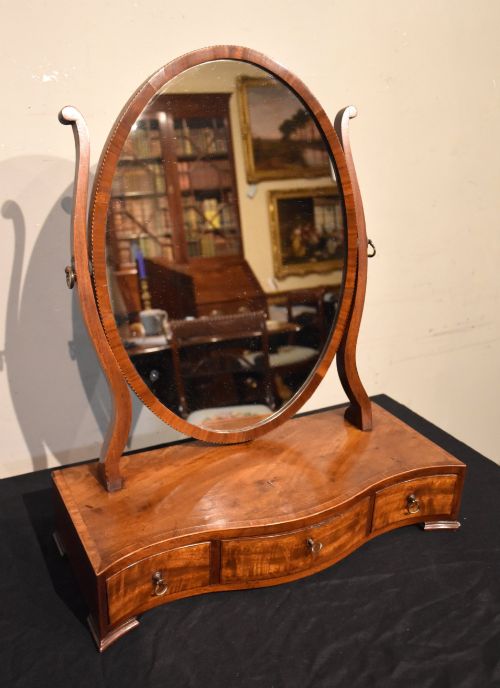
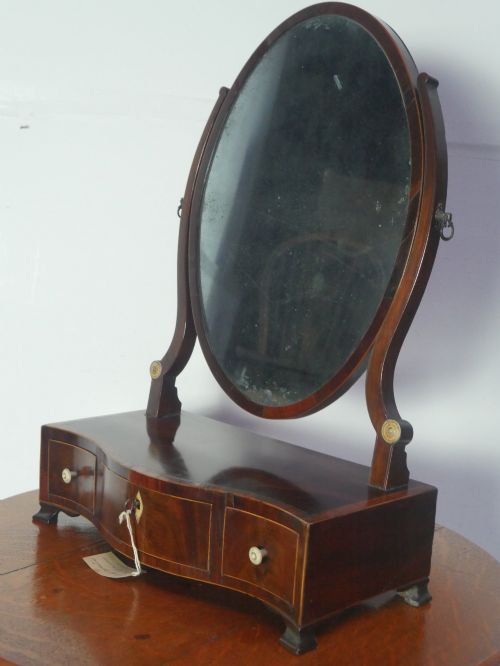


Serpentine Toilet Glass Mirror
A serpentine toilet glass mirror brings architectural curve and rich timber grain to a dressing table, sought after for its refined Georgian and Victorian lines.
Serpentine Toilet Glass Mirror
A serpentine toilet glass mirror is a tabletop dressing glass featuring a distinctive undulating front base, most commonly encountered in mahogany from the eighteenth and nineteenth centuries. These pieces combine a pivoting mirror plate with a small box base containing drawers, designed to sit upon a chest or dressing table.
The selections span Georgian, George II, George III, Sheraton, Regency, and Victorian periods, with styles ranging from plain rectangular plates to oval and shield glass shapes. The serpentine form dictates the curved contour of the drawer section below the frame.
Most examples rely on the warm tones of mahogany, occasionally enhanced by satinwood inlay, boxwood inlay, or bone escutcheons. The mirror plate swings between two upright arms mounted on the stepped or serpentine base.
Materials and construction
Cabinetmakers constructed these mirrors primarily in solid or veneered mahogany, shaping the distinctive serpentine curve of the base through careful sawing and joinery. Secondary woods and framing timbers support the drawer boxes and the upright mirror supports.
Brass fittings, including adjustment screws, side pivots, and small drawer pulls, provide the functional metalwork that allows the glass frame to tilt. Inlaid details in boxwood and satinwood add linear decoration to the mahogany surfaces on select pieces.
Serpentine Toilet Glass Mirror Retail Price Guide 2026
Typical asking prices for serpentine toilet glass mirror among the pieces listed under this phrase on Sellingantiques today, from the lower quarter to the upper quarter. They describe what is for sale here now, not the wider market.
Mahogany is the dominant timber across these listings, accompanied by decorative accents of satinwood inlay, boxwood inlay, and bone.
Factors of quality and distinction
Quality rests in the crispness of the serpentine sweep across the drawer front and the harmonious proportions between the mirror frame and the base. Sharply executed curves and balanced wood grain demonstrate superior cabinetmaking.
The choice of secondary details, such as delicate satinwood or boxwood inlay and original brasswork, elevates an example. The depth of the mahogany colour and the retention of the original mirror glass further distinguish finer pieces.
The Serpentine Toilet Glass Mirror Glossary
- Toilet glass
- A portable mirror designed for tabletop use on a dressing chest or table. It typically includes a small compartment base with miniature drawers.
- Serpentine front
- A curved furniture front characterised by a convex centre flanked by two concave sweeps, creating an undulating outline. This shape requires advanced woodworking skill.
- Shield glass
- A mirror plate cut into the shape of a heraldic shield, popular during the late eighteenth century. It softens the geometric lines of the rectangular dressing glass.
- Swing mirror
- A mirror plate mounted on horizontal pivots between two upright posts, allowing the glass angle to tilt. It forms the upper portion of a toilet mirror.
- Boxwood inlay
- Contrasting light-coloured wood inserted into recesses in a darker timber surface like mahogany to create fine lines or geometric patterns.
Serpentine Toilet Glass Mirror: Frequently Asked Questions
What is a serpentine toilet glass mirror?
A serpentine toilet glass mirror is a small tabletop dressing mirror featuring a curved, undulating drawer base. These pieces date primarily from the Georgian and Victorian eras.
Cabinetmakers built them to sit on top of larger chests of drawers, providing a functional glass for grooming alongside small storage drawers.
How were these mirrors used?
Owners placed them on dressing tables or chests of drawers to assist with shaving, hairstyling, and adjusting attire. The pivoting glass plate allowed the user to change the angle of reflection.
The small drawers in the base held cosmetics, jewellery, small grooming accessories, and personal trinkets.
How do I date a Georgian mirror?
Dating relies on timber selection, construction methods, hardware, and the profile of the mirror frame and base. Georgian pieces frequently feature solid mahogany, hand-cut dovetails, and period brass hardware.
Earlier examples often display simpler architectural lines, while late eighteenth-century versions introduce oval or shield-shaped plates and delicate satinwood inlay.
Are the mirror plates original?
Many surviving pieces retain their original mercury or silvered glass plates, though some have been replaced over the centuries due to wear or breakage. Original glass often shows slight foxing, minor speckling, or subtle imperfections characteristic of early manufacturing.
Replacement glass tends to look remarkably clear and uniform compared to period plates.
How do I care for a mahogany toilet mirror?
Keep the mirror away from direct sunlight and steady sources of heat to protect the mahogany finish and prevent the wood from drying out. Dust the timber gently with a soft, dry cloth.
Avoid liquid polishes containing harsh chemicals or silicone, which can build up on the antique wood surface over time.