

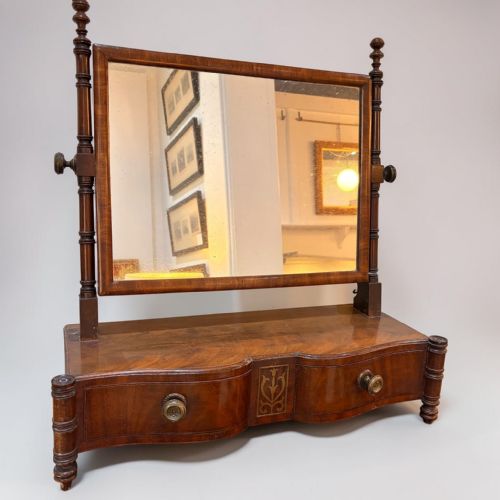
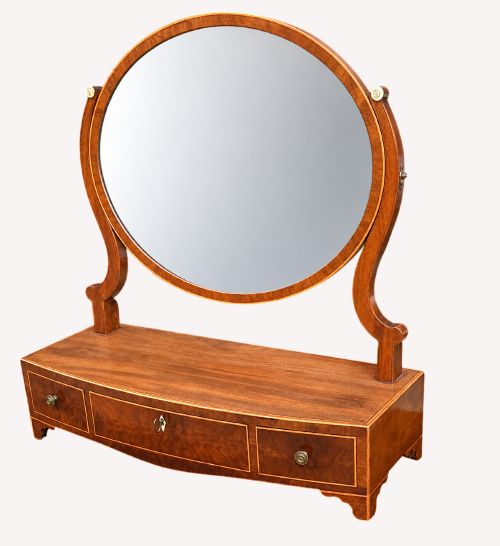
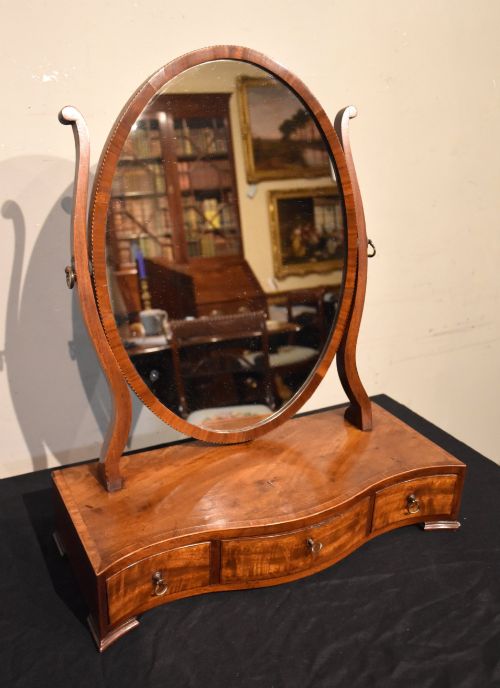
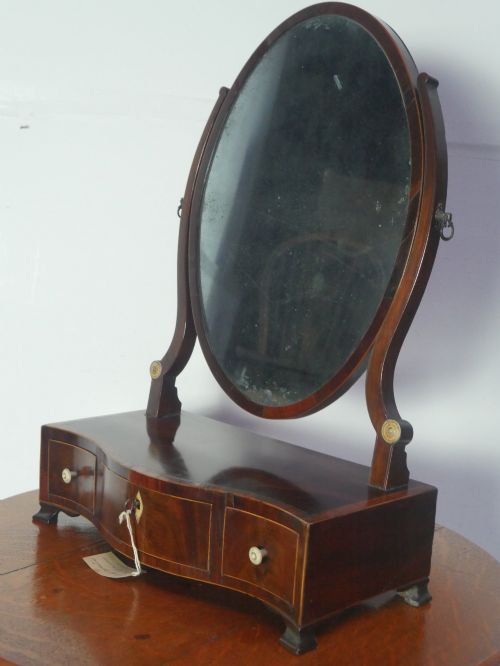


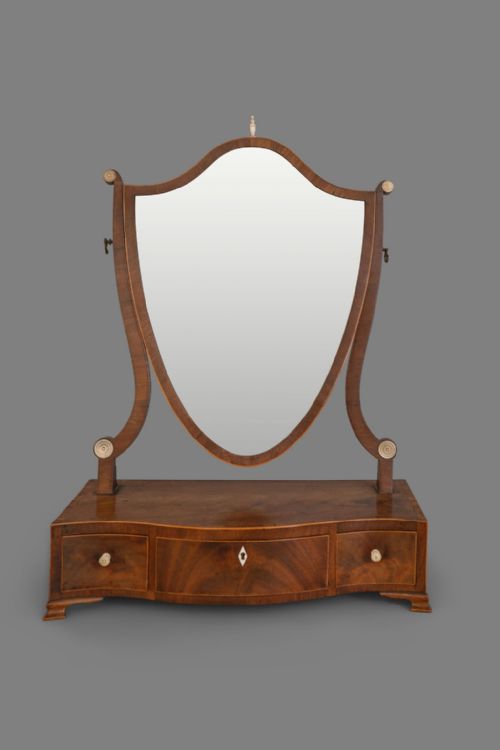

Serpentine Drawer Toilet Glass
These serpentine drawer toilet glass pieces offer timeless dressing table elegance with their curved fronts and pivoting mirrors.
Serpentine Drawer Toilet Glass
A serpentine drawer toilet glass provides a tabletop dressing mirror mounted on a small base fitted with curved drawers. Buyers searching this phrase want a functional antique that sits upon a chest of drawers or dressing table to reflect light and aid grooming.
You are most likely to meet Georgian and Victorian examples constructed in rich mahogany. These pieces range from simple utilitarian mirrors to elaborate Sheraton styles featuring boxwood inlay and oval glass frames.
The form typically combines a rectangular or oval swing glass supported by upright arms, above a serpentine-fronted base containing small compartments. This design balances practical reflection with delicate storage for small trinkets.
How they were made
Cabinet makers constructed these mirrors primarily using solid and veneered mahogany, often embellished with boxwood inlay to define the curved contours. Brass pivot screws and delicate handle fittings allow the mirror plate to tilt smoothly within its upright frame.
The complex curved fronts require precise woodworking techniques to shape the solid timber or bent veneers of the drawer section. Secondary woods like pine or oak frequently form the internal linings of the small drawers.
Serpentine Drawer Toilet Glass Retail Price Guide 2026
Typical asking prices for serpentine drawer toilet glass among the pieces listed under this phrase on Sellingantiques today, from the lower quarter to the upper quarter. They describe what is for sale here now, not the wider market.
Listings span the Georgian and Victorian eras, dominated by mahogany construction, boxwood inlay, and brass fittings.
What varies in quality
Quality rests heavily on the crispness of the serpentine curve and the subtlety of any inlay work. Finer examples display carefully chosen mahogany grain that flows naturally across the curved drawer fronts.
Proportion and stability separate standard pieces from the finest workshop productions. The weight and clarity of the original glass, alongside the delicacy of the support arms, indicate the maker's skill.
The Serpentine Drawer Toilet Glass Glossary
- Toilet glass
- A portable mirror designed to stand on a dressing table or chest. It typically includes small drawers in the base for storage.
- Serpentine front
- A furniture front characterised by a double-concave curve flanked by convex ends, creating a gentle wave shape. This profile demands advanced woodworking skill.
- Swing mirror
- A mirror plate suspended on pivots between two vertical uprights, allowing the glass to tilt. This mechanism lets the user adjust the angle of reflection.
- Boxwood inlay
- Contrasting light wood inserted into recesses within a darker timber surface to create decorative borders. It frequently outlines the drawer edges on Sheraton pieces.
Serpentine Drawer Toilet Glass: Frequently Asked Questions
Where should I place a toilet glass?
These mirrors sit comfortably on top of a large chest of drawers, a dedicated dressing table, or a sideboard. Ensure the supporting surface is deep enough to hold the curved base securely.
Because they are relatively portable, you can move them between rooms to catch the best natural light for daily grooming or display.
How do I date these mirrors?
Dating relies on stylistic clues, construction methods, and the type of wood employed. Georgian and 18th-century examples often feature hand-cut dovetails in the small drawers and simpler mahogany frames.
Later Victorian pieces from around 1860 tend to show heavier proportions and different secondary timbers inside the base. Examining the mirror plate edge and backboards provides further chronological context.
What is the difference between oval and rectangular mirrors?
Rectangular mirror plates tend to appear on earlier or more robust utilitarian pieces, while oval plates often signal the refined influence of the Sheraton style. The shape of the glass alters the overall visual weight of the object.
Both formats were popular across the Georgian period, with oval versions frequently paired with delicate boxwood stringing on the base.
Are the mirrors original?
Mirror glass frequently experienced replacement over the centuries due to foxing, cracking, or breakage. Many surviving frames retain their original mercury glass, which shows characteristic soft speckling.
A replacement mirror plate is common and does not diminish the decorative utility of the wooden base, provided the frame remains untouched.