


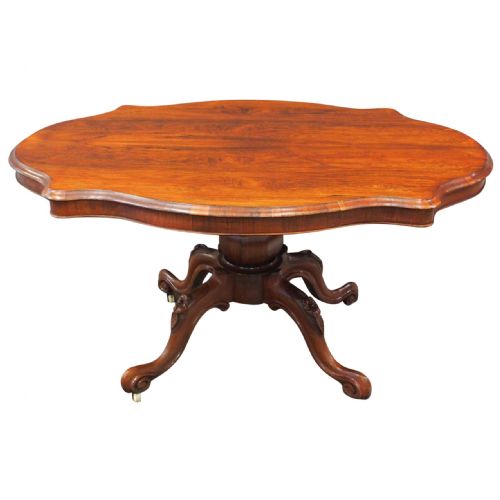


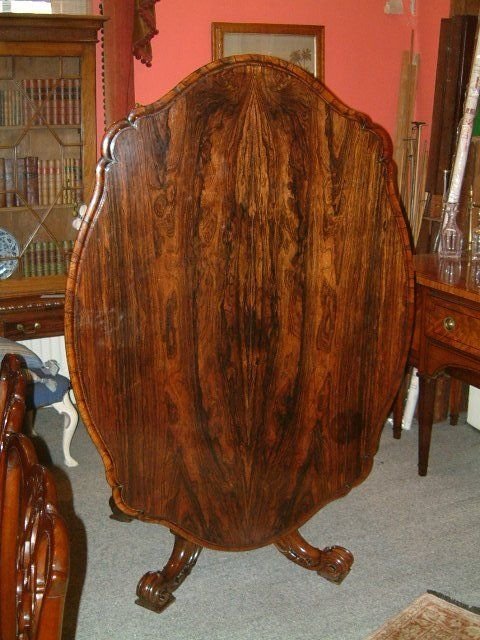


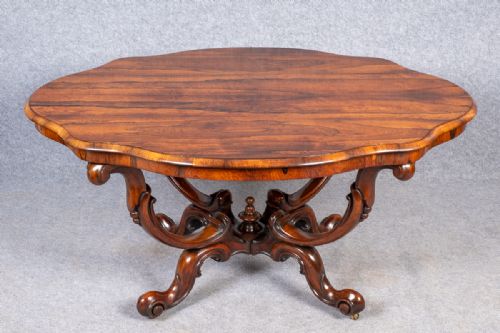
Serpentine Rosewood Centre Table
A serpentine rosewood centre table is a freestanding Victorian showpiece defined by sweeping curves and rich timber, built to anchor a formal drawing room.
Serpentine Rosewood Centre Table
When you search for a serpentine rosewood centre table, you enter the realm of mid-nineteenth-century British cabinet-making where drawing rooms demanded central display pieces. These tables stand free of walls, finished on all sides so they can occupy the middle of a room, often serving multiple domestic duties.
The versions you meet most frequently on this page belong to the Victorian period, spanning decades from eighteen-fifty to eighteen-eighty. Their tops trace undulating serpentine outlines, supported by elaborate pedestals, basket bases, or stretcher frames rather than simple four-leg designs.
Makers drew on several stylistic vocabularies, producing pieces shaped by Victorian Rococo Revival, Louis XV Revival, and Anglo-Indian influences. Alongside standard centre tables, the selection includes related dining tables, breakfast tables, loo tables, and occasional tables sharing the same dark timber.
The core material uniting these forms is rosewood, frequently applied as a veneer over subsidiary timbers, occasionally accented with satinwood, ebony, mahogany, fruitwood, and calamander. Brass fittings and ceramic castors frequently complete the lower assemblies of these nineteenth-century specimens.
How they were made
Cabinet-makers constructed these tables by laying fine rosewood veneers over sturdier carcase woods, taking advantage of the timber's dense grain and deep colour. This technique allowed workshops to curve and shape the intricate serpentine borders without splitting the primary decorative surface.
Carved details and moulded edges required skilled hand chiselling, particularly on the solid rosewood components used for pedestal shafts, stretcher frames, and base brackets. Marquetry inlay appears on select examples, inserting lighter contrasting woods like satinwood into the dark rosewood ground.
Pedestal tables relied on heavy central columns secured to platform bases, frequently fitted with concealed or exposed ceramic castors for manoeuvrability. Tilt-top mechanisms on breakfast and loo tables utilised robust wooden or iron catches allowing the heavy top to pivot vertically when not in use.
Serpentine Rosewood Centre Table Retail Price Guide 2026
Typical asking prices for serpentine rosewood centre table among the pieces listed under this phrase on Sellingantiques today, from the lower quarter to the upper quarter. They describe what is for sale here now, not the wider market.
Listings span the Victorian era from eighteen-fifty to eighteen-eighty, showcasing rosewood, satinwood, and calamander across pedestal, stretcher, and basket base forms.
What varies in quality
Quality rests heavily on the crispness of the carved ornamentation and the architectural ambition of the base, distinguishing simple utility pieces from grand drawing-room showpieces. The handling of the serpentine curve across the top reveals the maker's confidence in shaping undulating timber.
The choice of secondary woods and the selection of rosewood veneers establish another tier of distinction, with rich figuring and harmonious grain matching commanding higher regard. Finer examples integrate marquetry inlay or contrasting timbers like calamander and satinwood with precise geometric accuracy.
Structural integrity of the central pillar, stretcher, or basket base dictates durability, as heavy rosewood tops exert constant pressure on lower joints. Tables retaining original brass hardware and working tilt mechanisms demonstrate superior preservation.
The Serpentine Rosewood Centre Table Glossary
- Serpentine
- A furniture edge or front composed of a convex centre flanked by two concave curves. This undulating outline creates a fluid, organic silhouette typical of mid-nineteenth-century revival styles.
- Rosewood
- A dense, dark timber prized for its dramatic dark grain and rich reddish-brown colour. It serves as the primary surface material across these nineteenth-century tables.
- Centre table
- A freestanding table designed to be viewed from all sides rather than pushed against a wall. Such pieces occupied the middle of Victorian drawing rooms.
- Loo table
- A large round or oval table designed for the nineteenth-century card game loo. These tables typically feature a tilt-top mechanism allowing them to stand flat against a wall when idle.
- Marquetry
- The art of applying pieces of veneer to a structure to form decorative patterns and pictures. Craftsmen used contrasting woods like satinwood to create elaborate floral or geometric motifs.
Serpentine Rosewood Centre Table: Frequently Asked Questions
Where did these tables stand?
These tables occupied the middle of Victorian drawing rooms and reception spaces, functioning as central display surfaces for lamps, books, and decorative objects. Because they are finished on all sides, they did not require placement against a wall.
They also served dining and breakfast functions in smaller apartments or morning rooms, particularly the tilt-top variants that saved floor space when not in use.
What is a serpentine edge?
A serpentine edge follows an undulating line with a convex curve in the centre flanked by concave sweeps towards the corners. This flowing profile breaks up the rigidity of standard rectangular furniture.
Cabinet-makers used this shape to catch light across the rosewood grain and add movement to heavy nineteenth-century forms.
How do I identify a Victorian table?
Victorian tables typically display dense rosewood timbers, heavy central pedestals or carved stretcher frames, and often incorporate brass and ceramic castors. Stylistic cues draw heavily on Rococo Revival and Louis XV Revival motifs.
Construction methods reflect mid-nineteenth-century industrial and hand-craft overlap, utilising veneer over solid secondary woods with hand-carved details.
What is a tilt-top mechanism?
A tilt-top mechanism allows the heavy table top to pivot from horizontal to vertical using a hinged block and a securing catch beneath. This design originated to save floor space in crowded nineteenth-century rooms.
Tables featuring this system can stand flat against a perimeter wall when dining or gaming is finished.
Can these tables be used for dining?
Certain larger examples function effectively as breakfast or dining tables, offering stable circular or oval surfaces. Their central pedestals eliminate corner legs, allowing chairs to tuck in easily.
Height and stability vary by form, so occasional tables remain better suited for display rather than heavy seating use.