
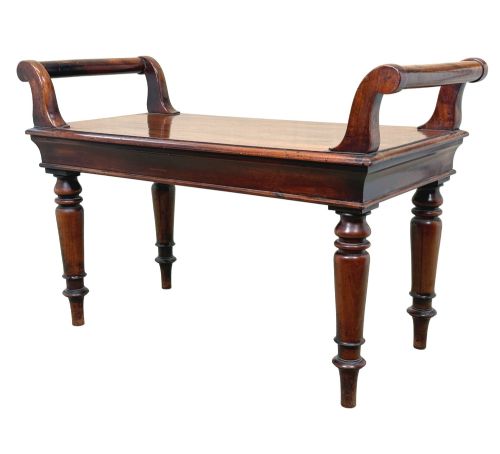


Scrolled Arm Window Bench
These scrolled arm window bench pieces offer compact seating tailored for alcoves and halls, bringing period character and refined woodwork into any room.
Scrolled Arm Window Bench
A scrolled arm window bench provides narrow seating traditionally designed to fit beneath sills or alongside walls without blocking light. These forms range from mid nineteenth century mahogany window seats to Edwardian framed upholstered versions and walnut duet benches.
The selections on this page draw from 19th Century, Victorian, Edwardian, and Regency periods. You will encounter styles spanning Early Victorian, Neoclassical, Georgian Revival, and French designs.
Common formats include window seats, benches, stools, and settees. Mahogany and walnut provide the primary wooden frames, paired with fabric, velvet, and damask upholstery.
How they were made
Frames rely on dense timbers such as mahogany and walnut, shaped with carved details and distinctive scrolled arms. Oak appears in specific neoclassical variants alongside brass elements.
Upholstery techniques utilise traditional fabric, velvet, and red damask coverings secured to padded seats. Woodwork demonstrates period cabinet-making methods, including cabriole legs and X-frame supports.
Several pieces double as dressing stools, proving that Victorians enjoyed sitting down while contemplating their morning waistcoats.
What varies in quality
Quality rests upon the crispness of the timber carving and the architectural proportion of the frame. Finer examples display balanced scrollwork on the arms and well-chosen mahogany or walnut grain.
The integration of the upholstery affects the overall standard, where sympathetic fabric choices and robust internal construction elevate the piece. The distinction lies in the harmony between woodwork and supporting legs.
The Scrolled Arm Window Bench Glossary
- Window seat
- A narrow bench designed specifically to sit within a window recess. These forms often feature scrolled arms to contain the sitter.
- Cabriole leg
- A furniture leg that curves out and then in, resembling an animal's leg. This shape frequently appears on period seating.
- Damask
- A reversible figured fabric traditionally used for upholstery. It adds texture and pattern to the seating surface.
- X-frame
- A structural base formed by intersecting diagonal members. This design provides robust support for stools and benches.
Scrolled Arm Window Bench: Frequently Asked Questions
Where do I put a window bench?
These benches sit comfortably beneath low windows, inside narrow hallways, or at the foot of a bed. Their compact depth allows them to occupy transitional spaces without obstructing movement.
They also function effectively as extra seating in reception rooms where bulkier furniture proves unsuitable.
How do I identify a Regency piece?
Regency items often display classical motifs inspired by ancient Rome and Greece, utilising dark timbers like mahogany. Look for clean architectural lines and restrained carving rather than heavy ornamentation.
Proportions remain elegant, frequently incorporating scrolled elements that reflect early nineteenth century tastes.
What is a duet bench?
A duet bench provides an extended seating surface originally intended for two people playing a musical instrument together. These forms share the same low profile as standard window seats.
They offer broader proportions while maintaining the shallow depth required for alcove placement.
How do I care for antique upholstery?
Protect delicate fabrics such as silk damask and velvet by avoiding direct sunlight that causes fading. Regular gentle vacuuming with a soft brush attachment removes surface dust.
Consult a specialist conservator for deeper cleaning to preserve the historical integrity of period textiles.