


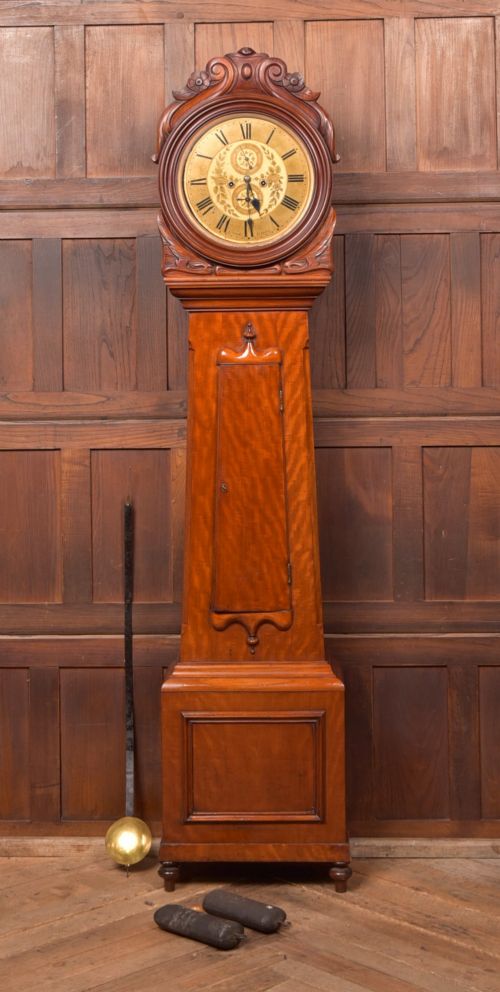


Scottish Victorian Clock
These pieces of a scottish victorian clock carry the steady pulse of nineteenth-century rooms, built to keep time through generations with quiet authority.
Scottish Victorian Clock
A scottish victorian clock most commonly appears as a tall mahogany longcase grandfather clock or a distinctive drumhead clock housed in rich timbers. Buyers searching this phrase encounter substantial floor-standing pieces alongside smaller bracket and mantel clocks originating from Scottish towns and cities.
The selection ranges from robust eight-day longcase movements to ebonised mantel pieces and wall-hung timepieces. Regional cabinet makers and clockmakers throughout Scotland produced these works during the Victorian period and the wider nineteenth century, utilising local materials and distinct regional proportions.
While the tall grandfather clock dominates the offerings, smaller bracket clocks and marble mantel pieces also surface. Each variation reflects the domestic interior of nineteenth-century Scotland, balancing functional timekeeping with traditional cabinet work.
Materials and construction
Makers constructed the primary housings predominantly from solid mahogany and oak, often selecting flame veneers for the grander longcase doors. Brass dials, silvered metal chapter rings, and bevelled glass protection complete the mechanical faces.
Movements rely on heavy iron and brass gear trains, driven by weights or spring-powered fusee mechanisms. Enamel and painted metal dials provide the clean white surface for roman numerals, frequently signed by the maker directly upon the face.
Scottish Victorian Clock Retail Price Guide 2026
Typical asking prices for scottish victorian clock among the pieces listed under this phrase on Sellingantiques today, from the lower quarter to the upper quarter. They describe what is for sale here now, not the wider market.
Listings include mahogany, oak, brass, and white marble, spanning the Victorian period and the wider nineteenth century.
Assessing quality in movement and case
The distinction between standard and superior pieces rests upon the precision of the clockmaker's movement and the depth of the cabinet timber. Signed dials bearing recognised Scottish makers add significant provenance, particularly when paired with undamaged flame mahogany graining and original hood mouldings.
Cabinet joinery, the clarity of the enamel dial, and the presence of original brass work define the higher tier of these timepieces. Untouched movements that retain their original weights, pendulums, and pendulum rods demonstrate superior preservation compared to heavily altered examples.
Tait Peebles·Andrew Thom·Bryson Edinburgh·James Ritchie Son·John McNeish Falkirk·Peter Whytock Dundee
The Scottish Victorian Clock Glossary
- Drumhead clock
- A timepiece featuring a circular dial housing mounted atop a tapered wooden longcase trunk, popular in nineteenth-century Scottish cabinet making.
- Longcase clock
- A tall pendulum clock enclosed in a wooden case designed to stand directly upon the floor, commonly referred to as a grandfather clock.
- Fusee movement
- A conical pulley mechanism that equalises the declining power of the mainspring as it unwinds, ensuring steady timekeeping across the eight-day duration.
- Chapter ring
- The outer metal ring on a clock face that bears the numerals for the hours.
- Regulator
- A high-precision pendulum clock designed for exceptional timekeeping accuracy, often featuring a simplified dial arrangement.
Scottish Victorian Clock: Frequently Asked Questions
How do I wind an eight day longcase clock?
Use the winding key to raise the heavy iron weights by turning the arbors clockwise until the weights reach the upper limit near the dial face.
Take care not to over-wind the movement, and allow the pendulum to settle into an even beat before closing the trunk door.
Where were these clocks originally placed in homes?
Tall longcase clocks stood in hallways, stairwells, or principal public rooms where the deep chime could resonate through the domestic interior.
Smaller bracket and mantel clocks occupied prominent surfaces in parlours and studies, serving as both utility and decorative ornaments.
What maintenance does a nineteenth century movement need?
Mechanical clocks require periodic cleaning and lubrication of the brass gear trains by a qualified horologist to prevent wear on the pivots.
Keeping the case in a stable environment away from direct heat sources helps preserve the mahogany timber and prevents veneer cracking.