

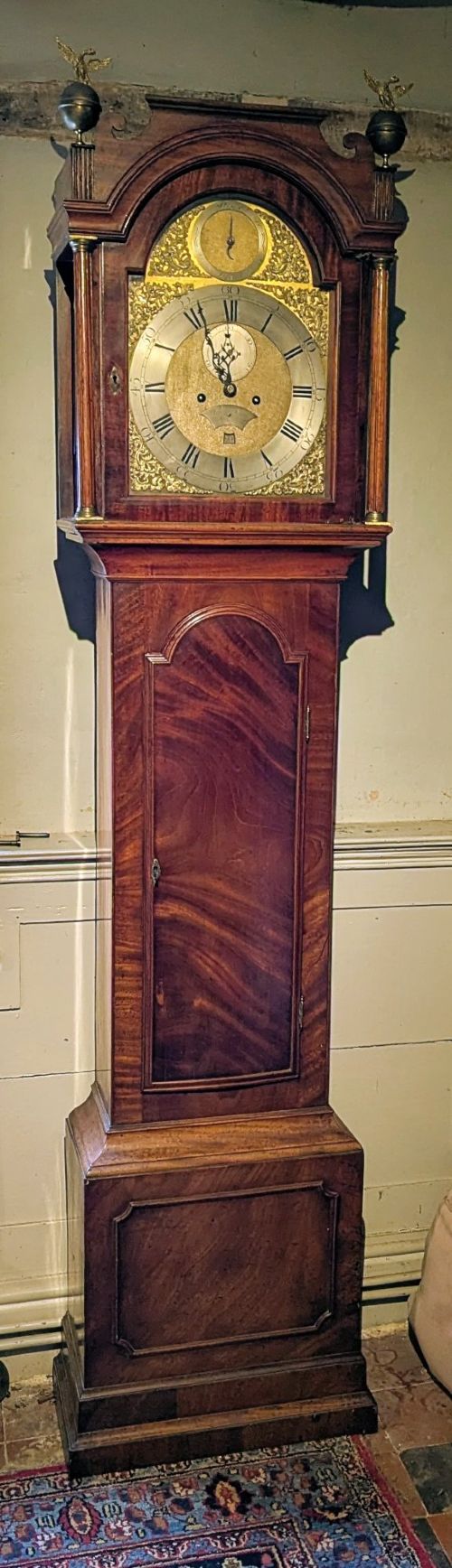


Rich Mahogany Clock
A rich mahogany clock brings warmth and mechanical precision to a room, crafted in timbers with deep grain and finished with brass and glass.
Rich Mahogany Clock
A rich mahogany clock encompasses tall floor-standing longcase examples alongside smaller mantel and wall clocks. These timepieces span the Georgian, Victorian, and Edwardian eras, reflecting centuries of cabinet-making and horological skill.
Buyers encountering this search phrase frequently find longcase grandfather clocks and fusee wall dials housed in flame mahogany veneer. The selection ranges from Scottish provincial floor clocks to London bracket pieces featuring enamel or painted iron dials.
How they were made
Cabinet-makers constructed these clock cases using solid mahogany and flame mahogany veneer, often incorporating inlaid details. Glazed doors protected the dial face while revealing the craftsmanship of the timber frame.
Clockmakers fitted brass movements, steel components, and bells within the timber housings. Dials were commonly finished in white enamel or painted iron, driven by weight-driven longcase mechanisms or spring-driven fusee movements.
Rich Mahogany Clock Retail Price Guide 2026
Typical asking prices for rich mahogany clock among the pieces listed under this phrase on Sellingantiques today, from the lower quarter to the upper quarter. They describe what is for sale here now, not the wider market.
Object types span wall clocks, mantel clocks, and longcase grandfather clocks originating from English and Scottish makers.
What varies in quality
The refinement of the cabinet-maker's timber selection dictates the visual impact of the case, particularly where figured flame mahogany veneer is matched across the door and base. Finely executed brass dial spandrels and crisp engraving on the brass chapter rings distinguish superior examples.
Mechanical execution separates standard production from high-grade horology, seen in the precision of the fusee movement and the integration of specialised complications like striking or chiming trains.
J Kingerley Manchester·Hay Wolverhampton·James Marshall·Halliday & Rich of Bridgwater·J Melrose Edinburgh·Richard Bolt·John Richardson London·Richard Reeves·Richard Honeybone·Richard Hornby·Richard Chater London
The Rich Mahogany Clock Glossary
- Fusee
- A conical pulley used in spring-driven clocks to ensure uniform power delivery as the mainspring unwinds. This mechanism maintains consistent timekeeping accuracy throughout the running cycle.
- Bracket clock
- A portable spring-driven clock originally designed to sit on a wall bracket or table. These pieces frequently feature arched brass dials and carrying handles.
- Longcase clock
- A tall weight-driven timekeeper housed in a wooden trunk with a base and hood. Often referred to as a grandfather clock, it accommodates swinging pendulums.
- Flame mahogany veneer
- Thin slices of timber cut from where branches join the main tree, showing a fiery, swirling grain pattern. Cabinet-makers applied this to prominent surfaces for decorative effect.
- Verge escapement
- An early type of mechanical escapement utilising a crown wheel and a rod with pallets. It regulates the release of the gear train to control the movement of the hands.
Rich Mahogany Clock: Frequently Asked Questions
How do I wind a fusee clock?
Use the appropriate winding key inserted into the dial aperture, turning it slowly and steadily until the movement meets resistance. Care must be taken not to overwind the spring mechanism.
Most fusee movements require attention every eight days, depending on the specific gear train configured by the maker.
Where were longcase clocks placed?
Floor-standing longcases typically stood in hallways, stairwells, or principal living rooms where the striking bells could be heard throughout the house.
Their height required stable flooring and sufficient ceiling clearance, particularly for tall Georgian and Victorian examples.
How can I tell a Victorian clock from a Georgian one?
Georgian pieces often display restrained classical proportions, arched brass dials, and cabinet work associated with George III or Regency styles. Victorian examples frequently feature heavier proportions, drop dial wall formats, or more ornate local provincial woodwork.
Examining the dial construction, signature style, and timber finishing provides further clues to the period of origin.
What is a drop dial wall clock?
A drop dial wall clock is a timekeeper designed to hang on a wall, featuring a circular dial above a short trunk or box that encloses the pendulum. This form became popular in public spaces and railway stations during the nineteenth century.
The lower case often incorporates a glazed side door for viewing the swing of the pendulum.