




Scottish Regency Chairs
Scottish regency chairs bring architectural presence to a room, offering robust timbers and clean classical lines.
Scottish Regency Chairs
Scottish regency chairs encompass dining chairs, armchairs, hall chairs, and side chairs originating from the Regency and Georgian periods. These pieces bridge late eighteenth-century restraint and the heavier proportions of the nineteenth century.
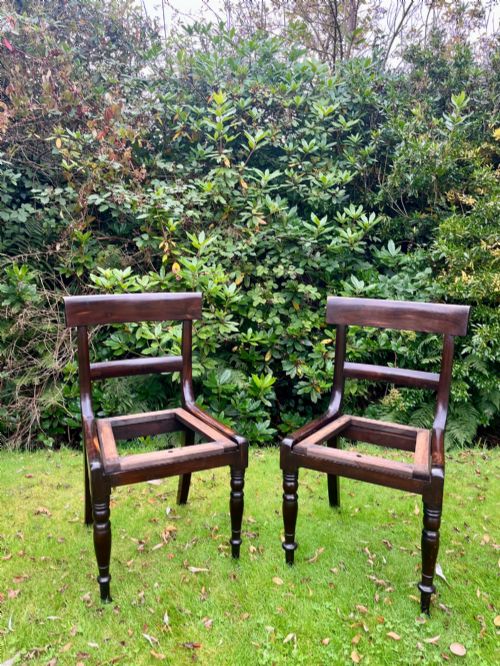
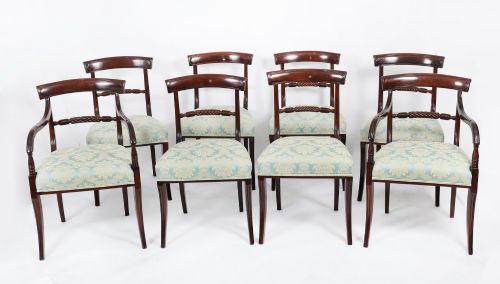
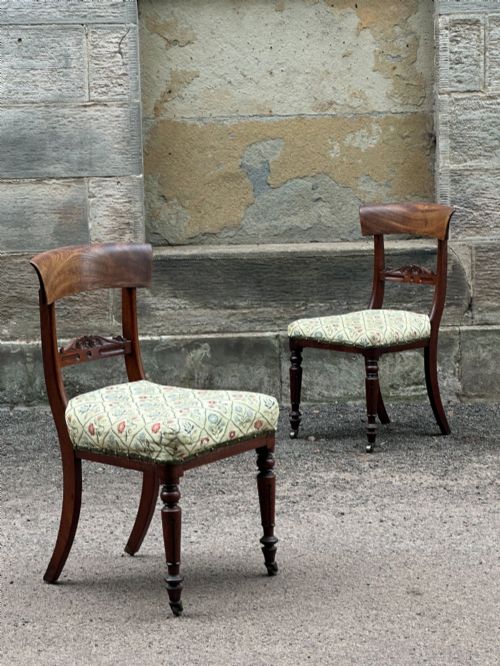
The version a buyer is most likely to meet on this page is the dining chair in mahogany, often appearing in sets ranging from pairs up to larger groups of ten or fourteen. Single hall chairs in oak or walnut also appear with some frequency.
Origins stretch across the Regency, George IV, William IV, and broader nineteenth-century eras, reflecting the distinct cabinet-making traditions north of the border. Makers utilised sturdy local hardwoods alongside imported mahogany to achieve both utility and formal elegance.
Materials and Construction
Cabinet-makers relied heavily upon solid mahogany, oak, and walnut, selecting timber for density and grain pattern. Secondary woods often provided hidden structural support within seat frames and underpinnings.
Upholstery fabric, leather, and brass details appear throughout the archive and current listings, adding tactile contrast to the polished timber frames. Drop-in seats and fixed squabs were common configurations for dining and armchairs alike.
Joinery techniques prioritised rigidity to withstand heavy daily use, employing mortise and tenon joints secured with wooden pins. Turning, reeving, and carved classical motifs shaped the solid wood components without relying on applied veneers.
Certain oak hall chairs carry carved stags, perhaps reminding guests not to drop their hunting hats in the hallway.
Assessing Quality
The top of the range is distinguished by timber selection, where the grain runs fluidly through structural curves and stress points rather than relying on surface finishes. Heavier gauge mahogany and carefully matched sets command greater attention than assembled groups.
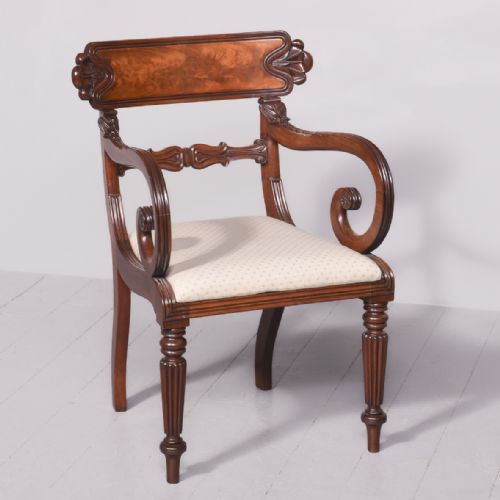
Carving depth and sharpness separate standard production from superior workshop output, particularly on crest rails and tablet backs. Crisp reeding and well-defined classical motifs show the hand of a confident artisan.
Proportions also dictate standard; finer chairs maintain a balanced relationship between back height and seat depth, ensuring visual lightness despite solid timber construction.
The Scottish Regency Chairs Glossary
- Regency
- A stylistic period spanning roughly from eighteen eleven to eighteen twenty, characterised by classical Greco-Roman influence. It draws upon ancient forms adapted for nineteenth-century interiors.
- Grecian
- A design style inspired by classical Greek artefacts, featuring saber legs, curved backrests, and scroll arms. This vocabulary dominates many side chairs from the era.
- Hall Chair
- A rigid timber seat intended for entrance halls rather than prolonged sitting, often featuring a solid wooden back with carved crests or armorial bearings.
- Reeding
- Parallel convex mouldings carved directly into the timber of legs or cross-rails. It provides texture and linear emphasis without heavy ornament.
- Mahogany
- A durable, reddish-brown tropical hardwood prized for stability and rich figuring. It serves as the primary material for high-status seating of the period.
Scottish Regency Chairs: Frequently Asked Questions
How do I spot a Scottish chair?
Scottish chairs often display slightly heavier proportions and distinct regional joinery traditions compared to their London counterparts. Local timbers like oak appear alongside imported mahogany in robust frames.
Look for specific regional turning styles and structural quirks in the underframe that point away from standard English workshop practices.
Are these chairs comfortable for daily use?
Many of these pieces were built as dining or reception seating, meaning they offer upright support rather than deep lounge comfort. Drop-in upholstered pads can be adjusted for modern seating height.
For daily dining, ensure the seat webbing and padding have been traditionally restored to support extended sitting.
Can I mix different sets together?
Mixing sets requires careful attention to timber tone, seat height, and back proportions to maintain visual harmony around a table. Side chairs and armchairs from similar decades within the Regency era pair more successfully.
Matching timber species, such as pairing mahogany with mahogany, helps bridge minor variations in carving style.
How do I care for antique timber?
Keep wooden frames away from direct heat sources and dramatic humidity shifts to prevent timber splitting or joint shrinkage. Regular dusting with a dry, soft cloth preserves the polished surface.
Apply a quality beeswax sparingly when the wood appears dry, buffing it gently to maintain the natural patina.