
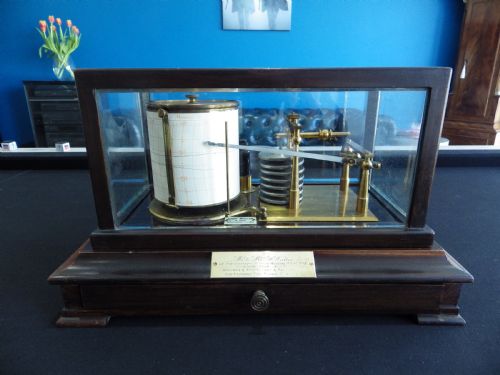


Scientific Weather Recorder
These scientific weather recorders track atmospheric pressure, rainfall and sunshine over time, offering a mechanical window onto the changing skies of the Victorian, Edwardian and interwar periods.
Scientific Weather Recorder
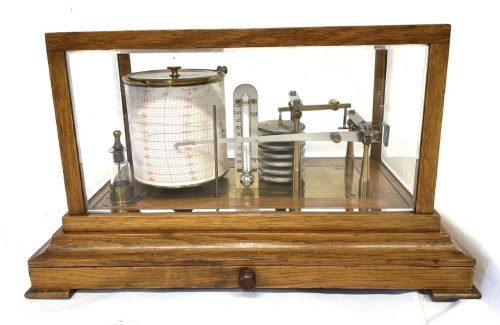
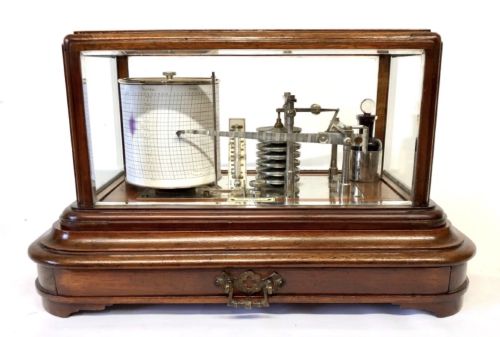
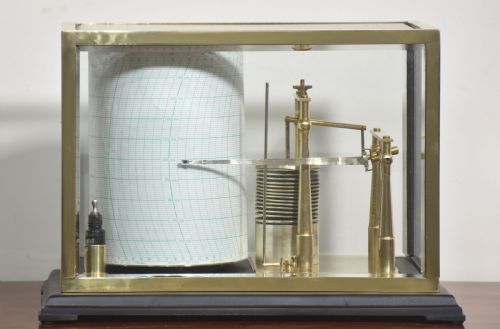
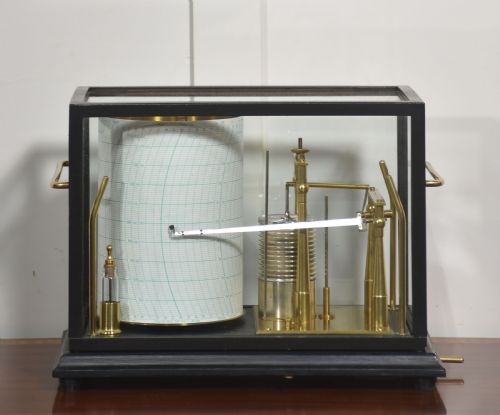
A scientific weather recorder typically takes the form of a barograph, a barometer combined with a recording mechanism that traces pressure shifts onto paper charts. These instruments span periods from the late Victorian era through to the 1940s, appearing in styles ranging from plain utilitarian designs to restrained Art Nouveau and Edwardian scientific casework.
You will most frequently encounter oak or mahogany cased barographs featuring bevelled glass panels, chart drawers and clockwork movements. Alongside barographs, the category encompasses specialised meteorological apparatus such as recording rain gauges and sunshine recorders housed in metal and glass.
The origins of these pieces are predominantly British, with London makers dominating the selection alongside regional firms and notable international retailers. They reflect an era when domestic and institutional weather tracking relied entirely upon precision brass mechanics and rotating paper drums.
How they were made
Casework relies on solid timbers like mahogany, oak and walnut, joined to protect the delicate internal mechanisms while displaying the instrument through glass panels. Many incorporate fitted chart drawers beneath the recording bed to store spare paper records.
The mechanical heart combines brass gears and levers with steel springs and glass barometric capsules or thermometers. Movements operate via clockwork drums that rotate once a week beneath an inked arm, translating atmospheric changes into a permanent line on paper charts.
Some Victorian recording rain gauges relied on a tipping bucket mechanism that rocked back and forth to count the drops in the middle of a storm.
What varies in quality
The distinction between standard utility instruments and finer examples rests upon the reputation of the maker and the finish of the housing. Signed movements by established London makers command greater interest than unsigned variants.
Cabinetwork quality differentiates the range, visible in the selection of figured mahogany or oak, the inclusion of bevelled glass panes, and the integration of auxiliary thermometers or subsidiary barometer dials. The crispness of the brass engraving and the precision of the clockwork movement further separate basic production from exceptional manufacture.
Short and Mason·Negretti and Zambra·Casella London·Jules Richard·Callaghan and Co
The Scientific Weather Recorder Glossary
- Barograph
- A self-recording barometer that traces atmospheric pressure onto a revolving drum holding a paper chart. This instrument provides a continuous weekly or daily record of weather trends.
- Aneroid
- A barometer that measures pressure without the use of liquid, utilising a flexible sealed metal box that expands or contracts. This mechanism drives the linked arm that records upon the rotating drum.
- Bevelled glass
- Glass panes featuring ground and angled edges, set into the wooden case to frame the movement. This detail adds refinement to the housing.
- Chart drawer
- A small compartment built into the base of the instrument case to store replacement paper recording sheets. It keeps consumables neatly organised beneath the mechanism.
- Sunshine recorder
- An apparatus utilising a glass sphere to focus sunlight and burn a trace onto a graduated card. This records the duration of bright sunshine throughout the day.
Scientific Weather Recorder: Frequently Asked Questions
How do barographs work?
A barograph operates through an aneroid capsule that expands or contracts with shifting air pressure. This movement transfers through a series of brass levers to an arm holding an ink nib, which traces the data onto a rotating paper chart driven by a clockwork drum.
The weekly chart gives a continuous visual history of meteorological shifts, showing whether pressure is rising or falling rapidly. Keeping the mechanism running requires winding the clockwork drum and supplying fresh calibrated paper charts.
Where were these instruments used?
These instruments found homes in domestic libraries, ship captains' cabins, agricultural estates and institutional meteorological offices. Wealthy Victorians and Edwardians tracked local atmospheric conditions as both a scientific hobby and a practical forecasting tool.
Public institutions and railways also deployed them to log precise environmental data for operations and record-keeping. Their handsome timber and glass casings allowed them to sit openly in reception rooms and studies.
How do I date an oak cased barograph?
Dating relies upon stylistic clues within the woodwork, the typography printed on the paper charts, and any maker signatures stamped on the brass bedplate. Late Victorian and Edwardian examples often feature heavier oak frames with bevelled glass, while interwar pieces adopt cleaner lines.
Maker records and specific addresses engraved on the instrument plates help narrow the manufacturing window further. Patent dates or retailer stamps also point toward the active period of commercial distribution.
What maintenance do they need?
Routine care involves gently winding the clockwork drum and replacing the paper chart on its weekly cycle. The ink nib requires occasional checking to ensure it flows freely onto the paper without catching.
Internal brass mechanics benefit from professional cleaning if the clockwork stops or loses time. Keeping the instrument away from damp environments preserves both the wooden case and the steel components.