


Scientific Recording Barometer
A scientific recording barometer maps atmospheric pressure continuously onto paper charts, turning invisible weather changes into neat inked lines.
Scientific Recording Barometer
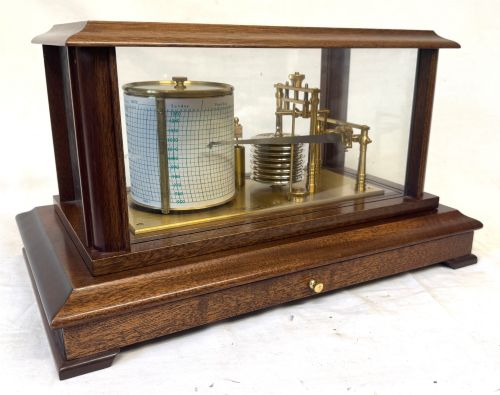
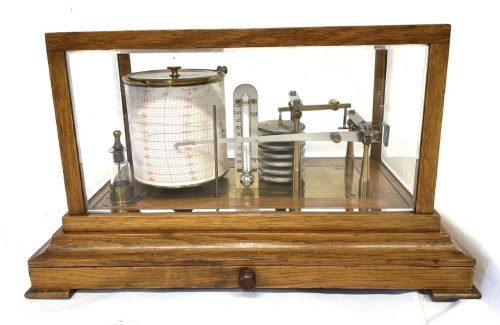
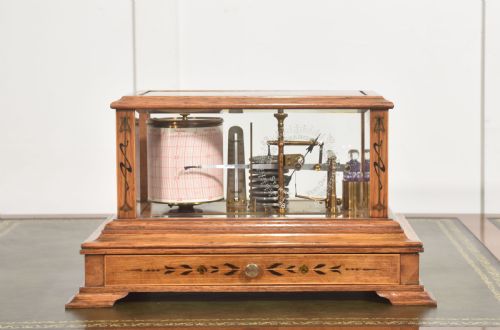
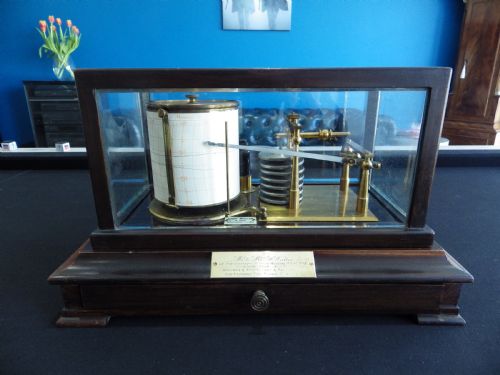
A scientific recording barometer appears predominantly as a barograph housed in a wooden case with glazed panels to protect the delicate mechanism inside. These instruments record barometric pressure over a week onto a rotating drum.
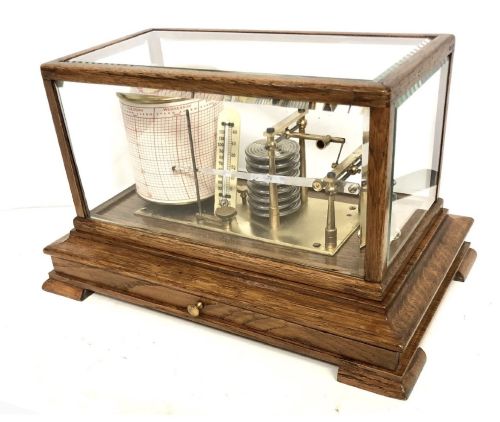
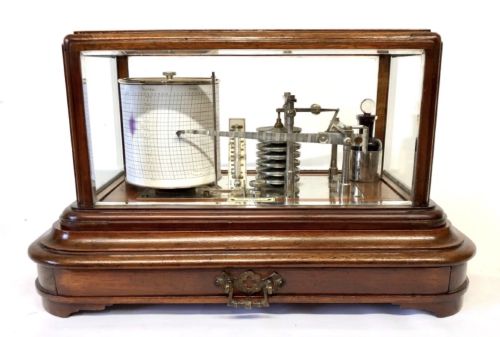
The form spans the Victorian, Edwardian, and interwar periods, appearing in both mahogany and oak enclosures. Many examples incorporate a thermometer alongside the main recording drum, and some include a lower drawer for spare paper charts.
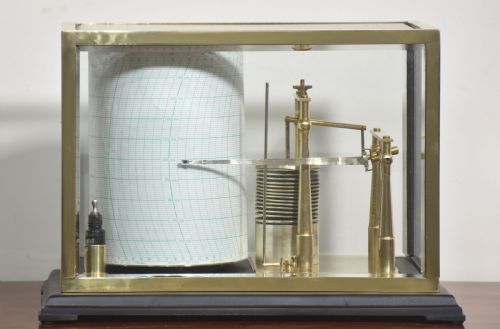
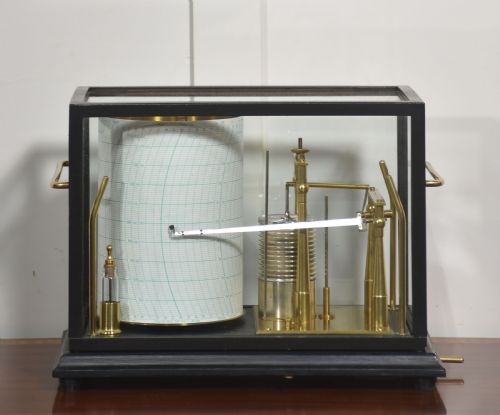
Makers housed these movements in five-glass brass-framed cases or heavy wooden boxes with bevelled glass. Wall-mounted variations and miniature formats also occur across the late nineteenth and early twentieth centuries.
Materials and construction
Makers constructed the primary enclosures from rich mahogany, oak, and walnut, frequently integrating bevelled glass panes to permit a clear view of the operating mechanism. Brass components form the internal levers, stacks of vacuum capsules, and clockwork drums.
Paper charts receive the inked record from a fine pen arm linked to the aneroid barometer capsules. Steel springs and paper complete the primary medium of these mechanical recording devices.
Listings feature recording barometers housed in mahogany, oak, and walnut, spanning the Victorian era through the mid-twentieth century.
Factors of quality
Quality rests upon the reputation of the maker and the precision of the internal clockwork movement. Signed brass beds and refined linkages distinguish standard production from superior workshop output.
Cabinetwork differentiates the selection, with fine timber matching, precise mitres, and decorative inlay such as Art Nouveau motifs elevating the enclosure. Original paperwork, intact ink bottles, and matching chart drawers add considerable merit to an instrument.
Short and Mason·Negretti and Zambra·Casella London·Richard Freres·Robson of Newcastle
The Scientific Recording Barometer Glossary
- Barograph
- A recording barometer that plots barometric pressure onto a rotating paper chart over a set period, typically one week.
- Aneroid
- Operating without liquid, utilising expanding and contracting vacuum metal capsules to measure changes in atmospheric pressure.
- Glazed case
- An enclosure constructed with multiple glass panels, often five, held within a brass or wooden framework to protect the instrument while allowing visibility.
- Chart drawer
- A small compartment built into the base of the wooden housing designed specifically to store unused recording papers.
- Thermometer
- An auxiliary instrument mounted inside or upon the case to record ambient temperature alongside atmospheric pressure.
Scientific Recording Barometer: Frequently Asked Questions
How do scientific recording barometers work?
A stack of sealed metal vacuum capsules expands and contracts with shifting atmospheric pressure. A system of multiplying levers transfers this physical movement directly to an inked nib resting on a paper chart.
The paper chart wraps around a clockwork-driven drum that rotates once every seven days. This continuous rotation produces a permanent graphical record of weather trends over the week.
How do I change the chart paper?
The brass drum lifts off its spindle or the retaining clip releases the paper cylinder. Fresh charts wrap smoothly around the drum and secure via a small slit or clip.
The pen arm lifts gently away from the paper surface before any adjustment occurs. Fresh ink feeds into the nib so the arm traces the new pressure line clearly.
Where should I place a barograph?
These instruments require a stable surface away from direct sunlight, central heating radiators, and damp environments. Sudden temperature swings alter the metal components and skew the pressure readings.
A sideboard, desk, or shelf in a principal room suits the instrument well, as the glazed case protects the delicate mechanism from daily household dust and accidental knocks.
How do I date a scientific recording barometer?
The style of the timber case, the shape of the brass feet, and the maker signature engraved on the bedplate provide initial clues. Edwardian examples often feature lighter oak or subtle inlay, whereas Victorian pieces lean toward heavier mahogany.
Paperwork left inside the chart drawer sometimes bears retailer stamps or calibration dates. Movement signatures also connect specific serial numbers to active workshop years.