


Vintage Barograph Drawer
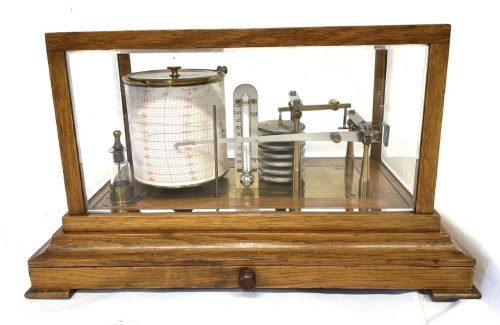
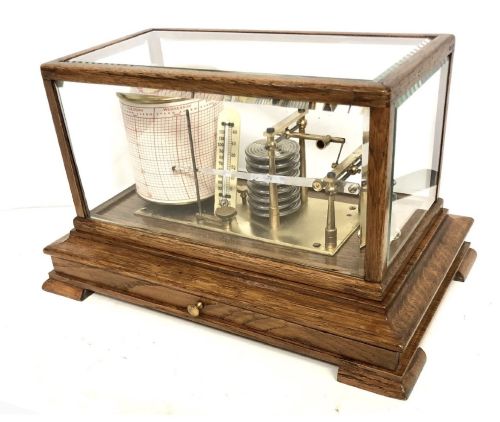
A vintage barograph drawer houses meteorological recording sheets beneath a brass-nibbed mechanism, offering both reliable weather tracking and striking period cabinetry for a study.
Vintage Barograph Drawer
A vintage barograph drawer forms the integral base of a recording meteorological instrument, designed specifically to slide outward for the storage of spare paper charts and ink bottles. These scientific instruments combine precision mechanical recording drums with substantial timber cabinetry that sits comfortably upon a library desk or a mantelpiece.
The examples most commonly met on this page span the Victorian, Edwardian, and early twentieth-century periods, fashioned primarily in oak or mahogany. Makers housed these complex movements beneath five-glass covers, allowing a clear view of the rotating drum and arm while concealing the paper supply safely within the lower drawer.
Makers integrated thermometers, barometer dials, and bevelled glass into the timber housing, reflecting the practical needs of Edwardian and interwar households. Surviving pieces range from plain utilitarian oak housings to sophisticated inlaid mahogany cabinets retailed by prominent London department stores.
Materials and construction methods
Cabinetmakers constructed the exterior housings from solid oak and mahogany, frequently selecting rich timbers and incorporating bevelled glass panels to showcase the internal mechanics. Brass components form the recording arms, barometer dials, and drawer pulls, while steel and paper complete the recording mechanism inside.
Many surviving drawers still contain forgotten bundles of unused weekly weather charts, preserving decades-old blank stationery ready for ink.
Distinctions in quality and execution
Quality rests significantly upon the reputation of the maker and the precision of the internal movement, with signed London workshop pieces representing the highest tier of production. The crispness of the timber cabinet work, the thickness of the bevelled glass, and the presence of retailer signatures elevate certain examples above standard utilitarian models.
Cabinet detailing distinguishes finer pieces, such as Art Nouveau marquetry inlay, superior grain selection in the mahogany or oak, and integrated secondary instruments like mercury thermometers. The smooth operation of the chart drawer and the substantial weight of the cast brass fittings further mark out superior production.
Short And Mason·Casella London·Negretti And Zambra·Harrods Of London
The Vintage Barograph Drawer Glossary
- Barograph
- A self-recording barometer that graphs barometric pressure over time onto a rotating paper chart.
- Chart drawer
- The built-in sliding compartment beneath the main instrument housing used for storing replacement recording papers and spare ink.
- Aneroid
- Operating without liquid, utilising expanding metal bellows to measure changes in atmospheric pressure.
- Bevelled glass
- Glass panes featuring angled, polished edges that fit closely into the timber joints of the five-glass display case.
- Movement
- The mechanical assembly of levers, springs, and spindles that drives the recording arm across the paper drum.
Vintage Barograph Drawer: Frequently Asked Questions
What is a vintage barograph drawer used for?
These instruments record atmospheric pressure continuously onto a paper chart fitted around a revolving drum. The integrated drawer beneath houses spare charts and ink supplies.
Historically, they allowed households and scientists to predict local weather patterns by observing the rising or falling pressure trace over the course of a week.
How do I operate the chart drawer?
The drawer pulls outward smoothly from the base of the wooden cabinet, positioned directly beneath the five-glass display case. It is designed solely to keep replacement weekly charts neat and accessible.
When changing the paper, opening this compartment gives immediate access to the necessary stationery without disturbing the delicate brass recording mechanism above.
How do I date a timber barograph case?
Victorian and Edwardian examples typically feature heavy oak or mahogany housings with robust brass fittings and hand-written paper charts from the period. Later 1930s models often display simpler timber framing and distinctively styled manufacturer plates.
Examining the internal movement signatures and the style of the woodwork provides the most reliable guide to the exact decade of manufacture.
How should I display a barograph at home?
Place the instrument on a sturdy desk, table, or sideboard away from direct sunlight, drafts, and excessive moisture to protect the timber and paper charts. The five-glass case ensures the movement remains visible from all angles while shielding the delicate internal arms from accidental contact.
Ensure the surface is entirely level so the recording arm rests correctly against the rotating paper drum.