
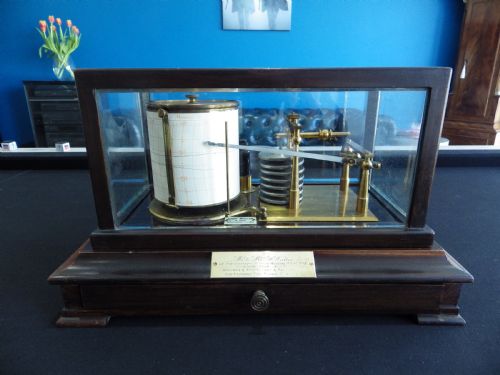


Scientific Barograph Recorder
A scientific barograph recorder records atmospheric pressure continuously on paper charts, combining precision mechanics with handsome cabinet work for any room.
Scientific Barograph Recorder
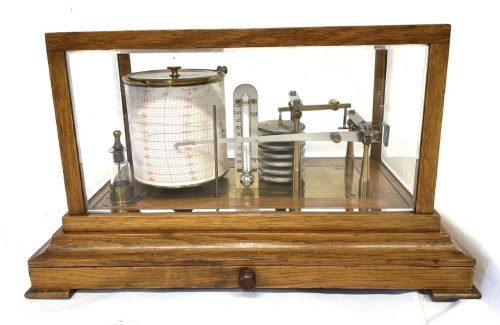
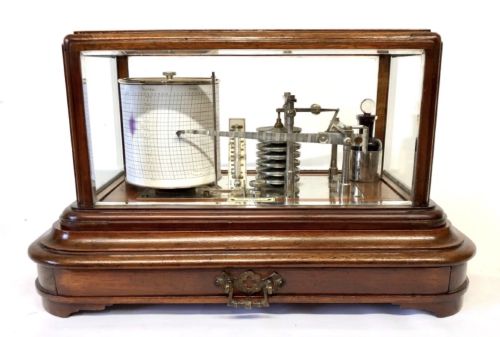
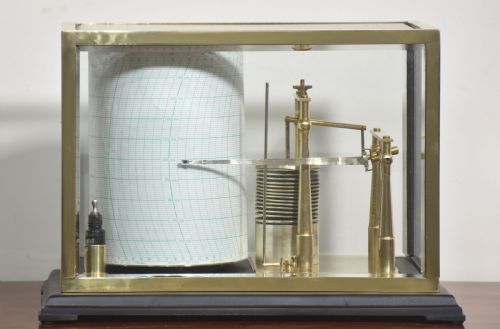
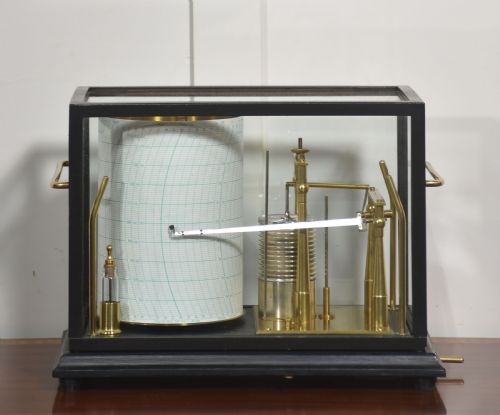
A scientific barograph recorder is a mechanical instrument that charts barometric pressure over time, housed within a protective cabinet fitted with glass panels.
The versions most commonly met on this page span the Victorian, Edwardian, and interwar periods, frequently incorporating mahogany or oak cabinetry.
Materials and construction methods
Cases are constructed from solid timbers including mahogany, oak, and walnut, often finished with bevelled glass panes to view the internal mechanism.
Internal components utilise brass, steel, and metal assemblies, while paper is used for the rotating weekly recording charts.
Cabinet styles range from plain Edwardian boxes to inlaid Art Nouveau designs and fitted drawers for spare chart storage.
Railway and Southend interest examples prove that weather recording once accompanied travellers down the line.
Assessing quality in barograph recorders
Quality rests in the precision of the maker's movement and the finish of the timber case, distinguishing standard utility instruments from signed London pieces.
Short and Mason·Negretti and Zambra·Casella London·Jules Richard·R Fuess
The Scientific Barograph Recorder Glossary
- Barograph
- An instrument that continuously records atmospheric pressure on a paper chart. It uses an aneroid barometer mechanism linked to an inked pen.
- Aneroid
- Containing no liquid. These barometers and barographs measure air pressure using flexible metal diaphragms.
- Bevelled glass
- Glass panes with angled edges fitted into the cabinet. This detail adds refinement to the viewing panels.
- Chart drawer
- A small compartment built into the base of the wooden case. It holds spare weekly recording papers and spare ink bottles.
Scientific Barograph Recorder: Frequently Asked Questions
How does a scientific barograph recorder work?
Stackable metal vacuum capsules expand and contract with shifts in atmospheric pressure. This movement transfers through levers to an inked arm that traces a line onto a rotating paper cylinder.
The cylinder contains a clockwork mechanism that turns the drum once every seven days. Changing the paper chart weekly keeps the instrument running accurately.
Where should I place a barograph at home?
Keep the instrument on a stable, level surface away from direct sunlight, radiators, and heavy vibrations. These factors can interfere with the delicate clockwork and expansion mechanisms.
Because the wooden cases and brass works benefit from stable indoor conditions, a study, hallway, or living room shelf makes an ideal location.
How do I identify the period of a barograph?
Examine the cabinet timber, hardware, and any maker signatures on the metal bedplate or paper charts. Victorian and Edwardian examples often feature rich mahogany or oak with bevelled glass.
Later interwar and 1930s pieces can display simpler joinery or different drawer configurations. Maker plates from London firms also help narrow down the production decade.
Do these instruments still record weather changes?
Many surviving barographs remain fully operational if their clockwork drums and aneroid capsules are well maintained. Replacing the paper charts and winding the clock allows them to track pressure live.
Some owners choose to run them continuously as working weather stations, while others prefer them simply as decorative mechanical objects.