






Scandinavian Painted Commode
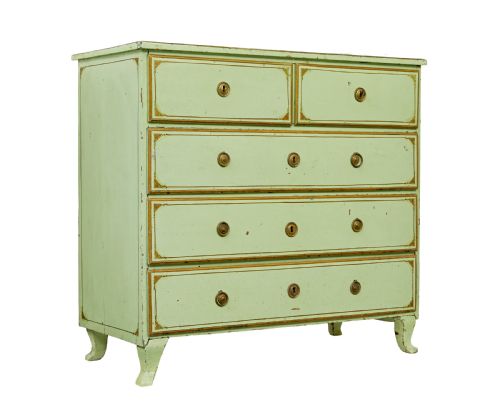
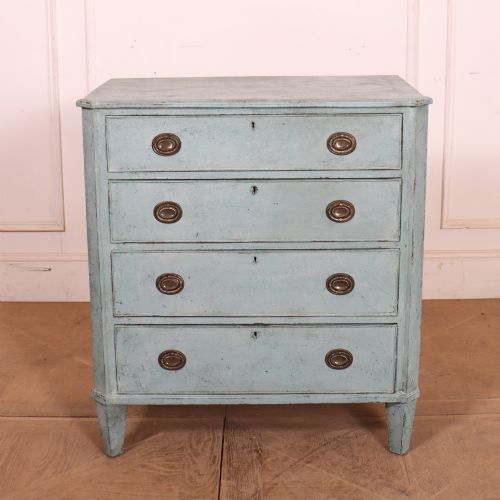
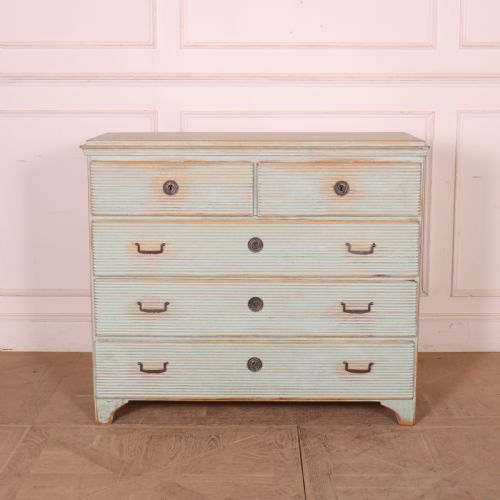
A Scandinavian painted commode brings northern light and colour into a room through generous drawers and layered historic pigment.
Scandinavian Painted Commode
A Scandinavian painted commode stands as a practical storage piece built with multiple drawers for domestic use. The pieces gathered here span centuries from the eighteenth period through to the twentieth, reflecting various regional tastes across Sweden and Denmark.
Most examples appearing on this page take the form of a chest of drawers constructed in pine or softwood. Alongside standard drawer units, buyers encounter related items such as painted cupboards and a child high chair.
Makers drew upon diverse design movements, ranging from Gustavian neoclassicism and baroque revivals down to rustic country and folk art traditions. The resulting furniture combines robust utility with decorative surface schemes characteristic of northern European workshops.
Materials and construction
Local timbers such as pine, softwood and oak form the primary structural carcassing for these chests and commodes. Carpenters joined these panels using traditional methods to build sturdy drawer fronts and frames.
Surfaces received coats of paint, sometimes applied to simulate more costly timbers like birch or finished in flat monochrome shades. Iron and brass fittings provide handles and key escutcheons across the drawer tiers.
Scandinavian Painted Commode Retail Price Guide 2026
Typical asking prices for scandinavian painted commode among the pieces listed under this phrase on Sellingantiques today, from the lower quarter to the upper quarter. They describe what is for sale here now, not the wider market.
Listings feature items spanning from the eighteenth century through the Victorian era up to nineteen thirty, constructed mainly in painted pine and softwood.
Distinguishing quality
Quality rests in the survival of original paint surfaces, where early scraped layers or untouched historical pigment preserve the character of the piece. Subtle details like fluted drawer fronts or serpentine shaping separate simpler rustic items from ambitious neoclassical designs.
Proportion and execution define the distinction between standard workshop output and finer regional furniture. Pieces reflecting formal Gustavian or baroque styles display careful attention to moulding and decorative balance.
GEMLA FABRIKERS
The Scandinavian Painted Commode Glossary
- Gustavian
- The Swedish interpretation of neoclassical style, popular during the late eighteenth century and characterised by restrained lines and light painted finishes. It draws inspiration from French Louis XVI design adjusted for northern aesthetics.
- Commode
- A low chest of drawers designed for bedroom or parlour storage. The term generally denotes a more decorative or formal drawer unit than a basic utility chest.
- Serpentine
- A curved furniture front shaped with a convex centre flanked by concave ends, or the reverse. This contour adds movement and visual complexity to drawer chests.
- Scraped paint
- A conservation method or natural wear state where upper layers of coating are carefully pared back to reveal older underlying pigment colours. Collectors value this technique for showing the chromatic history of a surface.
- Baroque revival
- A nineteenth-century style imitating the heavy, dramatic ornamentation of the seventeenth-century baroque period. It brings substantial forms and robust carving back into nineteenth-century production.
Scandinavian Painted Commode: Frequently Asked Questions
How do I date a painted commode?
Dating relies on examining the construction methods, hardware, and stylistic vocabulary evident in the piece. Eighteenth-century examples often display baroque or early Gustavian traits, whereas nineteenth-century pieces may incorporate revival motifs or simpler rustic carpentry.
Paint analysis also helps, as original surfaces reveal the ageing characteristics and pigment types specific to particular decades.
Where were these commodes used?
These commodes primarily functioned as bedroom or living area furniture for storing textiles, clothing, and household goods. Their substantial drawer capacity made them central storage items in domestic rooms.
Because they combined utility with decorative painted exteriors, they sat in main living spaces rather than being hidden away in service quarters.
How do I care for original paint?
Preserving historic paint requires keeping the furniture away from direct sunlight and maintaining stable indoor humidity levels. Dusting should be done gently with a dry, soft cloth without applying liquid cleaners or modern waxes that might soften fragile historical layers.
Respecting the aged surface ensures the underlying pigment and character remain intact for the future.