




Scandinavian Empire Furniture
Scandinavian empire furniture brings bold architectural forms and pale northern timbers together, offering striking focal points for formal interiors.
Scandinavian Empire Furniture
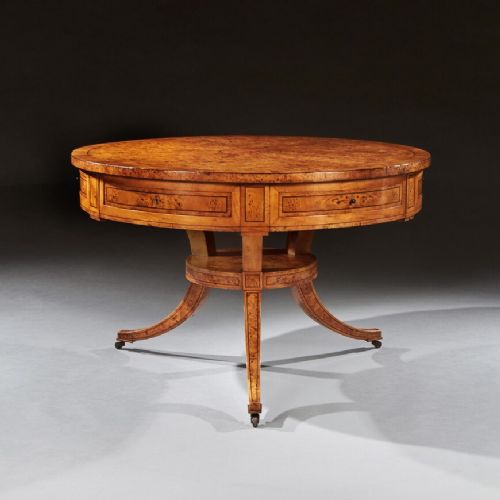
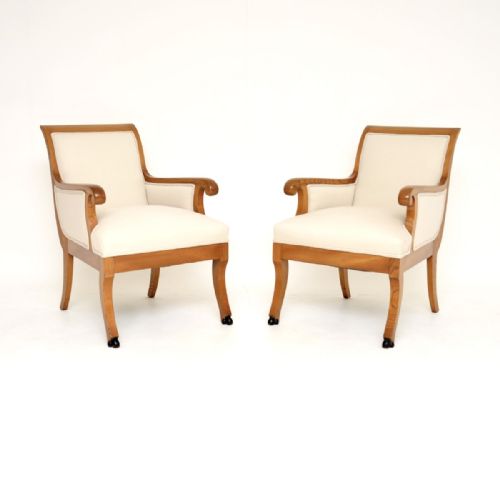
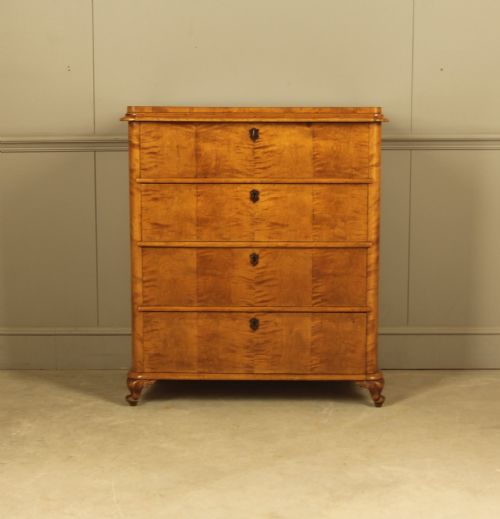
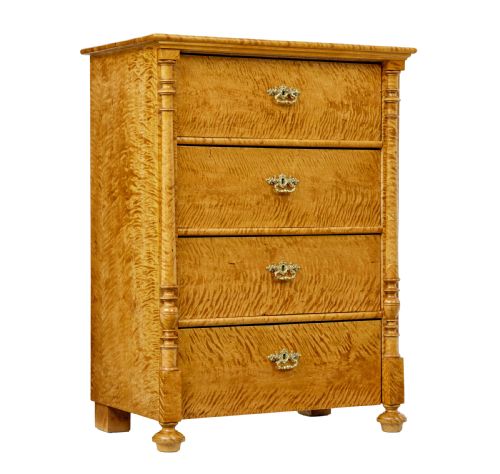
When you search for Scandinavian empire furniture, you encounter pieces that span the nineteenth century and early twentieth century revivals. The forms range from chests of drawers and armchairs to centre tables, sofa tables, side tables, armoires, cupboards, and sofas.
The selections on this page highlight regional variations including Swedish empire and Biedermeier styles. You are most likely to meet birch and flame birch timbers fashioned into practical yet grand domestic objects.
How they were made
Cabinetmakers utilised native northern timbers such as birch, flame birch, tiger birch, and occasional solids like elm and maple. Veneers were carefully matched across large surfaces to display intricate grain patterns.
Metal mounts in brass provide sharp contrast against the pale wooden surfaces. Construction methods combined solid framing with sturdy secondary timbers like pine to ensure structural stability.
Some chests of drawers hide secret compartments behind their top frieze rails, giving owners a private spot to stash letters.
What varies in quality
The refinement of the timber selection dictates the standing of a piece, particularly how symmetrically veneer patterns are laid across drawer fronts and tabletops. Elaborate grain figures like flame and burr root maple elevate a piece above plain surfaces.
Proportion and the crispness of applied brass mounts separate standard items from superior examples. The integrity of the original construction and the subtlety of neoclassical detailing govern overall execution.
The Scandinavian Empire Furniture Glossary
- Birch
- A pale hardwood native to northern Europe, prized for its distinctive grain and widely used in Scandinavian cabinetmaking. It forms the primary visual identity of many empire and revival pieces.
- Empire Revival
- A nineteenth and early twentieth-century design movement that reinterpreted the monumental classical forms of the Napoleonic era. This style adapts heavier architectural motifs for domestic Scandinavian interiors.
- Biedermeier
- A central and northern European style spanning the nineteenth century that prioritised clean lines and utilitarian comfort over excessive ornamentation. It often shares space with empire aesthetics in Scandinavian collections.
- Veneer
- A thin layer of choice wood applied to a secondary timber base to create decorative surfaces. Flame and tiger variations are typical of northern European furniture making.
- Centre table
- A freestanding table designed to be viewed from all sides, frequently placed in the middle of a room. These often feature circular tops supported by central pedestals or columns.
Scandinavian Empire Furniture: Frequently Asked Questions
How do I identify empire revival pieces?
Empire revival items date predominantly from the early twentieth century, echoing the classical proportions, darker contrasts, and formal symmetry of earlier nineteenth-century originals. They draw heavily on neoclassical vocabularies adapted by Scandinavian makers.
Look for architectural column supports, brass mounts, and structured geometric layouts that echo Napoleonic-era design principles while retaining regional timber choices.
What rooms suit these tables?
Centre tables, sofa tables, and side tables function well in reception rooms, libraries, or hallways where their freestanding forms can be appreciated from multiple angles. Their pale timbers brighten traditional and modern interior settings alike.
Keep them away from direct heat sources and strong sunlight to protect the polished birch surfaces and delicate veneer work over time.
How do I care for birch furniture?
Maintain polished birch surfaces by dusting them regularly with a soft, dry cloth. Avoid chemical polishes that can build up and dull the finish of the timber.
Maintain stable humidity levels in the room to prevent the solid timbers and delicate veneer applications from shrinking or cracking.
Are these pieces strictly antique?
The inventory spans the nineteenth century through to the early twentieth century, encompassing both original period items and subsequent revival pieces. Each era reflects shifting interpretations of classical Scandinavian design.
Examining the construction methods, secondary woods like pine, and wear patterns helps determine the exact period of manufacture for individual pieces.