
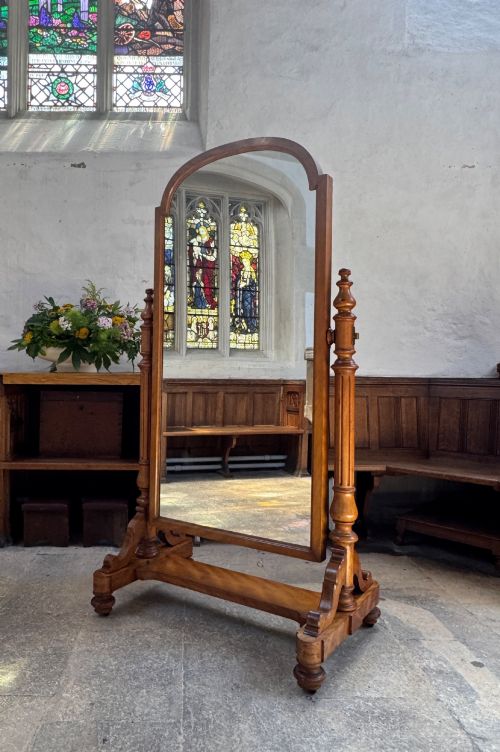


Satinwood Swivel Mirror
A satinwood swivel mirror offers a bright, figured surface and an adjustable glass, bringing period character and practical use to a dressing table.
Satinwood Swivel Mirror
A satinwood swivel mirror belongs to a tradition of table-top and floor-standing glass frames designed for personal grooming. The pieces on this page span the Victorian, Edwardian, and George III periods, taking forms such as toilet mirrors, dressing table mirrors, and larger cheval mirrors.
Most examples appear as smaller toilet mirrors meant to sit atop a chest of drawers or a dedicated table. Buyers also encounter taller cheval mirrors and dressing mirrors supported by pivoting stands, alongside related forms like dressing table chests and washstands incorporating wood frames.
How they were made
Cabinet makers constructed these frames using timber such as satinwood, mahogany, and satin birch, frequently enhancing the surfaces with marquetry inlay and boxwood stringing. The primary woods provide a pale, golden ground or a deeper reddish tone, depending on the specific period and workshop.
Mirror glass sits within pivoted frames attached to upright supports and a base, allowing the user to adjust the angle of reflection. Brass fittings often secure the swivel mechanism, while secondary woods and metal components complete the internal and structural elements.
Listings on this page include pieces from the 1800, George III, Victorian, Edwardian, and 1900 periods.
What varies in quality
Quality rests in the crispness of the cabinet work, the finesse of the marquetry inlay, and the choice of primary timber figures. Pieces from the George III period display refined proportions and hand-cut details that set them apart from later revivals.
The integrity of the swivel mechanism and the preservation of the original glass and brass hardware also influence the character of each piece. Finer examples maintain balanced proportions between the mirror plate and its supporting frame.
The Satinwood Swivel Mirror Glossary
- Cheval mirror
- A tall, freestanding mirror supported on a frame with four legs, allowing the full reflection of a person. These pieces typically pivot vertically within their stands.
- Marquetry
- Decorative veneer work arranged in pictorial or geometric patterns using various coloured woods. It appears frequently on Edwardian satinwood pieces.
- Stringing
- A narrow strip of contrasting wood inlaid into a channel on the surface of furniture to create a border. Boxwood is commonly used for this linear detail.
- Satin Birch
- A pale, figured timber utilised by cabinet makers during the Victorian and Edwardian eras. It provides a blonde surface similar in grain pattern to satinwood.
Satinwood Swivel Mirror: Frequently Asked Questions
What is the difference between a toilet mirror and a cheval mirror?
A toilet mirror is a compact table-top glass meant to sit upon a chest or dressing table, often featuring small drawers in its base.
A cheval mirror is a tall, freestanding floor model designed to show a full-length reflection.
How do I date a satinwood swivel mirror?
Dating relies on the structural form, timber choices, and decorative motifs such as inlay style. Pieces range from George III examples to Edwardian revivals.
Comparing the construction methods of the frame and the type of brass hardware provides further clues to the period.
Where should I place a swivel mirror in a room?
These mirrors suit placement on top of period dressing tables, chests of drawers, or dedicated low cabinets. Freestanding cheval versions stand directly on the floor in bedrooms or dressing areas.
Positioning them near a natural light source helps maximise the reflection and highlights the grain of the satinwood or mahogany.
How do the swivel mechanisms work?
The glass frame hangs between two upright posts by means of pivot screws or metal pins inserted into the sides. Brass nuts or tension caps allow the user to tighten the frame at the desired angle.
This pivoting action is standard across both table-top toilet mirrors and large floor-standing cheval mirrors.