


Satinwood Pier Table
Satinwood pier tables bring pale, figured timbers and classical lines to a hallway, appearing most often in demi-lune and console forms across eighteenth and nineteenth century rooms.

Satinwood Pier Table
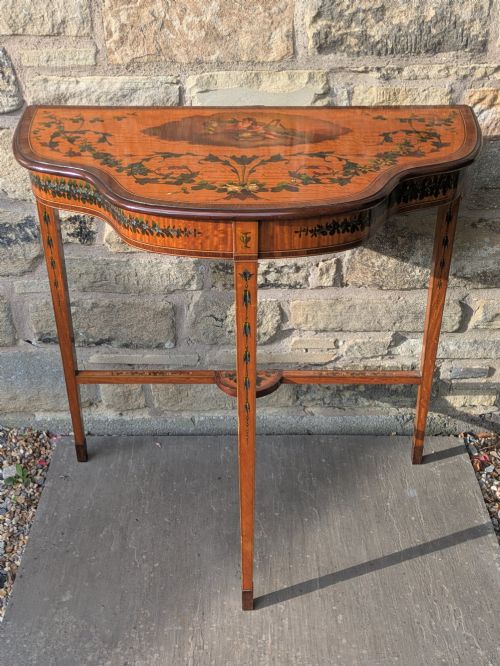
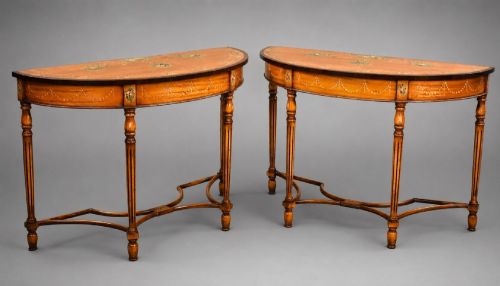
A satinwood pier table is designed to stand against a wall between windows, frequently taking a half-moon or demi-lune shape that fits neatly into panelled spaces. The examples on this page span the eighteenth and nineteenth centuries, taking in George III, Regency, and Edwardian interpretations alongside later revivals.
Makers fashioned these surfaces as console tables, side tables, and side cabinets, often pairing the primary timber with mahogany, rosewood, or boxwood banding. The surviving pieces lean heavily towards neoclassical restraint and Sheraton-influenced geometry.
While some pieces carry the simple architectural dignity of the seventeen-hundreds, others display the painted polychrome decoration typical of nineteenth-century revivals. The form remains remarkably adaptable to domestic spaces that require a shallow surface for display.
Materials and Construction
Craftsmen selected satinwood for its natural sheen and characteristic golden-yellow tone, often laying veneers over a sturdier secondary wood to build the curved demi-lune frame. Crossbanding in contrasting timbers such as mahogany and boxwood defines the edges of the top and apron.
Marquetry and hand-painted polychrome decoration feature widely across the surfaces, applied to panels of satinwood to create floral motifs or classical swags. Giltwood and brass mounts occasionally accent the structure, particularly on pieces influenced by French Empire and Louis XVI styles.
Satinwood Pier Table Retail Price Guide 2026
Typical asking prices for satinwood pier table among the pieces listed under this phrase on Sellingantiques today, from the lower quarter to the upper quarter. They describe what is for sale here now, not the wider market.
The listings here include eighteenth-century George III examples alongside nineteenth-century Sheraton Revival and Edwardian interpretations.
Assessing Quality and Execution
The distinction between ordinary and superior pieces rests on the choice of timber and the precision of the marquetry. Highly figured satinwood exhibits a distinct chatoyancy that catches the light, whereas lesser examples rely on flat, plain grain.
Painted decoration also separates the workshops: finely brushed polychrome scenes and crisp, disciplined banding indicate skilled hands. Poorly executed pieces show heavy, hesitant brushwork and a lack of depth in the surface finish.
Donald Ross
The Satinwood Pier Table Glossary
- Demi-lune
- Half-moon shape. This curve defines the front edge of many pier and console tables designed to sit flush against a wall.
- Crossbanding
- A strip of veneer laid perpendicular to the grain of the main surface. It creates a neat border around the edge of a table top.
- Marquetry
- Inlaid wood patterns forming pictures or geometric designs. Artisans cut contrasting veneers to fit flush within the primary timber.
- Polychrome
- Painted in several colours. This surface treatment appears on many nineteenth-century revival tables.
- Pier table
- A table designed to stand against the wall between two windows, often beneath a mirror.
Satinwood Pier Table: Frequently Asked Questions
What is a pier table?
A pier table is a shallow console table traditionally placed against the wall between two windows, often beneath a wall mirror.
Because they occupy narrow spaces, these tables feature flat backs and decorative fronts designed to be viewed from the room.
How do I identify a George III table?
George III pieces typically display restrained neoclassical proportions, precise mahogany crossbanding, and understated marquetry rather than heavy painted decoration.
They rely on the natural grain of the satinwood and boxwood stringing to create architectural clarity.
Where should I place a demi-lune table?
A demi-lune table sits flat against any suitable wall, making it practical for narrow hallways, entrance spaces, or living rooms.
Its curved front projects less into the room than a rectangular table while still offering a useful display surface.
What is Sheraton Revival?
Sheraton Revival furniture dates mainly from the late nineteenth and early twentieth centuries, copying the lighter neoclassical styles of the eighteenth century.
These pieces often feature painted satinwood, delicate floral swags, and slender tapered legs.