
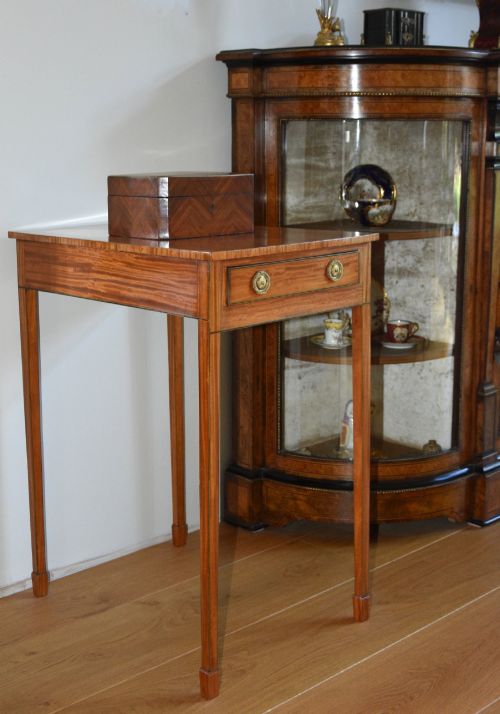
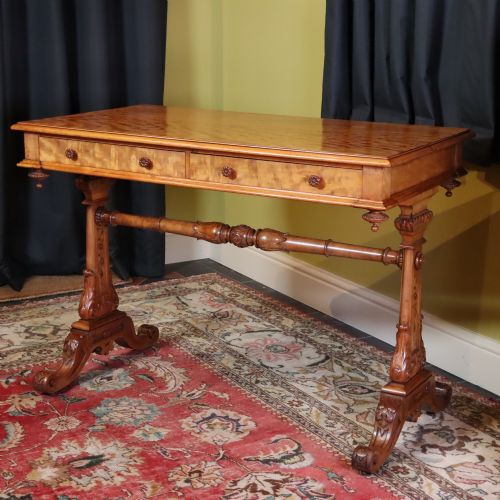


Satinwood Drawer Side Table
A satinwood drawer side table brings pale timber and practical storage into a room, offering a luminous surface for daily use.
Satinwood Drawer Side Table
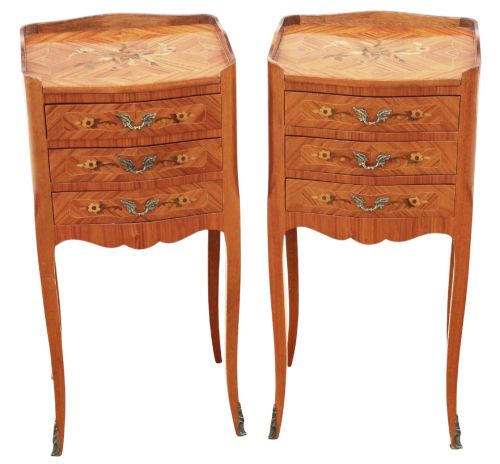
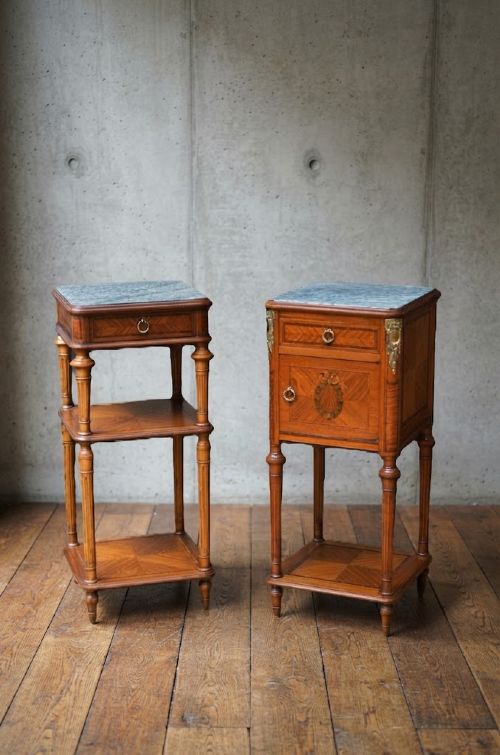
A satinwood drawer side table is a compact piece designed for occasional placement in a room, typically featuring one or more storage drawers beneath a smooth top. You will most frequently encounter Edwardian and Victorian examples on this page, alongside Georgian pieces and later twentieth-century interpretations.
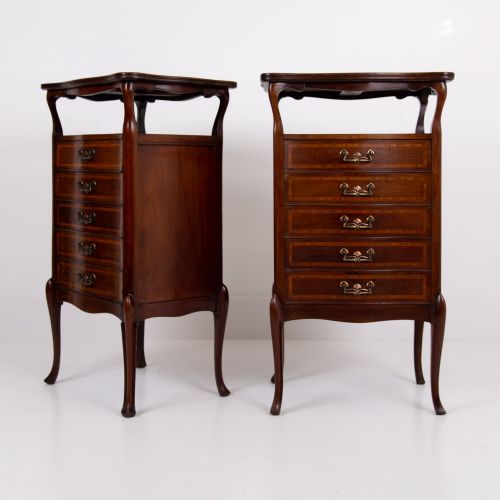
The form varies widely across the periods, appearing as lamp tables, writing desks, bedside cabinets, and drop-leaf occasional furniture. These tables serve as functional accents that combine the pale, figured grain of satinwood with mahogany, walnut, or brass details.
Materials and construction methods
Cabinet makers built these pieces using solid timbers and supportive secondary woods, applying satinwood as solid boards or fine veneers to create shimmering, light-reflecting surfaces. Cross-banding in mahogany, rosewood, or walnut often frames the primary satinwood panels, while intricate inlay work adds linear contrast.
Brass handles, castors, and hinges provide functional accents on drawers and drop leaves, while leather inserts occasionally line the tops of writing variants. Joinery relies on traditional hand-cut joints designed to accommodate timber movement across centuries of seasonal change.
Listings feature satinwood combined with mahogany, walnut, and satin birch across Victorian and Edwardian periods.
Factors that distinguish quality
Quality rests upon the selection of the timber, where dense, highly figured satinwood with natural chatoyancy marks the finest examples. The precision of the cross-banding and the crispness of any inlaid decoration distinguish workshop production from standard commercial output.
Construction details such as the smooth action of dovetailed drawers, the retention of original brass hardware, and the stability of slender legs determine the enduring value of a piece. Finer tables balance delicate proportions with robust structural integrity.
Howard And Sons·Heal And Sons·Gillows·Jas Shoolbred
The Satinwood Drawer Side Table Glossary
- Satinwood
- A hard, durable tropical timber known for its golden colour and reflective, satin-like sheen. It was widely utilised by cabinet makers during the Georgian and Edwardian periods for decorative veneers and stringing.
- Cross-banding
- A decorative border technique where strips of veneer are laid perpendicular to the grain of the main panel. This method frames the central satinwood surface with contrasting timber grain.
- Pembroke table
- A small drop-leaf occasional table featuring hinged flaps on two opposing sides and often a single drawer. It was designed for versatility and could be moved easily around a room.
- Sofa table
- A rectangular occasional table traditionally placed in front of a sofa, fitted with drop leaves and twin drawers. Regency and Georgian versions often feature trestle supports and cross-banded veneers.
- Inlay
- A decorative technique where pieces of contrasting wood, shell, or metal are inserted into recessed cavities flush with the surface. It defines the Sheraton Revival and Edwardian styles seen on many pieces.
Satinwood Drawer Side Table: Frequently Asked Questions
What rooms suit a satinwood drawer side table?
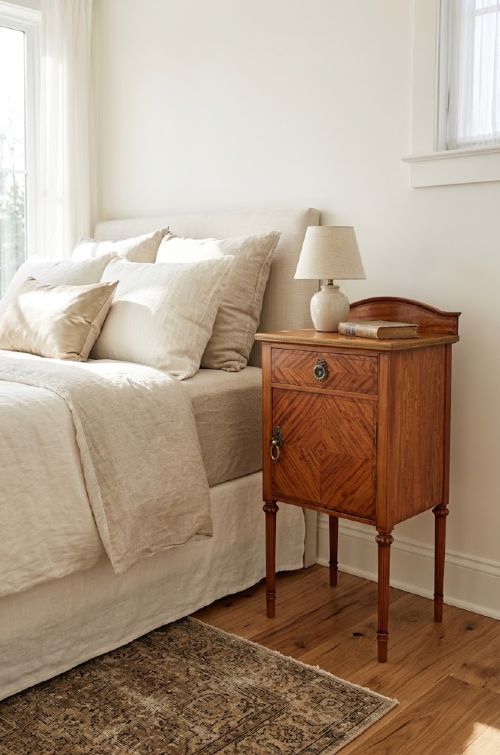
These versatile tables fit easily beside a bed, next to a sofa, or against a hallway wall where surface space is needed.
Their pale timber tones help brighten smaller or darker rooms without dominating the existing decor.
How do I care for antique satinwood?
Keep the wood away from direct sunlight and steady sources of artificial heat to prevent the natural veneers from drying out.
Apply a traditional beeswax polish occasionally and buff gently with a soft cloth to maintain the soft sheen.
Can I use these tables for writing?
Certain variants are specifically designed as writing tables or come equipped with integrated leather-lined writing surfaces and stationary drawers.
Check the internal height and depth of the piece to ensure it provides comfortable leg room for seating.
How do I distinguish Edwardian from Georgian pieces?
Georgian tables tend to display heavier proportions, deeper timbers, and restrained inlay work characteristic of the eighteenth century.
Edwardian and Sheraton Revival examples often feature lighter construction, prolific stringing, and brighter satinwood veneers.