



Sailing Ship Harbour Painting
A sailing ship harbour painting brings the movement of coastal trade and maritime craft directly onto the wall.
Sailing Ship Harbour Painting
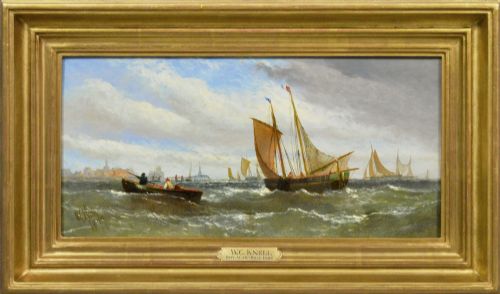
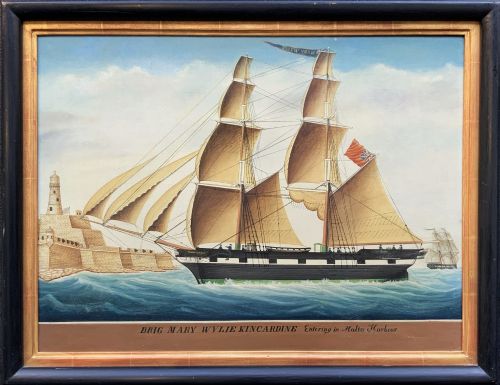
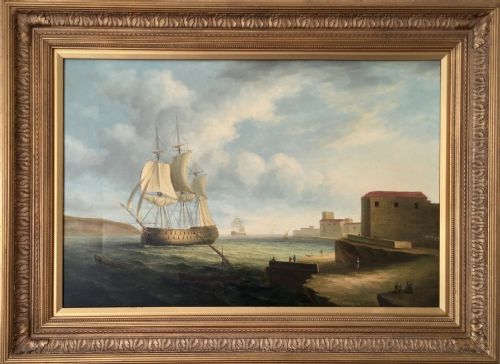
A sailing ship harbour painting captures vessels at rest or navigating coastal waters, ranging from bustling commercial ports to quiet estuaries. The works document maritime life through detailed depictions of rigging, hulls, and coastal architecture across various British ports.
Most examples found here date from the nineteenth century into the early twentieth century, spanning Victorian and Edwardian periods. These pieces appear in both oil on canvas and watercolour formats, framed in wood and giltwood.
Distinctions in quality
Quality rests on the artist's command of maritime architecture and atmospheric perspective, distinguishing precise vessel rigging from generic renderings. The handling of water movement and light determines whether a scene possesses genuine documentary depth.
Condition of the medium and the integrity of the original frame also set pieces apart, as well-preserved watercolours and stable oil paintings retain their original colour harmonies.
Sailing Ship Harbour Painting Retail Price Guide 2026
Typical asking prices for sailing ship harbour painting among the pieces listed under this phrase on Sellingantiques today, from the lower quarter to the upper quarter. They describe what is for sale here now, not the wider market.
Listings feature works executed in oil on canvas, panel, and watercolour on paper, spanning the nineteenth and twentieth centuries.
James Hardy·Frank Kelsey·Thomas Bush Hardy·Ernest Dade·Samuel Owen·William Wyld·George Gregory·John Callow·Rowland Henry Hill·William Langley·John James Wilson·Frank Wasley·Micheal Matthews·Edward Fletcher·Bertram Priestman·Henry Scott Tuke·Stephen Brownlow
The Sailing Ship Harbour Painting Glossary
- Giltwood
- Wood carved and coated with gold leaf or a gold-coloured finish. This material is common on traditional frames for marine art.
- Watercolour pigment
- Ground colour mixed with a water-soluble binder, applied to paper. It allows for translucent washes that suit coastal skies and water.
- Oil on canvas
- Pigment bound in oil applied to stretched fabric. This medium permitted nineteenth-century artists to work with rich textures and deep tones.
- Marine art
- Artistic representation of ships, harbours, and coastal scenes. This genre focuses heavily on accurate nautical detail and maritime weather.
- Panel
- A flat piece of wood used as a rigid support for oil painting. Panels were frequently utilised by artists working on smaller coastal studies.
Sailing Ship Harbour Painting: Frequently Asked Questions
How do I date a maritime painting?
Dating relies on the rigging style of the vessels, the clothing of figures on the shore, and the framing materials used. Nineteenth-century works often show specific commercial sailing craft that disappeared with the rise of steam.
Signatures, exhibition labels on the reverse, and the type of canvas or paper also provide reliable chronological markers for these works.
Where should I hang a watercolour?
Watercolours require placement away from direct sunlight to prevent the pigments and paper from fading over time. Maintaining stable indoor humidity helps protect the paper support and the framing materials.
Grouping smaller harbour scenes together creates a strong focal point on a wall without overwhelming adjacent furniture.
What is the difference between oil and watercolour marine art?
Oil paintings on canvas offer heavier texture and deeper colour saturation, making them suited for dramatic seascapes and stormy harbour views. Watercolours provide a lighter, more luminous quality that captures clear daylight and calm coastal waters.
Both mediums were widely used by marine artists documenting British ports during the Victorian era.
Are these paintings records of real places?
Many works depict named locations such as Portsmouth, Scarborough, or Valletta Harbour, serving as historical records of nineteenth-century port infrastructure. Artists often painted from direct observation of local shipping traffic and quayside activity.
Topographical accuracy varied by artist, but harbour landmarks frequently allow modern viewers to identify the exact coastal site.