



Victorian Steamship Art
Victorian steamship art captures the era of industrial maritime expansion through oil paintings and watercolours depicting vessels on rivers and open seas.
Victorian Steamship Art
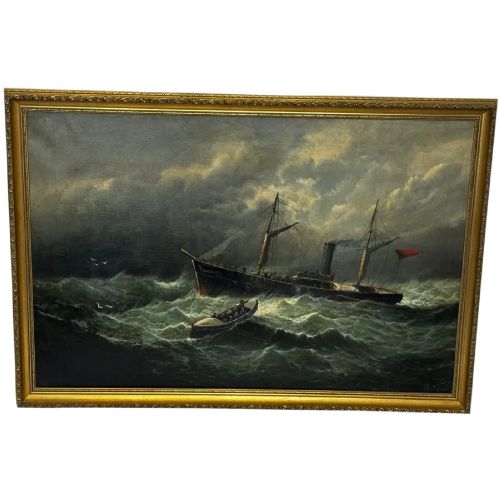
Victorian steamship art comprises oil paintings and watercolours created during the nineteenth century and the Edwardian period, recording the dominance of steam-powered vessels and maritime trade. These works range from depictions of royal yachts and polar expeditions to industrial river scenes along the Thames.
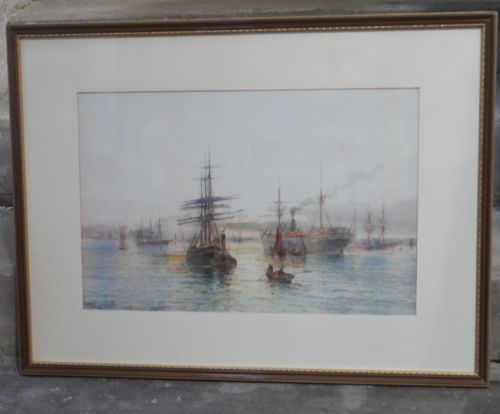
The pieces available on this page lean heavily towards framed oil paintings and watercolour paintings produced by named artists working in British marine realism and impressionism. Subjects frequently feature specific named locations such as Dublin Bay, the River Thames, and Scarborough, alongside individual steamers and rescue vessels.
Buyers will encounter both intimate works on paper and substantial oil on canvas formats depicting steamers alongside traditional sailing craft. The focus remains firmly on the transition from sail to steam within British coastal and river waters during the Victorian and Edwardian eras.
How they were made
These works rely on traditional nineteenth-century painting materials, primarily oil paint and watercolour applied to canvas, paper, or panel supports. Artists captured the dense atmosphere of industrial ports and river traffic using layered pigments to render smoke, water, and metallic hulls.
Gilt framing is frequently present, providing a period housing that complements the maritime subject matter. Watercolour works utilise paper supports often protected behind glass, while larger oil paintings employ sturdy canvas stretched over wooden frames.
Victorian Steamship Art Retail Price Guide 2026
Typical asking prices for victorian steamship art among the pieces listed under this phrase on Sellingantiques today, from the lower quarter to the upper quarter. They describe what is for sale here now, not the wider market.
Several watercolours delightfully capture the sheer volume of coal smoke hanging heavy over Victorian London.
What varies in quality
Quality in these maritime works rests on the artist's ability to render the atmospheric conditions of smoky industrial ports and open waters with convincing perspective. Stronger examples demonstrate confident brushwork in handling difficult subjects like steam, rigging, and reflections on choppy river surfaces.
Provenance and attribution also elevate certain pieces, particularly those linked to documented artists or specific historical vessels and polar expeditions. The condition of the original canvas or paper support and the preservation of the pigment layer further distinguish finer works from standard decorative pieces.
William Broome·Charles William Wyllie·Ernest Dade·Walter Duncan·Edward Fletcher·Frances E Nesbitt·J Syer·Frank William Scarbrough
The Victorian Steamship Art Glossary
- Oil on canvas
- Pigment bound in a drying oil applied to a woven fabric stretched across a wooden frame. This medium allowed artists to build rich textures and deep tones suitable for maritime scenes.
- Watercolour
- A paint consisting of colourants suspended in a water-soluble binder, traditionally applied to paper. It offers luminous transparency well suited to capturing river mists and open skies.
- Maritime realism
- An artistic style focused on accurate representation of ships, water, and coastal topography. Works in this genre meticulously record the technical details of nineteenth-century vessels.
- Gilt frame
- A wooden picture frame coated with gold leaf or metallic paint. These frames were designed to complement the tonal range of Victorian oil paintings.
Victorian Steamship Art: Frequently Asked Questions
What subjects appear in Victorian steamship art?
These artworks depict steam-powered vessels alongside sailing ships navigating British rivers, bustling ports, and coastal waters. Common motifs include industrial river traffic, polar expeditions, and royal yachts.
Artists frequently recorded specific locations such as the River Thames in London, Dublin Bay, and Scarborough harbour, capturing the technological shift towards steam propulsion.
How should I display these paintings at home?
Oil paintings on canvas and watercolours behind glass require placement away from direct sunlight and excessive moisture to protect the pigments and paper supports. Traditional gilt frames complement the nineteenth-century aesthetic of these maritime works.
Consider hanging them on neutral walls that allow the rich tones of the sea, smoke, and sky to stand out without competing surrounding patterns.
How can I tell the period of a maritime painting?
Dating relies on the vessel types depicted, such as early steamships transitioning alongside traditional sailing craft, as well as the artist's signature and framing style. Material evidence like canvas stamps and nineteenth-century paper types also assist in establishing age.
Works from this era often reflect Victorian and Edwardian artistic movements including marine realism and British impressionism.
What is the difference between oil and watercolour works here?
Oil paintings utilise heavy pigments on canvas, offering a textured surface capable of rich, deep tones suited to dramatic seas and industrial smoke. Watercolours employ translucent washes on paper, creating lighter and more luminous atmospheric effects.
Both mediums were widely used by nineteenth-century artists to document the changing maritime landscape of British ports.