





Sabre Leg Armchair
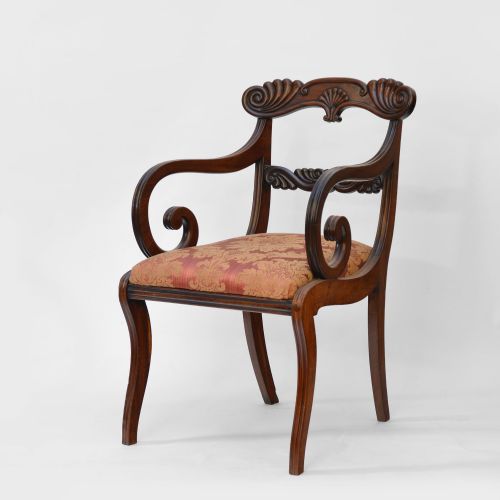
A sabre leg armchair offers the outward-curving rear or fore legs typical of the early nineteenth century.
Sabre Leg Armchair
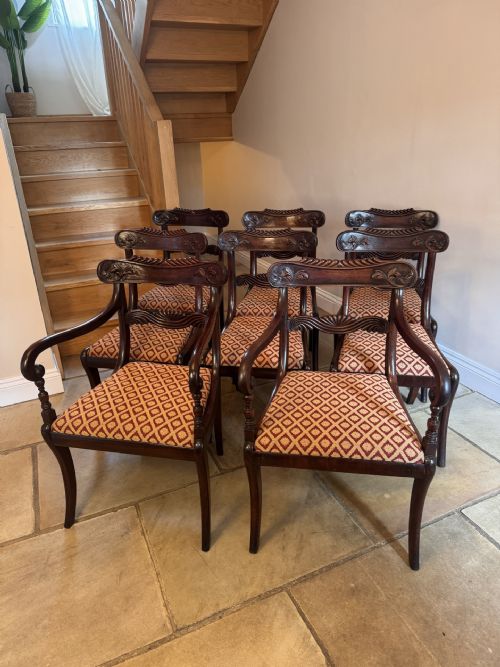
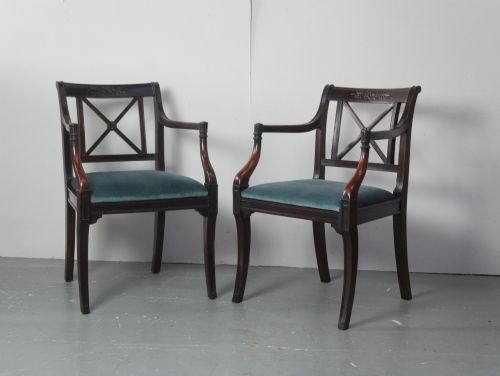
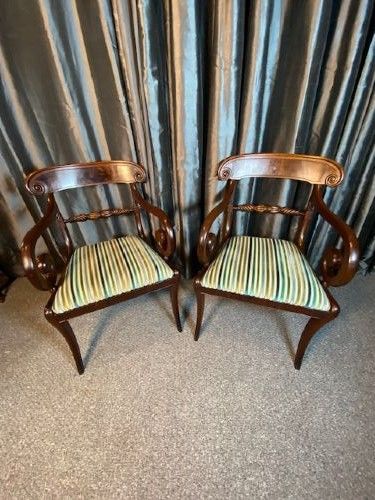
When you search for a sabre leg armchair, you encounter seating designed during the Regency and Georgian periods alongside later nineteenth-century revivals. The form appears most frequently in mahogany, constructed as open armchairs, carvers, and library chairs.
Many examples emerge as pairs or larger dining sets featuring elbow rests and curved supports. Surviving pieces span formal drawing-room seats and functional desk chairs with cane, leather, or fabric upholstery.
Materials and construction
Cabinetmakers utilised solid mahogany, ebonised wood, and occasionally gilded accents to build these seats. Frames incorporate turned or carved arm supports, shaped back rails, and characteristic swept legs.
Seating portions utilise drop-in pads, cane panels, or squab cushions covered in velvet, leather, or patterned upholstery fabric. Brass mounts and studded trim appear on select library and desk variants.
Sabre Leg Armchair Retail Price Guide 2026
Typical asking prices for sabre leg armchair among the pieces listed under this phrase on Sellingantiques today, from the lower quarter to the upper quarter. They describe what is for sale here now, not the wider market.
Current listings feature mahogany, cane, leather, and ebonised wood across Regency, Georgian, and twentieth-century revival periods.
Judging quality
Superior execution shows in the crispness of the turned details, the proportion of the scrolling arms, and the graceful sweep of the rear legs. Well-drawn examples maintain harmonious balance across single chairs and larger dining sets.
The choice of dense timber grain and the retention of original surfaces distinguish finer workshops. Subtle decorative flourishes, such as fine reeding or precise ebonisation, separate standard dining seats from library armchairs.
Gillows·Henry Maxwell
The Sabre Leg Armchair Glossary
- Sabre leg
- A chair leg that curves outwards in a concave sweep resembling a cavalry sabre. This form defines much of the Regency seating aesthetic.
- Carver chair
- An armchair designed to sit at the head of a dining table or to match a set of single dining chairs. These often feature open elbow supports.
- Bergère
- An enclosed armchair with stuffed upholstery and cane panels set into a wooden frame. These appear frequently in nineteenth-century libraries.
- Ebonised
- Wood stained or painted black to imitate ebony. This dark finish was popular during the Regency period.
- Rope back
- A chair back rail carved to resemble twisted rope. This detail occurs on early nineteenth-century mahogany dining seats.
Sabre Leg Armchair: Frequently Asked Questions
How do I date a sabre leg armchair?
Dating relies on timber selection, structural joinery, and stylistic markers typical of the Regency and Georgian eras. Earlier pieces from around eighteen hundred display hand-cut elements and rich mahogany patination.
Later revivals from nineteen hundred or nineteen twenty often reveal machine-tooled elements and distinct secondary woods beneath the upholstery. Comparing the rake of the leg and the carving style to documented examples clarifies the period.
Are these chairs suitable for a desk?
Specific variants designated as desk chairs or library chairs feature lower arms and generous proportions intended for seated work. These models provide comfortable back support while sliding easily beneath writing tables.
Standard dining armchairs possess higher elbows that may restrict movement under certain desk drawers. Selecting an appropriate height ensures daily comfort in a study.
Can I use these in a modern dining room?
These open armchairs function well alongside contemporary dining tables, offering contrasting historical form and durable mahogany construction. Pairs work effectively as host chairs at either end of a table.
Upholstery fabrics can be updated to coordinate with modern interiors while preserving the antique wooden frame. Their slender legs maintain an open appearance in smaller spaces.
What is the difference between an armchair and a carver?
The terms often overlap in nineteenth-century seating, though carver traditionally refers to an armchair designed specifically to accompany a set of dining chairs. These usually share the timber and decorative motifs of the single chairs in the suite.
Armchairs encompass a broader category that includes library seats, desk chairs, and drawing-room furnishings. Both forms utilise the signature swept leg configuration.